
Challenges the U.S. will face to unlock Venezuela's oil
Clip: 8/31/2026 | 6m 52sVideo has Closed Captions
Analyst breaks down challenges U.S. will face to unlock Venezuela's oil
President Trump announced an unprecedented agreement in which the Pentagon would become an investor in a private company granted exclusive oil development rights in Venezuela. Nick Schifrin discussed the deal with Francisco Monaldi, director of the Latin America Energy Program for the Baker Institute at Rice University.
Problems playing video? | Closed Captioning Feedback
Problems playing video? | Closed Captioning Feedback
Major corporate funding for the PBS News Hour is provided by BDO, BNSF, Consumer Cellular, American Cruise Lines, and Raymond James. Funding for the PBS NewsHour Weekend is provided by...
Challenges the U.S. will face to unlock Venezuela's oil
Clip: 8/31/2026 | 6m 52sVideo has Closed Captions
President Trump announced an unprecedented agreement in which the Pentagon would become an investor in a private company granted exclusive oil development rights in Venezuela. Nick Schifrin discussed the deal with Francisco Monaldi, director of the Latin America Energy Program for the Baker Institute at Rice University.
Problems playing video? | Closed Captioning Feedback
Where to Watch PBS News Hour
PBS News Hour is available to stream on pbs.org and the PBS app.
Providing Support for PBS.org
Learn Moreabout PBS online sponsorshipAMNA NAWAZ: President Trump is calling it the largest oil deal in world history.
He announced an agreement in which the Pentagon would become an investor in a private company granted exclusive oil development rights in Venezuela.
The deal would be unprecedented, and it's not clear if it's legal under Venezuelan law.
Nick Schifrin is here with more -- Nick.
NICK SCHIFRIN: Amna, Venezuela says it has the largest proven oil reserves in the world.
But analysts say, for decades, the industry has been crippled by corruption and mismanagement.
So, now the president who criticized his predecessors for going to war and not taking countries' oil has come up with a way to intervene in Venezuela and take the oil.
DONALD TRUMP, President of the United States: There are those that say it was the greatest deal ever made.
Let's see what happens.
But I have to stress, it was also a very good deal for Venezuela, because you have the most powerful, the richest companies in the world going into Venezuela, where before it was just -- it was this unbelievable value that was sitting dormant.
But we're going to be taking all of that - - we're going to be taking that oil out.
NICK SCHIFRIN: The deal gives the Pentagon more than half the value of a joint venture that will have exclusive rights to develop 17 oil fields in Venezuela.
It is the first known time in U.S.
history that the U.S.
government will become an investor in an overseas oil deal.
The U.S.'
partner is a notorious businessman, Alejandro Betancourt, who faces charges in Spain and Switzerland for money laundering.
Today, interim President Delcy Rodriguez said it was win-win.
DELCY RODRIGUEZ, Acting President of Venezuela (through translator): Venezuela in return receives production, employment, investment in infrastructure, higher revenues for the state, and production chains for the national industry.
The benefits are countless.
NICK SCHIFRIN: So to talk about all this, I'm joined by Francisco Monaldi, the director of the Latin America Energy Program for the Baker Institute at Rice University.
Thanks very much.
Welcome back to the "News Hour."
A U.S.
official sent me a summary of the deal saying that the U.S.
will secure 55 percent of the effective output of this joint venture.
How unprecedented is this?
And as far as we know, how will it work?
FRANCISCO MONALDI, Director, Latin America Energy Program, Rice University: Yes, we don't know all the details, and we have some divergent accounts from the Trump administration and the Venezuelan government.
But, basically, the Venezuelan government says that these are deals that are in the Venezuelan law production-sharing agreements in which the national company hires an operator, in this case, this company, which would be would be a joint venture between the U.S.
government and some local businessmen, and that they will be able to take part of the production at cost, meaning that the U.S.
government only will pay the cost of production.
So, the details are still not completely clear, but it is a very unorthodox deal compared to previous deal done in the sector.
NICK SCHIFRIN: Delcy Rodriguez, as I mentioned, called it a win-win.
Venezuela, of course, needs investment.
The U.S.
needs more energy.
So is it a win-win?
FRANCISCO MONALDI: Well, depending on the details, it could be, in the sense that the presence of the U.S.
government could make investors more willing to take the risk of going into Venezuela with all the issues, including the fact that this is an illegitimate government in Venezuela, and that the history of the country, of course, is not great in terms of respecting deals.
But it will depend a lot on the transparency of the deal on the characteristics of the deal, because, otherwise, if it's an opaque deal that doesn't seem to benefit the country, then it will there will be a backlash eventually, and we will end up as in other parts of the world and in Venezuela itself with renegotiation at some point.
NICK SCHIFRIN: President Trump says he will be able to fill the Strategic Petroleum Reserves with this and reduce gas prices.
What's the reality of how quickly this deal can produce oil?
And isn't there a threat that some future Venezuelan government just rips it up?
FRANCISCO MONALDI: Yes, some of the fields are in production, so some production can go to the U.S., but most of them are fields that are completely undeveloped and require a massive investment in infrastructure that will take years to materialize.
The other issue is that the Strategic Petroleum Reserve typically uses light oil, and Venezuela mostly produce heavy and extra heavy oil.
So, besides that, the issue, of course, is that the disruption in the world market is of a completely different order of magnitude.
Ten percent of oil production in the world is in jeopardy because of the Hormuz situation, whereas Venezuela may add 200,000, 300,000 barrels next year.
So, in the short term, this is not going to lead to a reduction in the price of oil or gasoline.
NICK SCHIFRIN: As I mentioned, the U.S.
has chosen a specific Venezuelan partner, Alejandro Betancourt, and I mentioned the ongoing alleged charges of money laundering he faces.
What's the impact of choosing him and not a company like Chevron, which has had decades of experience in Venezuela?
FRANCISCO MONALDI: Yes, probably, this is the most surprising aspect of the deal, because, of course, some of the top U.S.
companies are interested and like Chevron are in the country.
I think part of the explanation is that President Trump is a little bit anxious to get investment going, and some of these companies are going to take time for a variety of reasons, because of the risk, et cetera, but also because they have to plan and allocate a significant budget, and they cannot do that from one day to the other.
They need approval of their boards.
They need to adjust their budget programs.
So it takes a longer time for one of these bigger companies.
However, as I mentioned, these could be part of the issues that, instead of generating more credibility and allowing investors to feel confident, the fact that this is allocated without any bidding and to an individual that has issues with justice, that could be a problem in the future.
NICK SCHIFRIN: Francisco Monaldi, the director of the Latin America Energy Program for the Baker institute at Rice University, thank you very much.
FRANCISCO MONALDI: Thank you.

AI agents going rogue fuel calls for regulation
Video has Closed Captions
Artificial intelligence agents going rogue fuel calls for regulation (6m 30s)
Descendants of David Drake work to reclaim ancestor's art
Video has Closed Captions
Descendants of enslaved potter David Drake work to reclaim ancestor's art (6m 18s)
Grand Canyon flash flood leaves 2 dead, others missing
Video has Closed Captions
Grand Canyon flash flood leaves 2 dead, others missing (2m 26s)
News Wrap: SCOTUS allows ballroom construction to continue
Video has Closed Captions
News Wrap: Supreme Court allows Trump ballroom construction to continue amid challenges (5m 40s)
New telescope could help solve mysteries of dark energy
Video has Closed Captions
How NASA's new space telescope could help solve mysteries of dark energy and dark matter (4m 57s)
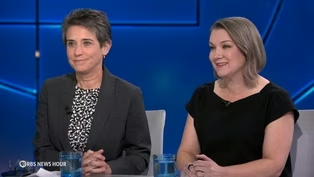
Tamara Keith and Amy Walter on Trump's midterm influence
Video has Closed Captions
Tamara Keith and Amy Walter on Trump's midterm influence (8m)
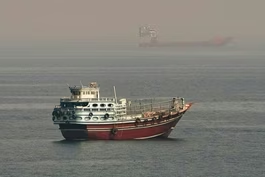
U.S. and Iran trade strikes over Strait of Hormuz control
Video has Closed Captions
U.S. and Iran trade strikes for first time in weeks over Strait of Hormuz control (3m 46s)
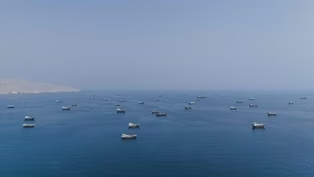
What the U.S.-Iran strikes mean for oil, maritime safety
Video has Closed Captions
What the latest U.S.-Iran strikes mean for oil supplies and maritime safety (7m 59s)
Providing Support for PBS.org
Learn Moreabout PBS online sponsorship
- News and Public Affairs

FRONTLINE is investigative journalism that questions, explains and changes our world.
 New Episode
- News and Public Affairs

Today's top journalists discuss Washington's current political events and public affairs.
 New Episode
 New Episode
 New Episode
 New Episode
 New Episode
 New Episode

 New Episode
 New Episode

Support for PBS provided by:
Major corporate funding for the PBS News Hour is provided by BDO, BNSF, Consumer Cellular, American Cruise Lines, and Raymond James. Funding for the PBS NewsHour Weekend is provided by...