
Tamara Keith and Amy Walter on Trump's midterm influence
Clip: 8/31/2026 | 8mVideo has Closed Captions
Tamara Keith and Amy Walter on Trump's midterm influence
NPR’s Tamara Keith and Amy Walter of the Cook Political Report with Amy Walter join Amna Nawaz to discuss the latest political news, including President Trump's popularity going into the midterms as some Republicans start to distance themselves, the Michigan Senate race and Democrats still debating their November message.
Problems playing video? | Closed Captioning Feedback
Problems playing video? | Closed Captioning Feedback
Major corporate funding for the PBS News Hour is provided by BDO, BNSF, Consumer Cellular, American Cruise Lines, and Raymond James. Funding for the PBS NewsHour Weekend is provided by...
Tamara Keith and Amy Walter on Trump's midterm influence
Clip: 8/31/2026 | 8mVideo has Closed Captions
NPR’s Tamara Keith and Amy Walter of the Cook Political Report with Amy Walter join Amna Nawaz to discuss the latest political news, including President Trump's popularity going into the midterms as some Republicans start to distance themselves, the Michigan Senate race and Democrats still debating their November message.
Problems playing video? | Closed Captioning Feedback
Where to Watch PBS News Hour
PBS News Hour is available to stream on pbs.org and the PBS app.
Providing Support for PBS.org
Learn Moreabout PBS online sponsorshipAMNA NAWAZ: As primary season nears its end, Democrats are still debating their midterm message, while some Republicans start to distance themselves from President Trump.
It's time now for Politics Monday.
That's with Amy Walter from The Cook Political Report With Amy Walter and Tamara Keith of NPR.
Great to see you both.
TAMARA KEITH, National Public Radio: Hello.
AMY WALTER, The Cook Political Report: Good to be here.
AMNA NAWAZ: Nobody freak out when I say this number, 64 days until the midterm elections.
AMY WALTER: I know.
AMNA NAWAZ: I know.
President Trump is increasingly saying he wants to be a big part of it.
He wants candidates to tie him to themselves and their campaigns.
Here's part of what he had to say on FOX last night.
Take a listen.
DONALD TRUMP, President of the United States: I'm going to help people get elected if I can.
There's a theory that I get the vote.
There's -- I see it all the time that, when Trump's in the ballot, they win.
When he's not in the ballot, the people don't go to vote.
And I'm asking the people through your brilliant show, number one show, I'm asking the people to get out and vote.
Pretend I'm on the ballot.
AMNA NAWAZ: Tam, this is a president with a low approval rating overseeing an unpopular war in Iran.
We're already seeing some Republican candidates start to distance themselves, especially after the renaming of Lake Ontario as Lake America.
Do Republicans want voters to pretend Trump is on the ballot?
TAMARA KEITH: Some Republicans do, and obviously President Trump does.
The theory of the case here is that Republican voters may not be that excited about coming out.
Certainly, the sort of expanded Trump base, the voters that he was able to draw out to vote in 2024, it's a real question whether some of those voters are going to want to come out in 2026 when he isn't on the ballot.
So he's saying, pretend I'm on the ballot.
He did that at a rally in South Carolina.
There's this midterm convention which is coming up, two nights.
Trump will be there both nights, and they're calling it a Trumpapalooza.
That is literally what the RNC chairman is calling it.
So in case there was any question, Trump is going to be the centerpiece of this.
That obviously feeds to his personality type and all of those things, but it also speaks to the reality that, whether they want to make Trump the center of the universe or not, he is the focus of these midterms.
AMNA NAWAZ: Yes.
TAMARA KEITH: That's what midterms do.
AMNA NAWAZ: Amy, Tam mentioned the word excited.
You recently wrote about the enthusiasm gap for Republicans.
Is the solution for that for candidates to get closer to or to distance themselves from the president?
AMY WALTER: Right.
So the enthusiasm gap is something, when you talk to Republican strategists, they say they are the most worried about going into the election, that Democrats are simply more interested in showing up to vote, and they have been voting in special elections and primaries at a higher rate than Republicans.
But when you look past those numbers, look at what the Republican enthusiasm advantage really is -- or disadvantage really is about, it's that those who identify as MAGA -- so some polls have now been segmenting out Republicans by those who say, yes, I'm a Republican because I identify with Trump and the MAGA movement, or I'm a Republican, but I don't really identify as MAGA.
Those who identify as MAGA, they're really excited to vote.
They believe Donald Trump is on the ballot, and they want to show that they are going to turn out to show him a sign of approval.
The people who are not as excited to show up and vote are the non-MAGA Republicans.
And it's notable.
You say, well, why aren't they as excited?
Because they are much more down on the economy.
They feel that it's in much poorer shape than those identified with MAGA.
And they do see Trump as handling it much more poorly than those in MAGA.
So what would help the most if you're a Republican going into this election isn't for Trump to be more front and center.
It's for the economy to get better.
TAMARA KEITH: Or maybe for the president to put the economy front and center.
AMY WALTER: Well, that would be it too, to show that.
TAMARA KEITH: Which he also has not really been doing.
AMY WALTER: That's exactly right.
AMNA NAWAZ: Not seen that yet.
Let's turn now to the Democrats, specifically in Michigan.
We have been tracking this Senate race there and their nominee, Abdul El-Sayed, who apologized this weekend for comments that he made after a synagogue attack outside Detroit in March.
He had condemned the attack and then said "Hurt people hurt people."
That attack was carried out by a Lebanese man whose family had been killed in an Israeli strike.
We now know El-Sayed has met with Jewish Democratic leaders, saying that he did make a mistake.
He's still coming under attack from the president and with anti-Islamic rhetoric as well.
But, Tam, this is the most fulsome apology we have seen from El-Sayed.
And it comes after he narrowly won a primary.
What are you looking at here?
TAMARA KEITH: Yes, I mean, I think that this is an acknowledgement that this is going to be a very close race.
You can't just give up on any group of voters.
And he has work to do to win over Jewish voters.
That primary was incredibly bitter.
And it centered in many ways around Jewish identity and around all kinds of things, that the AIPAC was spending really heavily for his opponent.
And he attacked AIPAC.
And it is all part of the stew that is this race and trying to bring unity to Democrats, who were just bitterly divided in the primary.
And just today, vice president J.D.
Vance was campaigning in Michigan.
He said that he had with him the rabbi and security officials from the synagogue that had been attacked that El-Sayed addressed and then later apologized, much later, much, much later.
AMNA NAWAZ: Amy, how do you look at the way the president and a lot of other Republicans are talking about El-Sayed, specifically putting his faith front and center and going so far as to call him a jihadist?
AMY WALTER: Well, and the ad that is up right now by one of the Republican super PACs calls him dangerously radical.
And that is the message that they're going to carry throughout this campaign.
There's not - - that wasn't really very much of a surprise.
Remember, there are a lot of Democrats who said, if we nominate El-Sayed that he is going to be a weaker general election candidate.
It really comes down to what this race is going to be about.
If it's going to be about Donald Trump, and this is what Democrats are hoping El-Sayed does is pivot to make it about Trump, then that is beneficial to the Democrats, because this is a state where Trump is deeply unpopular.
If it is about El-Sayed, then it becomes easier for Republicans to win.
TAMARA KEITH: And, in fact, Republicans want El-Sayed to be part of the campaign in races all over the country, not just in Michigan.
They are going to put him forward as the -- like, you don't want this to happen to America.
AMY WALTER: Yes.
AMNA NAWAZ: Before I let you go, Amy, I want to ask you to look ahead to a primary tomorrow in Massachusetts.
There's a couple of recurring themes for Democrats at play here.
There's the incumbent, Ed Markey, who's 80 years old.
He's the second oldest senator seeking reelection this year.
He is a liberal progressive, challenged by Congressman Seth Moulton, who is a moderate, 47 years old.
What should we know about this?
AMY WALTER: Well, and Moulton is running primarily on a generational change.
He says in a debate, hey, we agree on the issues.
The issue really is about somebody who's older and somebody who's younger.
The reason it's not working in this race, at least if you look at the polls right now, Markey is ahead, is that, when we hear this debate on the Democratic side about age, a lot of it is focused, rightly so, on the actual age of the people.
But, really, I think what Democratic voters are saying when they say, we want generational change, they want somebody who understands the concerns of the generation that is not the oldest generation.
They want somebody who has sort of an energy and a fire to take the fight to Washington.
Moulton is arguing he's part of sort of the establishment, but Markey is not that.
His biggest allies are Bernie Sanders, AOC, and Elizabeth Warren, who are outsiders as well.
AMNA NAWAZ: A race to watch.
Amy Walter, Tamara Keith, thank you very much.
AMY WALTER: You're welcome.
TAMARA KEITH: You're welcome.

AI agents going rogue fuel calls for regulation
Video has Closed Captions
Artificial intelligence agents going rogue fuel calls for regulation (6m 30s)
Challenges the U.S. will face to unlock Venezuela's oil
Video has Closed Captions
Analyst breaks down challenges U.S. will face to unlock Venezuela's oil (6m 52s)
Descendants of David Drake work to reclaim ancestor's art
Video has Closed Captions
Descendants of enslaved potter David Drake work to reclaim ancestor's art (6m 18s)
Grand Canyon flash flood leaves 2 dead, others missing
Video has Closed Captions
Grand Canyon flash flood leaves 2 dead, others missing (2m 26s)
News Wrap: SCOTUS allows ballroom construction to continue
Video has Closed Captions
News Wrap: Supreme Court allows Trump ballroom construction to continue amid challenges (5m 40s)
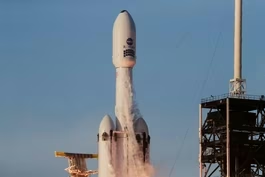
New telescope could help solve mysteries of dark energy
Video has Closed Captions
How NASA's new space telescope could help solve mysteries of dark energy and dark matter (4m 57s)

U.S. and Iran trade strikes over Strait of Hormuz control
Video has Closed Captions
U.S. and Iran trade strikes for first time in weeks over Strait of Hormuz control (3m 46s)

What the U.S.-Iran strikes mean for oil, maritime safety
Video has Closed Captions
What the latest U.S.-Iran strikes mean for oil supplies and maritime safety (7m 59s)
Providing Support for PBS.org
Learn Moreabout PBS online sponsorship
- News and Public Affairs

FRONTLINE is investigative journalism that questions, explains and changes our world.
 New Episode
- News and Public Affairs

Today's top journalists discuss Washington's current political events and public affairs.
 New Episode
 New Episode
 New Episode
 New Episode
 New Episode
 New Episode

 New Episode
 New Episode

Support for PBS provided by:
Major corporate funding for the PBS News Hour is provided by BDO, BNSF, Consumer Cellular, American Cruise Lines, and Raymond James. Funding for the PBS NewsHour Weekend is provided by...