
Youth sports become big business, putting stress on families
Clip: 9/8/2026 | 7m 54sVideo has Closed Captions
Youth sports become big business, putting stress on families and leaving some behind
Roughly 5 million kids are competing for travel or club sports teams that have cropped up across the country. Many benefit from that participation, including some who get college scholarships, but youth travel sports also come with increasing costs and challenges. As Stephanie Sy reports, those trade-offs and concerns are a part of the story that's getting more and more attention.
Problems playing video? | Closed Captioning Feedback
Problems playing video? | Closed Captioning Feedback
Major corporate funding for the PBS News Hour is provided by BDO, BNSF, Consumer Cellular, American Cruise Lines, and Raymond James. Funding for the PBS NewsHour Weekend is provided by...
Youth sports become big business, putting stress on families
Clip: 9/8/2026 | 7m 54sVideo has Closed Captions
Roughly 5 million kids are competing for travel or club sports teams that have cropped up across the country. Many benefit from that participation, including some who get college scholarships, but youth travel sports also come with increasing costs and challenges. As Stephanie Sy reports, those trade-offs and concerns are a part of the story that's getting more and more attention.
Problems playing video? | Closed Captioning Feedback
Where to Watch PBS News Hour
PBS News Hour is available to stream on pbs.org and the PBS app.
Providing Support for PBS.org
Learn Moreabout PBS online sponsorshipGEOFF BENNETT: With the new school year under way, millions of American parents are gearing up to cheer their kids on in sports, not necessarily for their school's team, but for one of the thousands of travel or club teams that have cropped up across the country.
AMNA NAWAZ: Roughly five million kids are competing on these private teams, and many benefit from that participation, including some who get college scholarships.
But youth travel sports also come with increasing costs and challenges.
As Stephanie Sy tells us, those trade-offs and concerns are getting more attention.
STEPHANIE SY: American youth sports have become a 40 billion dollar business.
Us parents, knowing that sports build character and are one of the few reliable ways to get your kids off screens, find family life subsumed by club sports.
So who built this ecosystem and who's making the most money from it?
In many cases, it's private equity firms that have found ways for so-called vertical integration.
And they're racking in profits on everything from backpacks to blocs of hotel rooms.
Parents are bearing the costs.
MAN: Stay-to-play tournaments should be called pay-to-stay tournaments.
Here's how it works.
You sign up for the tournament, and then you are told that you have to stay at their hotels.
You have to use the little -- magic little link that they send you.
It was basically like being stuck into a timeshare.
You have no choice.
WOMAN: Something nobody prepared me for as a mom was how expensive it is to have kids in sports.
I honestly don't know how you moms of multiple kids in sports do it, because my son is currently in soccer, and the fees are insane, OK?
Me and my best friend were actually talking about it yesterday, OK?
Camps are $250, $350 a week.
And how do you guys do it?
Like... MAN: You all, we need to talk about youth traveling sports teams.
Because why let kids enjoy their childhood when you can just turn every weekend into a high-stakes overpriced Hunger Games with 11-year-olds in matching compression sleeves?
STEPHANIE SY: Tom Farrey, the founder and director of the Aspen Institute's Sports and Society Program, has been following these developments for years in youth sports and joins me now.
And, Tom, I think Hunger Games kind of sums it up for a lot of us.
When I was growing up, it was all rec league or your school sports team.
That's where you played, unless you were really good, in which case maybe you did AYSO soccer.
When did all of this start changing?
TOM FARREY: In the 1990s.
So it was the chase for the athletic scholarship.
It's not the only reason, but in the early 1990s, there was about $250 million a year that was distributed through NCAA Division I division schools to schools for athletic scholarships.
Today, that's north of $4 billion.
And while that money is still hard to acquire for parents and kids, it's still a lot of chum that's been thrown into the waters of youth sports.
And then you tack on enforcement of Title IX, which opened up many more opportunities for girls and got parents thinking about supporting their career.
Then you have youth sport tourism cities, thinking about heads and beds and bringing kids to these -- and families to these communities, Tiger Woods, the 10,000 hours rule.
No Child Left Behind deprioritized school-based activities.
Then you had the economic crisis of 2008, which gutted municipal budgets, and they started by cutting park and rec budgets.
That's where the private sector really began to dig into youth sports, and then you had COVID, where they dug in even further.
STEPHANIE SY: OK, so we know that the demand is there from parents, who want the best for their kids, maybe a scholarship, maybe just fear of their kid missing out, not making the high school team.
And if everyone's doing it, I have to do it too.
How are we now seeing business capitalize on that psychology?
TOM FARREY: Well, they're creating these early-forming travel teams, which usually when I was a kid only existed really in high school.
Then they moved down to the middle school ages, and now they're all the way down to really first and second grade.
So we're sorting the weak from the strong well before kids grow into their bodies, minds, and their interests, and increasingly we're sorting kids based upon the ability of their families to pay for that activity, for the ability to stroke $2,000, $3,000, $4,000 checks a year.
STEPHANIE SY: How is this contributing to inequalities within sports?
TOM FARREY: I mean, so, I mean, the kids who get pushed aside are the kids from lower-income homes.
They're the kids who are the late bloomers.
They're the late starters.
They're the ones who just want to play and have fun with their friends, which is the rationale for most kids to play sports.
STEPHANIE SY: And those might be students that might have been eligible for scholarships and a path toward college.
I mean, talk more about this opportunity gap that we're seeing in what many are calling a pay-to-play system at this point.
TOM FARREY: Yes, we talk about how youth sports has become so competitive.
I would argue just the opposite.
It's become anticompetitive, meaning we're structurally pushing aside a lot of kids who could actually go on to be our best athletes.
We saw that with the U.S.
men's soccer team during the World Cup.
And we have more kids in uniform than any nation in the world, but because we don't make room for sustained experience for our very, very best athletes, our team consistently underperformed.
So, yes, they got they got to the round -- they made it out of their group.
But we should be a lot better than we are, and it's because our system is not set up in a way to make sure that the Odell Beckham Jr.s, who did play soccer when he was younger, have a pathway to staying in the game as it gets more expensive.
STEPHANIE SY: I think we can't ignore the profit motive in all of this, Tom, right?
Private equity has its hands in so much these days, including, controversially, in professional sports.
Is it more concerning when it comes to kids?
TOM FARREY: Well, look, I think, in fairness to private equity, a lot of the problems that we're talking about are, stay-and-play in hotels, things getting expensive and exclusionary very early on, they were all in place when I wrote my book back in 2008 on the state of youth sports in America.
What private equity did is see a really disjointed environment, where $40 billion a year are being spent by parents alone, where there's a need for more standards and professionalization and back office efficiencies.
They came into the space and then in some cases have kind of just wrung more and more money out of the families that can afford to youth sports arms race.
In other cases, again, out of fairness, there have been private equity groups who are attacking and creating more lower-cost local experiences.
And so I think we need to be incentivizing private equity to act like shepherds in the space, and not just an opportunity to monetize every kid out there.
STEPHANIE SY: Tom, what are potential solutions to the problems you have just outlined?
TOM FARREY: We need leadership.
We need, frankly, the government from the federal to the state to the local level to step up appropriately.
And that simply means creating standards, minimum standards, under which all programs should engage kids.
All kids should play for coaches who pass background checks, who've been trained in minimum key competencies in working with youth.
This could be done without government becoming too overly burdensome, and I think parents want it.
They want their kids to play in safe environments, and they want their kids to have access to sport.
And, I mean, schools need to step up as well.
They need to reinvest in school-based programs.
STEPHANIE SY: That is Tom Farrey with the Aspen Institute's Sports and Society Program joining us.
Thank you, Tom.
TOM FARREY: Thanks for having me.

Canadian tariffs on U.S. take effect, marking turning point
Video has Closed Captions
Canadian tariffs on U.S. goods take effect, marking turning point in relations (2m 29s)
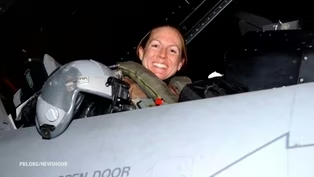
Fighter pilot reflects on order to stop Flight 93 on 9/11
Video has Closed Captions
Fighter pilot reflects on order to sacrifice herself to stop Flight 93 on 9/11 (8m 10s)
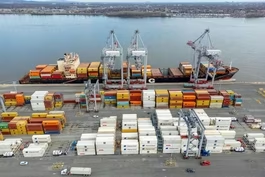
How U.S.-Canada trade dispute is impacting both economies
Video has Closed Captions
How the U.S.-Canada trade dispute is impacting the economy on both sides of the border (6m 28s)

Lonnie Bunch on political pressure facing the Smithsonian
Video has Closed Captions
Lonnie Bunch on his legacy and protecting the Smithsonian from political pressure (10m 53s)
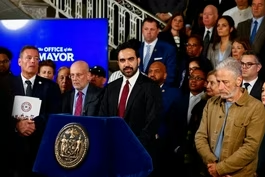
News Wrap: NYC officials aware of toxic air after 9/11
Video has Closed Captions
News Wrap: NYC officials release documents showing city was aware of toxic air after 9/11 (5m 41s)

Southeast Asia endures year of extreme weather amid El Nino
Video has Closed Captions
Southeast Asia endures punishing year of extreme weather amid super El Niño (5m 21s)

Trump’s trade war with Canada looms over key races
Video has Closed Captions
Trump’s trade war with Canada looms over key congressional races (4m 25s)
Providing Support for PBS.org
Learn Moreabout PBS online sponsorship New Episode
- News and Public Affairs

Today's top journalists discuss Washington's current political events and public affairs.
 New Episode
- News and Public Affairs

FRONTLINE is investigative journalism that questions, explains and changes our world.
 New Episode
 New Episode
 New Episode
 New Episode
 New Episode

 New Episode
 New Episode

Support for PBS provided by:
Major corporate funding for the PBS News Hour is provided by BDO, BNSF, Consumer Cellular, American Cruise Lines, and Raymond James. Funding for the PBS NewsHour Weekend is provided by...