John McGivern’s Main Streets
Wisconsin’s West Coast
Season 5 Episode 7 | 26m 48sVideo has Closed Captions
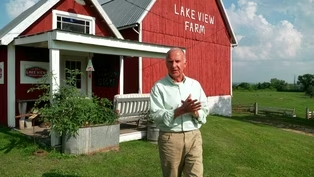
Wisconsin’s West Coast is real — and it’s wonderfully idyllic.
Wisconsin really does have a West Coast, and it’s idyllic. Along Lake Pepin on the Mississippi River, five Wisconsin towns — Nelson, Pepin, Stockholm, Maiden Rock and Bay City — line the Great River Road. Agritourism and weddings draw visitors, but it’s the scenery and the pie that steal the show!
Problems playing video? | Closed Captioning Feedback
Problems playing video? | Closed Captioning Feedback
John McGivern’s Main Streets is a local public television program presented by PBS Wisconsin
John McGivern’s Main Streets
Wisconsin’s West Coast
Season 5 Episode 7 | 26m 48sVideo has Closed Captions
Wisconsin really does have a West Coast, and it’s idyllic. Along Lake Pepin on the Mississippi River, five Wisconsin towns — Nelson, Pepin, Stockholm, Maiden Rock and Bay City — line the Great River Road. Agritourism and weddings draw visitors, but it’s the scenery and the pie that steal the show!
Problems playing video? | Closed Captioning Feedback
How to Watch John McGivern’s Main Streets
John McGivern’s Main Streets is available to stream on pbs.org and the free PBS App, available on iPhone, Apple TV, Android TV, Android smartphones, Amazon Fire TV, Amazon Fire Tablet, Roku, Samsung Smart TV, and Vizio.
Providing Support for PBS.org
Learn Moreabout PBS online sponsorship- John McGivern: There are five communities along the Great River Road that collectively call themselves the West Coast of Wisconsin.
- Announcer: Thanks to our underwriters.
Together, doing good for 130 years.
Horicon Bank: It's the natural choice for community banking.
- There's no place like Oconomowoc.
Explore, play, shop, stay!
Visit Oconomowoc!
- My father taught me that to make great bakery, you have to do it the right way.
O&H Danish Bakery, where kringle traditions begin.
- Support for this program provided by Plum Media, elevating conferences and meetings with smooth, stress-free production.
- Announcer: Financial support has been provided by our friends at Greenfire, a construction management company, the Friends of PBS Wisconsin, and the Friends of Main Streets.
- Announcer 2: One way you can support your favorite show, and of course we mean this show, is to shop online in our store, where you'll find the perfect gift for that big fan.
And, of course, by "big fan," we mean you!
Thanks for shopping!
♪ 'Cause these are our Main Streets ♪ ♪ Somethin' 'bout a hometown speaks to me ♪ ♪ There's nowhere else I'd rather be ♪ ♪ The heart and soul of community's right here ♪ ♪ On these Main Streets ♪ - This is Wisconsin's western border on the Mississippi River.
In fact, have you heard of Lake Pepin?
Okay, it's not actually a lake.
They call it a lake because it is the widest and deepest naturally occurring stretch of the Mississippi River.
This area, being branded the west coast of Wisconsin, is halfway between La Crosse and Minneapolis.
So, the communities we're covering this week-- Nelson, Pepin, Stockholm, Maiden Rock, and Bay City-- together, they have a population of about 1,800, but the largest, Pepin, with a population of about 750.
They all overlook the Mississippi on the Great River Road, and from one end to the other, it's about a half hour.
This is the west coast of Wisconsin.
Hi, Emmy.
- Emmy Fink: Hi, John.
- It's gonna be different today.
- Yes.
- You know why?
Because we are exploring five very small communities, so I'm going to presume that there's a lot of history.
- Buckle up, buddy... - Buckle up, here we go!
- ...because we've got a lot.
We're gonna start with the Dakota Sioux people, because the village of Maiden Rock got its name from a Dakota story.
Then come the French explorers in the late 1600s.
And then you fast forward to the 1850s, two brothers, Jean and Pierre Pepin, they built a community here.
- Hence Lake Pepin.
And we have the village of Pepin, and we have Pepin County.
- Yes, yes, and yes.
- John: And we're in Stockholm, so let me presume Sweden.
- Emmy: Exactly.
A lot of them were farmers.
They were coming, and they loved this area in the Midwest.
- John: Yeah, so in the late 1800s, people came from all over.
What did they do work-wise?
- Okay, so we're talking farming, fishing, milling lumber, digging for clams, for pearls, and making buttons.
All of that was happening.
- And what are these towns like today?
What are they doing today?
- Emmy: There's still a lot of farming that happens around here, a lot of agriculture.
But over the last two decades, this has become a destination hotspot.
All of these villages are like weekend getaways for people.
But another economic driver... [humming Wagner's "Bridal Chorus"] ...people are getting married here, because who wouldn't want to do that overlooking the beautiful river on a beautiful bluff?
- Wow, weddings.
So, I guess brides come here as miss, become missus... on the Mississippi.
- Oh, you just-- - Oh, that was really good.
- Wow, on the spot?
- Let's check out these five towns.
Come on, that was good.
So, we drove down this path, and when you go around the corner and this appears, it's really remarkable.
How did this happen?
- Angela Kissell: Kind of all of our dreams and hopes kind of wrapped up into one.
And so-- - You dream big.
You know that, Angela?
[all laugh] - Adam Kissell: We drove past this for years, and then we bought it a few years back because we just knew it had potential.
- John: Where are we going?
- We're going out to our outdoor ceremony area, so it's a cute little romantic walk through the forest.
- John: It certainly is.
- The doors open and it's just kind of like, "Oh!"
- And we've arrived.
[all laugh] - Yep.
- John: Oh, it's spectacular, you guys.
- Angela: Thank you, thank you.
- John: Look at this.
- Angela: The backdrop was here, and we just kind of spruced it up a little bit.
- John: You're a good sprucer.
- Adam: Yeah.
The shift in weddings has really changed over, like, the last 10, 20 years from the traditional churches and hotel settings.
You know, now people wanna be outside.
They want something unique.
- And is this where most people get married, out here?
- Yeah, that's usually the goal.
Here, we are open year-round.
I mean, we have an indoor backup option that's kind of always set up and ready to go.
We call 'em ghost chairs.
- Plexiglass, and they just kind of disappear really, don't they?
- Yeah, yep.
So, this is where the ladies normally get ready.
It's like a little glam bar area.
This is just a fun space where guys can hang out and get ready.
They don't take as long to get ready.
- Do they?
No.
[Angela laughs] And size-wise, you can go from what to what?
- Well, two.
- Adam: Two.
- Two, probably.
[all laugh] Two to two-fifty.
- Two to two-fifty?
- Angela: Yes.
- John: On a gorgeous summer night when there's 250 people in this room, these windows all open up?
- Angela: People can be outside enjoying the fireplace, but they can also be inside enjoying the music, grabbing a drink at the bar.
- It's not just this venue.
You have cabins?
- Angela: Having the cabins on site is just so convenient.
I think it does kind of pull the whole package together.
- So, I know this weekend... - Yes.
- ...Thursday, Friday, Saturday, Sunday.
- So, we have 103 booked, you know, this year.
We're well over 100 for next year.
So, it's been everything that you can hope for when you open a business.
- John: Congratulations on this.
- Adam: Thank you, thank you.
- John: This is really spectacular and really special.
Come on, I wanna get married.
[all laugh] - Adam: We'll welcome you back.
- John: [laughs] Thank you.
Have you heard the term agritourism?
It's exactly how it sounds: tourism around agriculture.
So, I am outside of Maiden Rock.
I'm gonna go into the store in just a minute, but if you wanna stay in this area, like, in fact, the next driveway, it's called Rush River.
You can pick your own blueberries.
That's in Maiden Rock.
Oh, these are so good.
You can go down to Stockholm and pick your own lavender at Lavender Bluff.
Options all over.
But I'm gonna go into this store, okay?
Come on in.
Sunflower oil.
Maple drool.
Here's some hot sauce.
Three-berry jam.
Peanut chili crisp.
Ta-da!
Cookies!
I bet they taste good frozen.
You add it all up, put it on the ledger there, and then you put the money right there.
Or if you don't have cash, Venmo.
And now all I need is a bag.
Never fear, I got two hands and strong arms.
Uh, kind of strong.
["Flight of the Bumblebee" by Nikolai Rimsky-Korsakov] We're at Honey Hill Apiary, which is a bee farm.
This is Doug and Kim.
How are you guys?
- Doug Sjostrom: Good, you?
- This is your farm.
- It is.
- Yeah, and how many generations of your family have been here?
- This is four.
Daughter, Hannah, would make the fifth generation.
- John: How great is that?
- Hannah Sjostrom: She doesn't always love it.
She's like, "You're like your father."
[all laugh] - And how did Kim show up?
- Kim Sjostrom: I thought somebody said, "You should meet him.
He's got a lot of money."
And then I found out it was "a lot of honey."
- John: Oh, God, no!
[laughs] Did you have a bee farm growing up?
- I was in 4-H.
I finally got up the nerve to ask Dad.
I said, "Do you care if I take bees for 4-H?"
I ordered 'em from Sears and Roebuck catalog.
They came in the mail, and the mailman was a little excited.
- John: And regular bees live for how long?
- Hannah: A worker bee only lives for about four to six weeks.
- John: Oh, really?
- So, in the summer right now, they fly so much, they actually wear their wings off and they die.
- John: And should I be afraid of bees?
- Doug: Not honey bees.
- John: Not honey bees?
- Doug: Honey bees don't like to sting 'cause they know if they sting, they're gonna die.
- John: Oh.
- Doug: Should we show him our friendly hives or the unfriendly?
- John: Please go to the friendly first.
- Doug: Okay.
- John: So, this is all one hive here, Yes?
- Doug: Each column is one hive.
Something like this, there can be 80,000 bees.
- John: Wow!
What are you doing with the smoke right now?
- Hannah: So, honey bees communicate by pheromones or by smells.
- John: Yeah.
- Hannah: So, if you just go in there, you rip that hive off, they're gonna think, oh, they're under attack.
The smoke kind of covers up that smell or that pheromones.
- John: [gasps] Oh, my God.
- Hannah: You see how it's nice and shiny right there?
- John: Yeah.
- Hannah: So that's nectar.
So, the honeybees, they go to those flowers, they get that nectar, and they bring it back to the hive.
You'll see this on the outside right here by my right thumb.
- John: Yeah?
- Hannah: That's all honey here.
- John: Wow.
- Hannah: And then they will take that beeswax right here and they'll cap it, and that's how they preserve it.
- John: Found the queen.
- Hannah: That white dot is fingernail polish.
Some people will mark their queens religiously to tell what year they got 'em.
She is about twice as long as everybody else.
- Doug: And she lays up to 1,500 eggs every day.
And just think how many cards she must get on Mother's Day.
[all laugh] - You have so much more than honey, yes?
- Hannah: So, our favorite thing we have here is our beeswax candles.
He'll try and tell people that he hand carves them all.
Just, you know, spike the... - He does a really good job.
- [chuckles] Yeah.
- Sure.
[laughs] - John: Honey sticks.
- Doug: Honey sticks.
It's our way of getting the kids addicted to honey, so when they get to be adults, they come and buy the big stuff.
- The gallon.
You see a lot of return customers, I'm sure.
- Yeah.
- Yeah.
Half of our sales are farmers markets, and then the other half are the grocery stores.
So, we sell a lot of everything.
A honey bee's goal is just to fly out to the flower, get the nectar, pollinate the flower, and come back to the hive.
- John: They just wanna go home, don't they?
- Doug: Yep.
- I'd make a good bee.
- Yep.
- I would, 'cause all I ever wanna do is go home.
[all laugh] This log cabin behind me is a replica of the birthplace of one of the most famous people to come out of this area.
Okay, this author who was born here wrote their first book about what it was like growing up in the big woods of Wisconsin.
That's the hint.
Here's the question.
Do you know the answer?
The big wood-- That's such a small house for growing up in the big woods!
You'd think they would've had a bigger house.
[playful music] - Before she lived in a little house on the prairie-- hint, hint-- Laura Ingalls Wilder was born here in Pepin in 1867.
Her family moved around a lot when she was a kid, but her very first book, Little House in the Big Woods, is all about her life in Pepin, and there's a museum on the Great River Road that pays tribute to her.
I just loved Laura Ingalls Wilder.
If you are planning to come to this area, here's my tip.
The locals do not refer to the towns around here as north or south of one another.
Everything is upriver or downriver.
So, I'm in Pepin, which is downriver from Bay City, but upriver from Nelson.
They're river towns.
It's all about the river.
- Brian Brecka: We're in Pool 4 of the Mississippi River.
Pool 4 runs 44 miles.
Lake Pepin is about 20 miles long.
- John: Yeah.
- Brian: At the lowest end of Lake Pepin, you have the Chippewa River.
Chippewa River flows in.
Over a long time period, a lot of sand had been deposited by the Chippewa, and that created Lake Pepin.
- John: Okay.
- Brian: These series of pools that have been put on the Mississippi River, created by the locks and dams, have slowed the water.
Sediment settles out, things become shallower.
- As a scientist who, this is your area of expertise, what do you worry about?
- Brian: The habitat change that comes with sedimentation.
- John: And do you see work being done that's really addressing that?
- Work is being done all up and down the river.
One thing that did happen was the Lake Pepin Legacy Alliance.
- Let's talk about what this is.
- Michael Anderson: Lake Pepin Legacy Alliance is here to be kind of a conduit for what the people around the lake and in the area have seen happen to Lake Pepin over the years and what they wanna see changed.
- Missi Blue: It's this deep now where it was, you know, this deep.
Lake Pepin Legacy Alliance is trying to educate people to where the trouble spots are and, you know, if you go out in this area, you might not get out.
- Michael: The lake is filling in at a drastic rate compared to what it used to be.
So, if this were left to its natural devices, you know, think 3,500 years at this current rate of how we are farming plus increased rainfall, we're looking at 350 years.
- That's shocking.
- Yeah.
- And, in fact, something has to be done today.
- Yeah, if we don't start now, like, that rate goes-- Three-fifty is gonna drop down to, you know, two-fifty.
- What's going on here?
- Oh, yeah, we're here.
- Michael: We are staring at an island-building project right now.
- John: They built that one?
- Michael: Yes.
- John: Yeah, and they're building another.
- Michael: This one's being built.
- John: Why?
- Michael: This will reduce wave action and resuspension of that sediment.
- And all part of the solution?
- Missi: This project has allowed for Bay City as part of the plan to not be cut off.
And so, as the sedimentation was filling in this whole bay here, they were approaching zero access.
- John: So, who does the Alliance have to partner with?
- Missi: Everybody.
- Michael: Everybody.
- Is it everybody?
- It really is, it really is.
'Cause you got the legislatures, you've got all the corps, you've got both sides of the DNR, Minnesota on one side, Wisconsin on the other, and you have to work with all of 'em.
- And does everybody see that there's a problem and that there has to be a solution, that it's really important?
- We have not talked to one person, I don't think, that has not thought there was a problem.
- No, I completely agree.
Everyone is saying, yes, there's a problem and how do we fix it?
- Missi: So, any good we do up here affects everybody downstream in a positive way.
- All the way down the river, they should be like, "Let's help them."
- Yes, right.
I agree.
- Yeah, let's help upstream.
- John: Come on.
- Missi: Wouldn't it be fun?
- When I see the term "Bottoms of the Mississippi," just know that I am not talking about missing swim trunks in the bottom of the river.
No, definitely not.
The Bottoms refer to the floodplains of the Chippewa and the Mississippi River.
You will find thousands upon thousands of acres of undisturbed wilderness.
So, hop in one of these babies and go exploring!
I'm not getting out, you guys!
[bright music] - John: I'm excited to tell this great family story.
So, you and your father and his father grew up right across the street from where we're standing today.
- Greg Hetrick: Right there.
Becky and I live in the house that my great-grandfather built.
Fifteen years ago, I would've never, ever thought we'd be distilling.
- It was your idea, wasn't it?
[all laugh] All of this?
- Zach Hetrick: Yeah, I was behind it.
- Greg: He said that he had this interest in starting a distillery.
- John: That, to the naked eye, has nothing to do with farming.
But in fact, it has everything to do with farming, doesn't it?
- Right.
- Zach: The grain's grown right on our property, right on our farm for the distillery.
Our farm name is Village Edge Farms.
- Oh, nice.
- Our vodka is Village Edge Vodka, By Golly Gin.
The creek that runs through our property is By Golly Creek.
- Becky Hetrick: It brings something back from the land and it keeps it in the family.
- Sam Hetrick: I thought, "Wow, we just got married, "and you wanna do what now?
What did I just sign up for?"
- Greg: Zach did his homework.
- John: And then did you both sign off on-- - Well, every new venture is a risk.
- Greg: Well, you know, with farming, farming's a risk, but we kind of know how to handle it.
- John: Yeah.
- Zach: This is gonna be a mash for vodka.
- John: Okay.
- So, it's 85% corn, and it's 15% ancient wheat.
This is right off the farm, and my dad brings it up as we need it.
Corn is first, and then we'll dump in the wheat.
- You need help over there, Greg?
- Greg: Too late now.
- John: "Too late now."
- So, this is the still.
- John: They look like steampunk musical instruments, don't they?
- Zach: Yes.
- John: Talk about your name, Township 23.
How did you get it?
- It was both of us reading an 1880s county book, so-- - Light reading.
- Light reading.
- You know.
- Yes, yeah.
Back then, they didn't state, "Oh, in the town of Nelson or the village of Nelson."
They said, "in Township 23."
And she was just like, "Wait, stop, that's it."
It ties back to that history that's so important to us, our family, and as well as where the land sits.
- John: Yeah.
- It's a generational change from the tradition of families handing farms down to their children and then they farm.
- Is this what you envisioned, where we're standing today?
- It's better.
- John: Is it?
- It's better than I imagined.
- John: Wow.
This is really inspiring, so thanks for sharing that.
- Zach: Thank you.
- John: Really a pleasure.
- Sam: Thank you.
- Zach: Thanks.
- The official population of Stockholm, Wisconsin, is 78 people.
But there is one Saturday in the middle of the summer because of the Stockholm Arts Fair that this population explodes.
Can you guess how many people visit Stockholm, Wisconsin, during the Stockholm Arts Fair?
Guess!
[playful music] - Did you guess anywhere close to 8,000 to 10,000 people?
Because that's how many show up for the Stockholm Art Fair.
That is a 10,000% population increase.
- I am on the porch of the Smiling Pelican Bake Shop.
They are only open on Saturdays.
So, every Saturday morning, people line up for blocks to shop here.
They come to this porch to buy their bread, cookies, cakes, pies, scones.
They come right here, and the only rule is you can't cut in line.
Hey, no skips!
Stockholm Pie & General Store.
I'm interested in the pie.
What was the pie that made you famous?
- Alan Nugent: So, probably the one that really put us on the map was this one right here.
So, this is the Double Lemon, a classic lemon chess pie.
So it's a dense custard pie with this intense, lemony, house-made English lemon curd.
- It's so smooth and so just enough tart.
- Sweet and tart.
- It's so good.
- Alan: There's a little magazine called Gourmet that said it was one of the 53 best things they ate in the world that year.
- John: It's the crust, isn't it?
And is it, is there a secret?
- There is, yeah.
- Yeah, and?
- There are two ways you can find out the crust.
You can come to work for us, or you can buy the place.
So, either option is open.
- Other than that.
- Alan: During the busy season right now, we have about 24 people working here.
But every year, we bring in what are called work campers.
- Tell me what a work camper is.
- So, work campers live in their big, beautiful RVs, travel the country, and take jobs in different places.
When you're in a town of 76 people, there's not a lot of people to hire.
- It would be a third of the population.
- That's exactly right.
- What are you making right now?
- Tasha Burns: Blackberry raspberry.
All of our pies, you see pieces of fruit.
You don't see gelatin, you don't see a pile of goop.
- John: Oh, a little almond, there we have it.
- Tasha: And make sure the sugar is evenly distributed.
- John: Oh, geez.
- If it's not, when you bake it, one edge of the pie is very discolored.
- Oh, is that right?
This one may be a little discolored.
The crimp is second nature.
- Tasha: Pretty much.
I don't even need to look at the pie to do this anymore.
And then repeat this about 200 times.
- John: And do you have a piece?
- Of course!
- Okay, I just wanted to know.
- Mia Robus: I have some of my strawberry raspberry six-inch in here.
- John: Six-inch is popular?
- Mia: Yep.
This is great for, like, two people to share a pie.
- Yeah, and these?
- These are my big, beautiful 10-inch peaches.
- Oh, my God!
- Mia: You can see that caramelized sugar that we put on top of our pies.
- John: Oh, sure, oh, yeah.
And the smell.
- Mia: It smells so good, oh, my goodness.
- Alan: We have our general store.
We have our marketplace.
It's all focused on an experience, a feeling of comfort and taking you back.
It truly is magical.
- And this is not your hometown?
- Alan: It is no one's hometown here except for one gentleman who lives across the street.
Everyone is a transplant here.
The more you are here, the more you discover.
And then at the end of the day, you get pie.
I mean, come on, that's perfect.
- Have you ever just heard the name of a place and thought, "This place is gonna be fun?"
Scandihoo!
That sign is so right.
"Nordic style with a kick."
This stuff is from Norway, Sweden, Denmark, Finland, and Iceland.
I mean, have you ever heard of a place that has its own cuckoo clock department?
Oh, wait a minute.
Ginger snaps from Sweden!
This and a cuckoo clock.
That's all I need.
[rooster calls] [laughter] - Here is the story of how Maiden Rock got its name.
So, there's a Dakota Sioux maiden, and she was being forced to marry a suitor that she was not in love with.
So, she actually went through with the wedding, and an hour into their marriage, her relatives couldn't find her.
They did not find her until the very next morning, and they found her at the base of this cliff.
And I hope this is as sad of a story as we tell here on Main Streets, but it's how it got its name!
We had to tell it!
- John: Let's tell our audience what this is.
- Mary Anne Wise: So, on a trip to Guatemala, my business partner Jody had been volunteering, came back with this idea of starting a shop for women who don't have access to the outside markets.
If you elevate their artistry within their home community, they are valued and they're being paid a fair wage.
That is going to ensure continuation of these extraordinary crafts that are deeply embedded within their cultures.
So, the pillows are Laos and Thailand, cotton that's handspun, handwoven.
And then they bring it to another community and they do the embroidery.
So, in the production of this pillow, we are supporting three different communities of artisans.
This is made from recycled clothing that you and I donate.
They create the design that is based on their traditional textiles and turn it into a large-scale hooked rug.
And what we ask all of the women to do is sign their piece.
Now, with Angélica as the new owner, all of these stories will continue.
- So, there's a new owner?
- So, the new owner is Angélica and Daniel Sanchez from Milwaukee.
- A year ago?
- Angélica Sanchez Mora: Just a year ago, yes.
- Did you know each other before?
- Both: No.
- No?
- I mean, it was just we kind of bump into it, this particular opportunity.
We're celebrating 15 years of Cultural Cloth, which is just amazing.
- John: Congratulations.
- Some beautiful runners from Morocco, and these are from South Africa.
And always people ask, like, is it just for kids?
Not really.
[laughs] - John: No.
In fact, they're not for kids.
They'd be like, "Get your hands off that!"
To be a retail operator who has to think about the money coming in, there's a mission so beyond that.
And to have that story as part of my home?
- Yeah.
- I think it's important.
- Yeah, remarkable work, isn't it?
- Whoever did this work didn't just do it, like, on a Tuesday morning.
- Not so much.
- No, yeah.
- Angélica: This is just another room.
- What?
Wait a minute.
- So, this is from near Kolkata.
So, you can see there is a circle design.
That is block printed into the silk.
And then, the embroidery is done to create different patterns.
- Can I pull one out?
- Angélica: Oh, absolutely.
- Just for fun.
- Angélica: Pick your favorite.
- John: How many women are represented in this store?
- We have over 30 countries.
- 30 countries.
- Angélica: But some of these organizations that we work with might be working with 250, 300 women.
- How did the store on the east side of Milwaukee happen?
- Me and my family, we live in Milwaukee.
Now that we have two stores, instead of ordering maybe three quilts, now we can order six, which might not seem like a lot, but for women who are working on this, this is huge.
It's huge.
- John: The work you guys do is really important, that you now are the voice of so many is really, really cool.
- Mary Anne: We just really found beauty.
- You know what it's like when you show up to a new town and you're hungry-- you go right to online reviews and you see who has the best food.
When you look up good food in Pepin, this place is gonna come up, Harbor View Café, because it has fantastic food, it's across from the river, but here's a tip: They don't take reservations.
It doesn't matter who you are, even John McGivern.
His name's gonna go on the waiting list and he's gonna have to wait!
- John: Emmy, it's our last stop.
We're at the old Pickle Factory.
Now, they no longer make pickles, but they make really good food, and they serve the pickles with that food.
- Emmy: Okay, and I did see pickle beer.
- John: Oh, excited?
- Emmy: Yeah, very.
What did you think about five communities all in one episode?
- I thought it was great.
It was just like a hop, skip, and a jump from each other, and they each had something really special to offer.
- Now, we said you could come for the weekend and hit all five of them.
- Yeah.
- I think they're all special enough for their own weekend.
- Oh, okay.
- What do you think?
So, I gotta get planning.
Actually, I gotta go.
- You're gonna spend five weekends here?
- Yeah, great to see you.
- You are so good.
♪ There's nowhere else I'd rather be ♪ ♪ The heart and soul of community's right here ♪ - Is this how you make television?
- You need to eat those.
- Yeah, okay.
Well, you're kinda bossy.
- Oh, heck yeah!
- Lois: [laughs] Now you're like the Karate Kid.
- No, I just changed my clothes outside.
This is the kind of production this is.
Oh, this is a lot of information that I'm not sure I really wanted.
[all laugh] - Announcer: Thanks to our underwriters.
Together, doing good for 130 years.
Horicon Bank: It's the natural choice for community banking.
- There's no place like Oconomowoc.
Explore, play, shop, stay!
Visit Oconomowoc!
- My father taught me that to make great bakery, you have to do it the right way.
O&H Danish Bakery, where kringle traditions begin.
- Support for this program provided by Plum Media, elevating conferences and meetings with smooth, stress-free production.
- Announcer: Financial support has been provided by our friends at Greenfire, a construction management company, the Friends of PBS Wisconsin, and the Friends of Main Streets.
- Announcer 2: One way you can support your favorite show, and of course we mean this show, is to shop online in our store, where you'll find the perfect gift for that big fan.
And, of course, by "big fan," we mean you!
Thanks for shopping!
- John: Nobody handled them but me and God.
- Lois: They're warm, and they're sweet.
- Mmm, do you want some?
- Lois: Yeah.
- Go get your own basket.
- Lois: I knew it, I knew it was coming.
Preview - Wisconsin’s West Coast
Preview: S5 Ep7 | 30s | Wisconsin’s West Coast is real — and it’s wonderfully idyllic. (30s)
Providing Support for PBS.org
Learn Moreabout PBS online sponsorship













Support for PBS provided by:
John McGivern’s Main Streets is a local public television program presented by PBS Wisconsin