
Washington Week with The Atlantic full episode, 4/3/26
4/3/2026 | 26m 46sVideo has Closed Captions
Full Washington Week with the Atlantic broadcast from April 3, 2026.
Full Washington Week with the Atlantic broadcast from April 3, 2026.
Problems playing video? | Closed Captioning Feedback
Problems playing video? | Closed Captioning Feedback
Major funding for “Washington Week with The Atlantic” is provided by Consumer Cellular, Otsuka, Kaiser Permanente, the Yuen Foundation, and the Corporation for Public Broadcasting.
Washington Week with The Atlantic full episode, 4/3/26
4/3/2026 | 26m 46sVideo has Closed Captions
Full Washington Week with the Atlantic broadcast from April 3, 2026.
Problems playing video? | Closed Captioning Feedback
How to Watch Washington Week with The Atlantic
Washington Week with The Atlantic is available to stream on pbs.org and the free PBS App, available on iPhone, Apple TV, Android TV, Android smartphones, Amazon Fire TV, Amazon Fire Tablet, Roku, Samsung Smart TV, and Vizio.
Buy Now
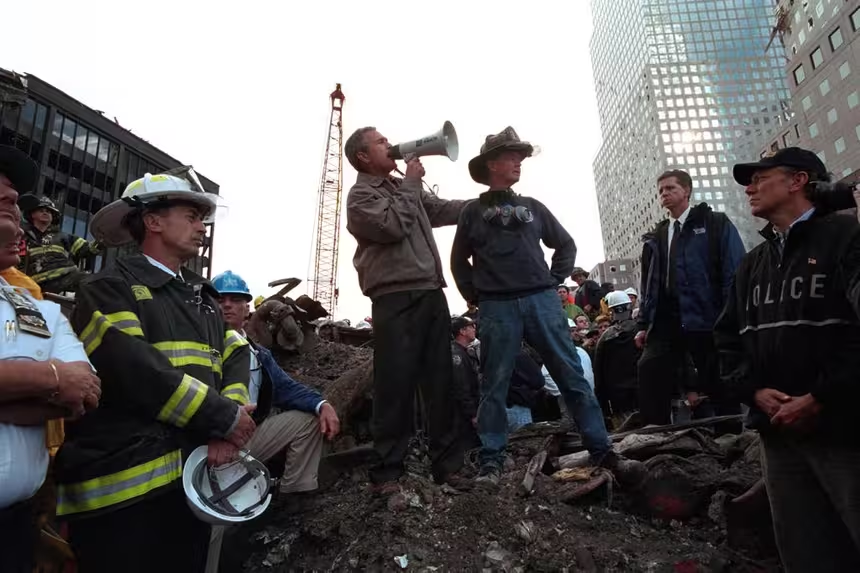
10 big stories Washington Week covered
Washington Week came on the air February 23, 1967. In the 50 years that followed, we covered a lot of history-making events. Read up on 10 of the biggest stories Washington Week covered in its first 50 years.Providing Support for PBS.org
Learn Moreabout PBS online sponsorshipVivian Salama: President Trump operates on what he calls -- Donald Trump, U.S.
President: Trump time.
Vivian Salama: He also has a preferred timeframe in which he operates.
Donald Trump: I'll let you know, in about two weeks, within two weeks.
I think within the next two to three weeks.
We'll have something in two weeks.
Vivian Salama: It's in that same timeframe the president in a prime time address to the nation said The Iran war is wrapping up.
Tonight, can the president deliver?
And if so, what does the end of America's latest Middle East conflict look like, next.
Good evening and welcome to Washington Week.
I'm Vivian Salama in tonight for Jeffrey Goldberg.
President Trump addressed the nation this week in what he framed as a progress report on the Iran war.
In his telling, a quick detour to the Middle East was necessary.
The world is safer because of it, and the American economy will be just fine.
But in reality, there were more questions than answers after the president's 20-minute address, especially as he vows to bomb on.
There's a lot to unpack and joining me tonight, Idrees Ali is a national security correspondent at Reuters, Peter Baker is the chief White House correspondent for The New York Times, Susan Glasser is staff writer at The New Yorker, and Michelle Price is a White House reporter at the Associated Press.
Thank you all for joining me.
Before we get to the president's speech, Idrees, there was some breaking news just as we were coming to air, an F-15 fighter pilot fighter, jet pilot was rescued alive by the U.S.
military after the plane went down over Iran.
First of all, what do we know about the incident and also what does that say about maybe Iran's capabilities if it was responsible for this?
Idrees Ali, National Security Correspondent, Reuters: You know, firstly, what we know right now is that two-seater F-15 jet was shot over Iran.
We don't know who was responsible, but I think it is likely that Iran was responsible in some way, shape, or form.
We don't know the fate of the second pilot yet, but I think what broadly it shows is that a war is brutally unpredictable.
And what President Trump and Secretary Hegseth have been saying, which is, you know, Iran has been destroyed militarily, their capabilities, their air defenses just isn't true.
You know, Iran has a plethora of air defense systems, something as simple as a manpad actually can bring down a fighter jet.
So, I think it really raises questions about what the president, Secretary Hegseth have been saying and really risk for the thousands of, you know, U.S.
personnel who are flying in and around Iran every day.
Vivian Salama: Yes.
Susan, we -- as we showed in the open, the president is trying to set a timeframe for getting out of Iran.
Already, there were questions about how realistic that is.
And now on top of that with this incident, do you think it's possible that we could wrap this war up in two to three weeks?
Susan Glasser, Staff Writer, The New Yorker: Well, again, I mean, part of the reason that I think the American public is suggesting in polls by an overwhelming margin, they're very skeptical about the war.
You've seen a very negative reaction from the markets.
The reason is because while Trump said two to three weeks, he did not offer any kind of a sense of a realistic plan.
In fact, he actually suggested that the most serious economic consequence of the war, which is the effective closing of the Strait of Hormuz, he basically said that he may just walk away from it and leave European and Asian partners who rely upon energy imported through the strait, that he would just leave that problem to them.
That's not really a realistic scenario for winning, as anyone would conventionally define it.
And so I think not only has Trump left the goals of this operation hazy, but I think he's been not only untruthful but amazingly untruthful with the American people and with the world both about what's already happened over the last month and about what he's trying to do with this war.
Vivian Salama: Let's stay with the speech now Wednesday night primetime address, Peter.
Why did the White House feel that now was the time to deliver this speech?
What was the objective behind it and do you think it was effective?
Peter Baker, Chief White House Correspondent, The New York Times: Yes, that's a good question.
The thing about it, it's always better for a president in the time of war to go to the public and explain what he's trying to do, to explain the goals, to explain why it's worth American treasure lives to take this action.
But it felt like a day 1 speech, not a day 32 speech, right?
It did not feel like a speech a month into the war saying, where are we going to go from here?
And I think that it left a lot of people confused.
On the first day of the war he told us that regime change was the goal.
He said, Iranians, it's time for you to take over your country.
He says on Wednesday night, regime change was never my goal.
He told us that the nuclear program was obliterated, and now he says we need to obliterate it again, so forth and so on.
We've been through this.
But he didn't outline a plan, a concrete plan, or an understanding of what he wants out of this war.
He said at one point he wanted unconditional surrender.
Okay, but now he's negotiating.
Well, what do you negotiate?
You can negotiate conditions.
So, it's all over the map.
And I don't know that it satisfied the Republicans who wanted him get out there and talk, who were very nervous about the impact on the economy and on their political prospects in the fall.
Vivian Salama: I mean, gas prices hit a record the day before this speech was delivered.
Do you think that had a big -- was a big factor there?
Peter Baker: Of course, absolutely.
Well, he's hearing from his people around him, and obviously from Republicans on the Hill, is that the public isn't for this and they don't see why we're doing it.
And you need to explain why it's important to them.
And I don't know that he sold that case.
Susan Glasser: Well, I mean, I think that's a really important point because people are not only not used to the American president, you know, really not speaking to them at a moment of such enormous international gravity.
But let's just say for a second here, 19 minutes-long that address was from the White House.
It really was basically a 19-minute long Truth Social post instead of a meaningful strategy for why he's taken such a consequential decision that has plunged the global economy into turmoil.
I mean, literally, people are not being able to go to school five days a week in Bangladesh.
In South Korea.
They're working from home because Donald Trump did this.
And yet, in 19 minutes, what did he offer us?
Like essentially platitudes from his social media posting, America is winning.
We've never been doing better than before.
That's not a strategy.
It's actually insulting to people to talk like this, I think, in a time of conflict.
Vivian Salama: And, Michelle, one of the things that we've been talking about throughout the course of this conflict is the Strait of Hormuz, that passage -- that crucial passageway especially for oil tankers getting in and out that region.
What, if anything, did the president say as far as whether or not that passage would be reopened, who would control it, sort of those lingering questions they keep asking.
Michelle Price, White House Reporter, The Associated Press: I mean, it depends on what day of the week it is and what time of day it is, because the answer keeps changing.
You know, in the speech and in the days leading up to it, the president has said, it's not for us.
It's for those who use it, who rely on it.
This morning, he's suggesting that maybe the U.S.
could very easily go take the Strait of Hormuz, that it would only go on a little bit longer, that it would bring great wealth to the U.S.
if we took it.
And the president has been expressing privately in a video that the White House put up this week, and then that was taken down, some -- you know, he's expressed a desire to stay and try to get some of this oil and said, but he understands that there isn't patience in the U.S.
to stay.
And you can see he's kind of feeling out whether he might be able to prolong this.
But the question of whether this will wrap up in two or three weeks, it actually isn't up to just him, right?
Iran has this choke point.
They have leverage now.
And there's two parties here that decide when this ends.
Vivian Salama: Actually, we have the president here saying that one of the things that, you know, has been a concern is obviously the financial markets, and the president sort of framed the way out economically.
Here's what he had to say.
Donald Trump: To those countries that can't get fuel, many of which refuse to get involved in the decapitation of Iran, we had to do it ourselves, I have a suggestion.
Number one, buy oil from the United States of America.
We have plenty.
We have so much.
And, number two, build up some delayed courage, should have done it before, should have done it with us, as we asked, go to the strait and just take it, protect it, use it for yourselves.
Vivian Salama: Peter, the relationship with allies over the course of this conflict has been rocky, to say the least, obviously messaging to them, especially there.
What's the president looking to get out of this?
Peter Baker: Well, it was surprising he didn't go further actually, in the bellicose that we expected in that speech toward the allies, and particularly toward NATO, he's been threatening even to get out of NATO, out of all this.
In effect, what has happened was, is it's a -- it's something he -- it's a self-fulfilling prophecy, right?
He has said NATO is obsolete.
They won't come to our aid.
He then goes to war without consulting them, without asking them their opinion, without asking them if they would do something, if they thought it was a good idea or not.
And then when they say, no, it's your war, we don't particularly want to be part of, he says, see, I told you all, I was right all along.
Now, he has backed off of the threat at the moment, but it does feel like that the alliance basically is all but over.
It's in name -- everything but name only.
Yes, there's still a NATO.
But if you are in NATO, do you believe that the United States is a full-fledged partner with you or do you think that it's going off on its own?
And Europe is thinking the United States is going off.
Vivian Salama: Well, and Secretary General Mark Rutte of NATO is coming to Washington next week to talk to President Trump.
Clearly, they are concerned.
Peter Baker: And he's been a Trump whisperer.
He's been into the -- sometimes the consternation of his European colleagues who think he's gone too far, maybe he'll be able to smooth things over in some way.
But I think that this is still a fundamental break here that's not going to be repaired.
Vivian Salama: Yes.
Idrees, I want to go back to the military portion of this.
Obviously, there have been concerns, questions about how well this military operation has been going, who's calling the shots.
Interestingly this week, the Army chief of staff, Randy George, was fired by Secretary Hegseth.
First of all, is that an unusual move to see in the middle of a war?
And what does it say about the military operation?
Idrees Ali: I think it's extraordinary to fire the head of the Army, the largest branch in the military during a war, and not related to the war itself, right?
He did nothing wrong about within the war.
And so I think it's extraordinary, raises real questions.
There are thousands of U.S.
military, specifically Army soldiers in the Middle East, actually manning air defense systems on the defensive side and airborne troopers from the 82nd Airborne Division.
And I think if you're someone who's deployed, you're looking sort of at the T.V.
in the Middle East and saying, what is going on?
Who are the people that I'm following.
And, you know, it just really raises a lot of questions.
And, you know, the military is sort of, like a freight train moving.
It's really tough to stop when it starts moving.
And I think the momentum right now is towards some sort of, you know, action potentially on the ground.
And I think not having a leader like Randy George, I think, really raises questions.
Vivian Salama: I mean, you mentioned the 82nd Airborne Division.
They would be deploying at any moment now.
So, what happens if we're done in two to three weeks, they pack up and they come back home?
How does that work?
Idrees Ali: You know, I think as a president, when you have sent troops to the Middle East and other parts of the world, there's sort of this sunk cost fallacy, right?
You think that you have sent so many troops, now you have to do something.
And I think Trump is one of those people who may look at it this way and say, look, I've sent so many troops, Marines, 82nd Airborne Division paratroopers, I should do something.
And I think it's going to be really tough to stop him from doing something just given the cost of moving so many people so far.
Vivian Salama: Yes.
Susan, one of the things that we've talked about quite a bit is Israel's role.
First of all, obviously, this was a war waged by Israel and the United States together, but Prime Minister Benjamin Netanyahu really pushing the president toward this decision.
Is there a world in which Israel continues its war in Iran alone if the U.S.
were to scale back or withdraw completely?
And also if you could talk a little bit about its offensive in Lebanon as well.
Susan Glasser: Well, that's exactly right.
I'm glad you brought up the offensive in Lebanon.
Because what it shows is that Israel, you know, of course, has its own very imminent security concerns around everything concerning Iran, right, you know?
So, if this is a war of choice for the United States, it's much more existential at least in terms of the framing for Israel, for the Israeli public.
And what's happening here, this is not the first time Prime Minister Netanyahu is using this conflict as an opportunity to go after, you know, not just around itself, but its proxy, Hezbollah, in Lebanon.
This is not the first time that Israel has gone to war in Lebanon.
In fact, it's done it over and over and over again.
The question on everybody's mind is whether there's going to be a full-fledged Israeli ground assault in Southern Lebanon.
We are hearing indications that that is certainly a possibility.
CNN reporting suggesting that Israel plans to take, in effect, a large swath of territory in Lebanon to increase essentially what you might call their strategic depth to increase the kind of safe zone that they feel that they need.
I do think that the basic assumption here that both Netanyahu and Trump had going into this conflict was about Iran's weakness, that this was the moment to strike because they believed that Iran's proxies had been weakened ever since the conflict after October 7th.
They believed also that Iran itself had been weakened after their initial round of airstrikes last summer.
In some ways, that's the original mistake of the conflict, is believing that Iran was so weak that it would capitulate quickly.
Michelle Price: Also it would be like Venezuela all over again.
Vivian Salama: Absolutely.
What are you all hearing about security guarantees for the region too, especially those Gulf allies that have gotten hit in the crossfire, despite the fact that they said initially they didn't want to take part in the war, they didn't even want the U.S.
to use its bases to launch its war?
Now, they're very much kind of pulled in.
Susan, what are you hearing as far as their interest in having long-term security guarantees and the U.S.
possibly leaving this fight and them having to kind of lick their wounds and pick up the pieces?
Susan Glasser: Well, that's exactly right.
Whatever the range of opinion was among Gulf Arabs before the conflict, at this point, there are many of them saying, absolutely, you've got to finish the job that you started, otherwise you risk leaving us in a much more perilous political situation.
This goes to the point as well about sunk costs.
Donald Trump unleashed the conflict without properly taking into account the consequences of it.
Now, you have a global economic catastrophe and a regional security catastrophe.
I believe nine different countries, including Israel, have been struck by Iran since the U.S.
began the war, right?
So, all of the neighbors are feeling the military heat, both Donald Trump and his secretary of defense, Pete Hegseth, have said publicly that they failed to anticipate that Iran would hit the neighbors.
So, now, the neighbors are saying, absolutely, you've got to finish this job.
But let's also remember, on some level, the U.S.
is there fighting, arguably, for the security interests of the Gulf Arab states and of Israel more, as much or more than for the U.S.
interest itself.
Vivian Salama: Yes.
Taking that into account, Michelle, you know, we've talked so much about how the president was surrounded by yes men and women, people who kind of go along with what he would like.
How much of this is the product of just not having people pushing back in his inner circle, the proper advisers in place to be able to kind of flesh out some of the conditions and the risks that were involved in a military operation of this nature?
Michelle Price: I mean, that's one of the ongoing questions we have on a whole host of subjects with the president.
You know, there's been some reporting that the briefings he's been getting are just like highlight reels of explosions.
You know, I think that there is high confidence in General Caine and that he is a straight shooter and would give the president real information, real information on risks.
But we don't have great detail on if he is the one giving the briefings every day, what information the president is getting.
And if he's the one glossing things over to make them look rosier than they are, or if that's what he's being fed.
Vivian Salama: But one of the things I keep hearing is that one of the people who's been most frank with him is Treasury Secretary Bessent and obviously with the economy taking a hit now.
Is the president getting realistic advice on where the country could go?
I mean, judging by the address on Wednesday night, where he was talking about essentially the American economy being in good shape, you know, the polls don't show that, and economic indicators don't show that.
And so who is kind of.
Talking to him about the economy, or does he feel like he knows best when it comes to the economy?
Michelle Price: It's kind of the last person in the room is always the thing with Donald Trump, right, who's giving the last piece of information.
But in terms of the economic piece of this, there is a real awareness that this is a big political, a domestic political problem, staring them down the face that even if, let's say, the war wraps up next week, this is not going to be solved economically immediately.
The repercussions of this are going to continue on and on, and they are aware of that, and that's why you hear him speak about maybe two to three weeks, we'd like to wrap this up.
At the same time, there is this awareness that he has made all these promises about the reasons that we went to start this conflict.
And that if it did wrap up, a lot of those objectives, shifting as they are, have not actually been achieved.
And he's kind of between -- stuck between a rock and a hard place on his promises here.
Vivian Salama: Really important developments to keep watching.
I do want to switch gears, Attorney General Pam Bondi out this week, probably not a surprise to folks who were watching very closely.
Susan you follow the White House very closely.
In general, what can you tell us about Pam Bondi's dismissal, her relationship with the president, but also the fact that she really didn't get much of a soft landing the way that, let's say, Homeland Security Secretary Kristi Noem did and others?
You know, he was gracious, but he sort of just sent her packing.
Susan Glasser: That's exactly right, she's out, and there's no face-saving job.
You know, I mean, even Kimberly Guilfoyle, his, you know, son's former fiance, landed as the U.S.
ambassador to Greece, nothing like that for Pam Bondi.
And that's what's so remarkable.
I mean, it's a -- you know, we're ten years in to the Donald Trump phenomenon.
So, on some level, people should not be surprised to understand that a president who has made loyalty the supreme requirement for serving him feels no obligation to offer it himself to those who have, you know, in many ways, remade their entire lives, remade their careers in order to serve him.
Pam Bondi, great example of that.
I think people who knew her best, there was a terrific, you know, profiles in both The Atlantic and The New Yorker that make it very clear this woman transformed herself.
You know, many of the people who worked closely with her when she was a pretty well-regarded, pretty nonpartisan prosecutor in Florida, they were stunned.
You know, people saying, who the heck is this sort of MAGA warrior who's now the attorney general?
And, you know, look at the record of what Pam Bondi did.
She attempted to prosecute a long list of Donald Trump's personal and political enemies at his very explicit orders, in many cases.
She fired personally hundreds of career attorneys.
Thousands more left the department on her watch.
She has pursued and fanned the flames of the January 6th conspiracy theories about the 2020 election.
These things will be on her record.
But Donald Trump seems to be mad at her that she didn't contain the Epstein file scandal, and that may be it.
Vivian Salama: And, Michelle, I wanted you to kind of flesh that out a little bit more.
So, it seems that, to her detriment, she just could not get control of the messaging behind the Epstein files.
What else are you hearing as far as what led to her ouster, and are others next?
Michelle Price: Well, so we'd been hearing for a long time, like this was not a surprise.
I think some of this was trickling out for a while that he was unhappy with her, that he was frustrated with the coverage of the Epstein files, and it seemed like she could not find a way out of it to kind of navigate this.
You know, in terms of the DOJ, we're not expecting any departures like Todd Blanche seems to be sitting well as the interim A.G., it's possible he could move into it.
The frustrations with Tulsi Gabbard that the president has had are very interesting because he -- those have been kind of hot and cool over the last year.
There was a time early in the administration where it seemed like she might be on her way out.
He was very frustrated by a video she put out on her own about the dangers of nuclear conflagration around the world.
She seemed to have kind of redeemed herself in his eyes with the Georgia elections investigation.
But -- Vivian Salama: I thought it was interesting.
She wasn't at the cabinet meeting last week.
Michelle Price: Right.
Vivian Salama: She was one of the only ones not there.
And yet I keep hearing the same thing that she's probably okay for now.
Michelle Price: Well, for now.
I think the thing is we've had two high-profile departures in the last month, and we know that the president did not want this to look like the first term when there were all these huge firings.
And that's why we've seen those soft landings.
In fact, it was like everybody became an ambassador of sorts was the kind of the way out.
You weren't truly just given the door like Pam Bondi was.
But, you know, maybe give it a few months, a little bit of time will die down, we might see some more.
Vivian Salama: I mean, Idrees, looking at Secretary Hegseth, who barely skimmed through the confirmation process, what's his position at this point?
Is he on good standing?
Idrees Ali: You know, Hegseth seems to have made quite a few missteps, you know, Signal gate, you know, a number of different issues.
But I think Trump sort of sees him like a son in some ways.
You know, he seems to be willing to accept the shortcomings that are very public and doesn't seem to have the same level of ire or frustration with him.
Look, Iran, if it doesn't go well, Trump is going to look for a head to roll.
It could be Secretary Hegseth.
But we're also hearing names like Army Secretary Driscoll, who is seen as very close to J.D.
Vance.
So, I think it's going to be interesting to see sort of the Hegseth-Driscoll dynamic play out in the next few weeks.
Vivian Salama: Not to bounce back, but you said if it doesn't go well, what does that -- define what does -- define that for me.
Idrees Ali: Look, I think if there is a mass casualty event in the Middle East, and, you know, that could be problematic, or, B, this war just keeps on continuing, on the economic front, things continue to worsen, I think that could be seen as not going well.
Vivian Salama: Right.
Well, this is definitely something that we definitely want to follow.
But before we go in the last couple of minutes, let's turn to something that has captured certainly my imagination and the imaginations of people around the world.
Unidentified Male: Integrity, good roll pitch.
Vivian Salama: Four astronauts, Reid Wiseman, Victor Glover, Christina Koch and Jeremy Hansen are officially on their way to the moon.
Artemis II is the first crewed mission to the lunar vicinity in over 53 years, serving as the dress rehearsal for human landing currently planned for 2028.
Peter, a little birdie tells me that you're a space nerd.
What is the significance of this, for the country for you?
Peter Baker: It's only because we're at the clubs - - you know, the clubs together, the meetings, you know, you and I have the same secret.
Vivian Salama: There we go.
Peter Baker: We're going to be competing for first journalists in space.
But, no, it was an extraordinary moment.
And I think, you know, I think a lot of people say, look, it's a rerun, we did this 50 years ago, but we haven't done this in most of our lifetimes.
And to go outside of our planet and the immediate vicinity, to go to another world is and should be an inspiring event.
Unfortunately, it happens at a time when we're so divided at home, right.
We have war, we have political divisions and tribal divisions.
And, you know, even on the night of this triumphal launch, when they -- everything went right, even then they only had about a two-hour window in which they could celebrate before Donald Trump comes in on screen and changes the subject back to war.
But it is this one thing, I think, that brings people together at a time when we don't trust our institutions and we don't agree with each other on the endeavors that we're trying to achieve, you know, that we don't trust our president, we don't trust our Congress, we don't trust our Supreme Court, we don't trust our media.
We don't trust a lot of things these days collectively.
But if you look at the polls, and one of the things we trust is NASA.
We trust the space program.
We trust them to get it right.
And so I think we'll see in the next ten days whether that transmits back to a country and to a world that could use a little bit of inspiration.
Vivian Salama: Definitely, and something we're all going to be very excited to watch, but we're going to have to leave it there for now.
Thanks to my guests for joining me, and thank you at home for watching.
I'm Vivian Salama.
Goodnight from Washington.
 New
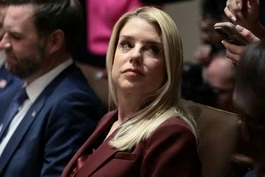
NewAfter Bondi's ouster, who could be next?
Video has Closed Captions
After Bondi's ouster, who could be the next official fired by Trump? (6m 46s)
 New
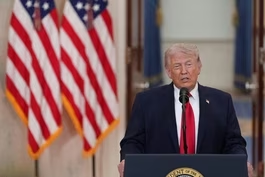
NewTrump's Iran war address leaves questions unanswered
Video has Closed Captions
Trump says Iran war wrapping up, but address leaves more questions than answers (16m 10s)
Providing Support for PBS.org
Learn Moreabout PBS online sponsorship
- News and Public Affairs

Top journalists deliver compelling original analysis of the hour's headlines.

- News and Public Affairs

FRONTLINE is investigative journalism that questions, explains and changes our world.












Support for PBS provided by:
Major funding for “Washington Week with The Atlantic” is provided by Consumer Cellular, Otsuka, Kaiser Permanente, the Yuen Foundation, and the Corporation for Public Broadcasting.