
Meta, YouTube found liable in landmark youth addiction case
Clip: 3/25/2026 | 7m 38sVideo has Closed Captions
Jury finds Meta and YouTube liable in landmark youth addiction case
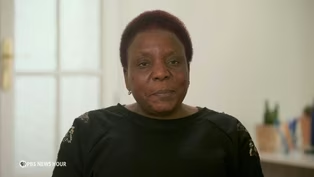
In a span of less than 24 hours, juries have returned historic verdicts in a pair of high-profile lawsuits that accuse big tech companies of putting children and teens in harm's way on their social media platforms. John Yang discussed more with Jacob Ward of The Rip Current.
Problems playing video? | Closed Captioning Feedback
Problems playing video? | Closed Captioning Feedback
Major corporate funding for the PBS News Hour is provided by BDO, BNSF, Consumer Cellular, American Cruise Lines, and Raymond James. Funding for the PBS NewsHour Weekend is provided by...
Support provided by:

Meta, YouTube found liable in landmark youth addiction case
Clip: 3/25/2026 | 7m 38sVideo has Closed Captions
In a span of less than 24 hours, juries have returned historic verdicts in a pair of high-profile lawsuits that accuse big tech companies of putting children and teens in harm's way on their social media platforms. John Yang discussed more with Jacob Ward of The Rip Current.
Problems playing video? | Closed Captioning Feedback
How to Watch PBS News Hour
PBS News Hour is available to stream on pbs.org and the free PBS App, available on iPhone, Apple TV, Android TV, Android smartphones, Amazon Fire TV, Amazon Fire Tablet, Roku, Samsung Smart TV, and Vizio.
Providing Support for PBS.org
Learn Moreabout PBS online sponsorshipJOHN YANG: In a span of less than 24 hours, juries returned historic verdicts on a pair of high-profile lawsuits accusing big tech companies of putting children and teens in harm's way on their social media platforms.
Today, in California, a jury found YouTube and Meta, the parent company of Instagram and Facebook, liable for designing their platforms to be addictive for children and teens, despite knowing it could harm their mental health.
All told, the companies would pay $6 million in damages.
And, yesterday, in New Mexico, a jury ordered Meta to pay $375 million after it said the social media giant concealed what it knew about child sexual exploitation on its platforms.
Jacob Ward is a tech writer.
He is also host of the podcast and newsletter Rip Current.
Jake, you noted that Meta has now been found liable under two different legal theories of this case.
What does that mean?
What implications does that have?
JACOB WARD, Founder, The Rip Current: So we're looking here first at New Mexico, which returned its verdict yesterday.
And that case is about sexual exploitation as made possible by the platform.
And, as a result, under a sort of unfair practices statute, that's basically saying that the platform facilitated something dangerous.
That's very different from what we saw in Los Angeles.
And I would argue the Los Angeles verdict is the much, much bigger one when it comes to the precedent it sets, because what that is saying is that it is the design of the platform, not the stuff we post on it, not even the way the algorithm moves content around.
It is the way that like buttons and the way that people are bucketed together by interest.
There's some stuff in the design of it, the Meta jury -- sorry -- the jury in Los Angeles determined.
And that is an enormous deal.
I mean, until now, John, we've really lived in a country where people have always just assumed, your choices are your own.
We tend to blame people for addiction and blame people for obesity.
But what this jury is saying is that they're looking at a bigger system of basically architecture, a kind of choice design system built by these two companies.
And they're saying, this has had a harmful effect on kids, is addicting them, and we won't stand for it any longer.
JOHN YANG: In the California case, some parents spoke after the verdict.
Let's listen to one of them.
JULIANNA ARNOLD, Founding Member, Parents Rise!
: Being in that courtroom and hearing those answers from the jury, it's really validated, but a complete validation of what we've been screaming on the top of roofs about for years.
And, for parents, we now know that they were manipulating our children for profits while we were watching and trying to keep our families safe.
They are the predators.
JOHN YANG: The jury in that case awarded $6 million in compensatory punitive damages, in New Mexico, $375 million.
How much does that really affect these big tech companies?
JACOB WARD: Well, it feels like a very small amount of money, $6 million compared to Meta, worth a trillion dollars, Alphabet worth way more than that.
But you got to think about all of the other cases that this sets the tone for.
This is setting essentially a per plaintiff kind of price in this case.
And so you have 350 family cases behind this.
Multiply $6 million times that, and you're well over a billion dollars.
You get then the 250 school district cases that come after that.
That's thousands of kids in each school district.
And suddenly you're looking at very, very big numbers very fast.
Also, I would point out just a few days ago, Meta's insurers sued and won to no longer have to insure them against the judgment in this case.
And so that is another -- there's basically no cap suddenly on the amount they could be hit with.
And I would also just point out here, John, Meta gets a lot of the headlines here and they were determined by this jury in L.A.
to be 70 percent of the responsibility.
But the other 30 percent was handed to YouTube, which has never been held to this kind of standard before.
And the fact that they are now grouped together with this other social media platform could change that platform forever.
So this really has the capacity not just to hit these companies with enormous fines, but also to change the way they do business.
And parents like the one we just heard there are no longer just shrugging and saying, geez, it just feels like something's wrong, but I can't name it.
Now there is a name for it, a legal theory for it.
And suddenly there's a way for lots and lots and lots of people to sue like they'd never been able to before.
JOHN YANG: Big numbers adding up, you said.
But the prosecutors in New Mexico were asking for $2 billion.
The jury only gave them $375 million.
What do you make of that?
JACOB WARD: Well, it's this thing where the per-kid price was max -- the statutory maximum was $5,000 per user, right, per teenager in this case.
And so they brought it down to $1,800 per.
So, again, that's -- you're in a state of,what, 2.1 million people.
But you got to remember, there are state cases coming up that involve Florida, 22 million people, New York, 19 million people.
Now you're talking -- I did the math the other day on it.
If you look at all of the cases that are coming down the pipeline and you use that $1,800-per-teenager judgment, you're looking at $40 billion alone.
And that's just the cases that have been filed.
You can imagine that, as of today, there are armies of lawyers who are going to start getting -- going on their own cases here.
And so I think that this is going to be an enormous problem for these companies.
And it's why, of course, they're going to appeal like crazy here, John.
JOHN YANG: Appeal.
The Meta released a statement today.
They said they -- quote -- "respectfully disagreed" with both verdicts and that they would appeal in New Mexico and were evaluating their legal options in California.
What was the company's defense?
What do they say to these allegations that their platforms are causing harm?
JACOB WARD: Well, they have always argued that the misbehavior is not their fault when it comes to what happens on the platform.
And they have -- they tried in the Los Angeles case to say that this plaintiff, this kid had all of these difficulties.
And she did.
She had a whole host of problems in the home and a history of some mental health issues.
But what really has now happened is, we're seeing, instead of juries say, oh, well, it's not that they caused that, it's that they managed to make a vulnerable kid worse.
And that is a very different standard than what Meta has been arguing and YouTube have been arguing all of this time.
And so - - and the big thing here, John, right, is that they have been protected behind both the First Amendment and something called Section 230, which is a big blanket immunity for social media companies, makes them not liable for the crazy stuff that you and I might post there.
That has been the core of the defense, the big legal wall built around them forever.
Suddenly, these two cases, which step around those issues, and get into the question of design and behavior modification by design, suddenly, we're in a very new landscape that I think these companies are going to have a very difficult time arguing against.
JOHN YANG: Tech journalist Jacob Ward, thank you very much.
 New
NewA Brief But Spectacular take on empowering 'soccer grannies'
Video has Closed Captions
A Brief But Spectacular take on empowering 'soccer grannies' (2m 21s)
 New
NewHow Australia's social media ban is impacting teens
Video has Closed Captions
How Australia's pioneering social media ban is impacting teens (8m 9s)
 New
NewIran rejects Trump's ceasefire terms and issues own demands
Video has Closed Captions
Iran rejects Trump's ceasefire terms and issues own demands as war continues (4m 5s)
 New
NewLebanese emergency workers risk lives to aid civilians
Video has Closed Captions
Lebanese emergency workers risk lives to aid civilians during ongoing Israeli attacks (5m 49s)
 New
NewMideast experts on state of Iran war and efforts to end it
Video has Closed Captions
Mideast experts analyze state of Iran war and diplomatic efforts to end it (7m 23s)
 New
NewNews Wrap: Democrat wins election in Mar-a-Lago's district
Video has Closed Captions
News Wrap: Democrat wins Florida state House seat in district home to Mar-a-Lago (4m 23s)
 New
NewWhere talks to fund DHS stand as shutdown drags on
Video has Closed Captions
Where talks to fund DHS stand as shutdown reaches 40 days (3m 42s)
Providing Support for PBS.org
Learn Moreabout PBS online sponsorship
- News and Public Affairs

FRONTLINE is investigative journalism that questions, explains and changes our world.

- News and Public Affairs

Amanpour and Company features conversations with leaders and decision makers.












Support for PBS provided by:
Major corporate funding for the PBS News Hour is provided by BDO, BNSF, Consumer Cellular, American Cruise Lines, and Raymond James. Funding for the PBS NewsHour Weekend is provided by...