
June 5, 2026
6/5/2026 | 55m 36sVideo has Closed Captions
Joseph Aoun; Kristen Holmes; Eddie Glaude Jr.; Craig Fehrman
Lebanese President Joseph Aoun sits down for an exclusive interview. He discusses the conflict with Israel and the future of his country. Reporter Kristen Holmes on the latest from the White House. Professor Eddie Glaude Jr. discusses celebrating America's 250th at a time of division. Craig Fehrman offers a fresh look at the expedition of Lewis and Clark in his new book.
Problems playing video? | Closed Captioning Feedback
Problems playing video? | Closed Captioning Feedback
June 5, 2026
6/5/2026 | 55m 36sVideo has Closed Captions
Lebanese President Joseph Aoun sits down for an exclusive interview. He discusses the conflict with Israel and the future of his country. Reporter Kristen Holmes on the latest from the White House. Professor Eddie Glaude Jr. discusses celebrating America's 250th at a time of division. Craig Fehrman offers a fresh look at the expedition of Lewis and Clark in his new book.
Problems playing video? | Closed Captioning Feedback
How to Watch Amanpour and Company
Amanpour and Company is available to stream on pbs.org and the free PBS App, available on iPhone, Apple TV, Android TV, Android smartphones, Amazon Fire TV, Amazon Fire Tablet, Roku, Samsung Smart TV, LG TV, and Vizio.

Watch Amanpour and Company on PBS
PBS and WNET, in collaboration with CNN, launched Amanpour and Company in September 2018. The series features wide-ranging, in-depth conversations with global thought leaders and cultural influencers on issues impacting the world each day, from politics, business, technology and arts, to science and sports.Providing Support for PBS.org
Learn Moreabout PBS online sponsorshipHello, everyone, and welcome to Amanpour & Co.
Here's what's coming up.
My duty and I'm committed to save the country.
I'll do whatever it takes.
Christiane sits down for an exclusive interview with Lebanese President Joseph Aoun, forced to navigate between Israel, Hezbollah, Iran and the United States.
Then, America imagines itself at once as a beacon of freedom and as a white republic.
And you can't hold those two commitments together without contradiction.
As America approaches its 250th birthday, just what sort of nation is it celebrating?
I speak with historian Eddie Glaude Jr.
and I don't think there's a better adventure story in American history than Lewis and Clark.
This vast enterprise.
Walter Isaacson speaks with author Craig Fehrman about his fresh take on the iconic Lewis and Clark expedition.
- Amanpour & Co.
is made possible by the committed to bridging cultural differences in our communities.
and by contributions to your PBS station from viewers like you.
Thank you.
- Welcome to the program, everyone.
I'm Bianna Golodryga, New York, sitting in for Christiane Amanpour.
In Lebanon, a US-mediated ceasefire shows little sign of holding.
Four people were killed in Israeli strikes on southern Lebanon on Friday, according to the state news agency, while Hezbollah says that it continues to target Israeli troops near the border.
The ceasefire was announced Wednesday in Washington, contingent on a complete cessation of Hezbollah fire and the evacuation of all Hezbollah operatives from southern Lebanon.
On Thursday, Hezbollah rejected those terms.
Today, Lebanon's parliament speaker Nabi Bari, a Hezbollah ally, says that he will support a withdrawal if Israel withdraws at the same time.
Complicating things further, Iran says a full ceasefire in Lebanon is a necessary condition for any peace deal with Washington.
Today, Christian met with Lebanese President Joseph Aoun in Beirut for an exclusive interview.
Aoun rarely speaks with foreign media, but is taking this step to send a message to the world about the fate of his nation.
President Aoun, thank you so much for being with us.
Welcome to the program.
Thank you for coming.
Please.
This is a very crucial moment for your country, for you, in fact, for the region.
The latest ceasefire has been announced late this week, and yet, as we speak, the Israeli Prime Minister says Hezbollah has not agreed, so he will not recommend a ceasefire to his cabinet.
Therefore, it doesn't exist, according to Israel, at this moment.
And in any event, they're always being violated by both sides.
Do you think this is going to be any different?
It's difficult, I know.
The only way, for me, the only way to end this conflict is through negotiation.
The Israelis, Prime Minister Netanyahu and Hezbollah, they have to understand that they are waging a futile war.
The strategy that they are following is short-sighted, counterproductive and believe me it will never lead to the desired outcome.
War, it's a bloody negotiation, whereas negotiation is a bloodless war.
We have a great opportunity to end the state of hostility between Lebanon and Israel.
We have a great opportunity for both the Lebanese and the Israeli people to live in safety and security.
They are both, I think, fed up with war since 1948.
This is a huge opportunity.
So both have to choose, war or negotiation or diplomacy.
Believe me, diplomacy is the best way forward.
As a military man, I understand, I've lived the atrocities and the hardship of the war.
The best way is through diplomacy.
Wars normally, historically speaking, ends either way.
There is a victor and a vanquished or it's renegotiation.
Both sides will never be able to achieve their objective.
Why do you say that?
Because clearly Israel believes, and it is the superior power conventionally speaking, that it can keep pushing Hezbollah back.
As long as Hezbollah keeps firing into Israel, it's the whole mowing the lawn strategy that they have.
And you're right, every time there's a ceasefire there are violations, there have been these incursions, these wars periodically over the last, you know, at least since 2000 with Hezbollah in Israel.
And it keeps coming back to the same place.
Hezbollah keeps doing the provocations, keeps doing Iran's work.
So maybe this is what suits them.
Maybe you will always be in the middle of this.
You're absolutely right, that's what they think, but that's what I said, that their strategy is short-sighted.
They've tried it before in 2000, in 2006, in 2023, 2024, and in 2026 now.
But honestly, they can invade the whole country.
They can flatten the whole country, but they will never be able to achieve their objective.
Because dealing with non-state actors is different than dealing with conventional forces.
When you have two conventional forces, the one that possesses more capabilities will defeat the other side.
So Hezbollah is not an idea, it's not an objective that you can see, it's not a geographic objective, it's war amongst the people, as the former British General termed it, Rupert Smith in his book, The Utility of Force, it's war amongst people.
The battlefield is the people, they are hiding among the people.
So how you measure your success?
You count bodies?
They've tried it in Gaza.
Hamas still exists or not?
It does.
You have, take for example the FARC in Colombia, take for example the IRA.
When dealing with non-state actors, it requires different strategy, a strategy of multiple lines of effort.
The kinetic part of it is 10%.
The non-kinetic part, social, political and economic, is 90%.
Hezbollah can only be dealt with domestically.
It's the job of the state of the government.
But on one condition that we remove the root causes of the existence of its weapons.
Which is?
Which is Israeli withdrawal, stopping and the state of hostility with Israel.
OK, so that all sounds great and conventional.
It just doesn't work.
And it hasn't worked for decades now, because there's so many other actors.
Let's just take Hezbollah, non-state actor, backed by Iran, a state.
You go into ceasefire agreements as the head of state with Israel.
But the non-state actor is not party to this.
In fact, the latest comments from Hezbollah to your government and to you basically says that this is a farce.
The talks between your government and Israel, they call a farce.
They say that they're not bound by this and they don't believe in this right now.
So do you have any reason to believe, because you don't negotiate directly with Hezbollah, that they can be persuaded?
What are the steps to make this happen?
Hopefully, and eventually, they'll be persuaded but the cost will be high, unfortunately.
I will try.
Actually, nothing is impossible and I will keep pushing for it.
At the end of the day, I have two choices, as I said, either to sit idle doing nothing or trying to negotiate and to reason with them.
Definitely, I don't maintain direct contact with them but I maintain contact with Speaker Burry, who is also in line with the negotiation, who also wants to end this war, who is also fed up with this war, seeing the destruction of the South, and he wants to end this war.
So I'm counting on him.
Definitely, IRGC has a major influence on Hezbollah and they have to remember what they said yesterday.
I totally reject their statement.
Who said?
IRGC, the Iranian Revolutionary Guard Corps.
They don't approve this agreement.
It's not your country, it's our country.
It's our obligation.
It's not your job to interfere in our country.
I reject the statement totally.
Because our people are being killed.
Our house is being destroyed.
They are using Lebanon as a bargaining chip in their negotiation with the United States.
It's unacceptable.
And here also, Hezbollah must understand that.
Hezbollah must understand that there is no other way but to sit and talk.
No other way to solve this problem and to save what's left, except through negotiation and diplomacy.
OK, so, as I said... Definitely I have no influence over Iran.
I don't have any influence over Iran.
And when you tell them that, when you tell the Iranian government what you just said to me, because I know you've spoken with them, what do they say?
Yeah, so I spoke, I met with the Iranian president twice, with the foreign minister a couple of times, and most of our discussion was based on the relationship, based on mutual respect, non-interference into internal affairs, and it should be a state-to-state relationship, not from state to only one part of the country.
But they don't necessarily agree with what you want to do, which is to stop Hezbollah and to disarm them and make them the political force or party that they are.
As I said, they are using Lebanon and Hezbollah mainly as a bargaining chip in their negotiation with the United States.
So, let's get back to Hezbollah then.
If Iran is not willing to do what you want.
And you tried to expel the Iranian representative here, not a full ambassador but nonetheless.
And he didn't go.
He's still living here.
Is he operating?
No, no, no.
He's a normal resident with no diplomatic capacity whatsoever.
So the Hezbollah leader here, Naeem Qasem, has warned you all against confronting them.
As I said, he also said these talks with Israel under US auspices in the United States are a farce.
And he also basically said, quote, "The people have the right to take to the streets and bring down the government in confronting the American-Israeli project."
Whoa, that is a direct challenge to everything you're just saying right now.
I don't want to comment on that, but let me tell you that the majority of the Lebanese people are fed up with wars.
I'm seeing many of them across the board, Christian, Sunni, Jews, even Shiite.
They said, "We are with you.
We are fed up.
We need you.
We need your help."
To you.
Yes, yes, exactly.
I met many people from the South and the same conversation took place.
We are fed up.
Since 1969, we want to live in peace and they deserve to live in peace and in dignity.
They deserve not seeing their homes being destroyed every five to ten years.
They are fed up and they are really counting on me.
And it's my obligation towards my people.
It's the Lebanese people that are not Qasim Naim Qasim people.
So they're Lebanese, they're not Naim Qasim Hezbollah's people.
Exactly.
Can I ask you just, because I see you have some images there and we see the images on our television screens day in and day out, neighbourhoods being flattened, medics being targeted and killed.
This is by the Israeli counter offensive or offensive, however you want to call it, civilians, at least 3,500 civilians in this latest round.
You've got a million people who've been displaced.
What is the toll on your own people and what can you do about it?
Since March 2nd, more than 3,500 people in Lebanon killed.
On average, 13 children have been killed by Israelis every day since the escalation began.
More than 10,000 people have been injured or wounded.
More than 1 million people have been displaced from their homes.
20% of the population.
Can you imagine that?
20% of Lebanon's population.
Entire families have been wiped out.
This is one family, the Fa'oor family.
This is the Nimr family, Hamdan family.
These are the Red Cross.
This is the funeral of 13 members of the state security.
They were killed in one airstrike.
Exactly.
And this is a three-month-old baby.
Is this imminent threat?
Well, we see these kind of pictures coming out of Gaza, coming out of the occupied West Bank.
We hear the Israeli defence authorities and others saying, "We are going to turn this part of Lebanon into Gaza."
I mean, it's said, that is what they say.
Again, here we are in the presidential palace, one of the areas of Beirut that have been struck.
You can feel it here in this palace, you told me, when the bombings happen.
You can see it from your balcony here.
Are you powerless?
- As I said, nothing is impossible.
My duty, my duty and I'm committed to save the country.
I'll do whatever it takes.
When there is a will, there is always a way.
I'm not saying that it's very easy, it's easy.
Can you imagine or have you ever seen a 40 years conflict or 50 years conflict end in one day or overnight?
So, but we have to struggle in order to save what's left of the country.
and again, allow me to repeat that, they can flatten the whole country, they can destroy the whole country, they can invade the whole country, but they will never be able to achieve their objective.
On the contrary, Hezbollah can drag the country into a protracted war, but they will never be able to achieve their objective as well.
So it's about time for both sides to sit and talk.
And we'll have more of that interview on Monday.
And now to U.S.
politics in a week that gave President Trump a win in the Senate, a loss in court, and a birthday party to plan.
Lawmakers passed a 70 billion dollar bill funding his immigration crackdown, but it nearly collapsed over a 1.8 billion dollar Justice Department anti-weaponization fund that critics call a slush fund for his allies.
Meanwhile a judge ordered Trump's name stripped from the Kennedy Center as the White House pivots to the nation's 250th birthday, where Trump now plans to headline the festivities himself.
Joining me now for more on all of this is senior White House correspondent Kristen Holmes.
Kristen, it's good to see you.
So yes, finally, that bill, that immigration bill that the president has long been pushing for, that Republicans have long been pushing for, finally crossed the finish line.
But it was a hard-fought battle here that didn't necessarily need to be as difficult for the Republicans as the president and his administration seemed to make it at the last minute.
Explain why.
Well look, we're into an entirely different period now, Biana, in this administration and in this term.
You have an ongoing war in Iran.
You have this $1.8 billion weaponization fund that even Republicans have given immense blowback to.
You have an administration that is deeply unpopular, a president who's deeply unpopular, and midterms right around the corner.
And Republicans are trying to look out for themselves.
What we saw at the beginning of his term was Republicans kind of blindly following President Trump without a lot - without a lot of pushback.
We have now entered into a completely different part of this term.
Now, President Trump is going to come out of this with a win.
This is $70 billion.
It's going to go towards paying - funding ICE and Border Patrol through the end of President Trump's term, essentially making them immune from any other kind of government shutdown that might occur.
They also got through this without having anyone put in writing that there was going to be no or they were going to kill that $1.8 billion weaponization fund that people don't like.
But that's part of the hiccup here, because you had Republicans voting against that fund, trying to bring that amendment up.
And it really goes to show you that they're in a very different place.
And remember, there's still a lot that they want to get done before those midterms end, before January.
But talking to Republicans up on the Hill, it doesn't seem likely they're going to be able to actually push anything else through, many of them speculating this is the last piece of major legislation Trump's going to get through before the midterms.
Yeah, the president just can't seem to get this weaponization fund behind him, continuing to say that it was justified invalid and also causing a massive headache for Republicans by announcing his acting DNI pick, someone with no national intelligence expertise, his mortgage adviser, Bill Pulte.
Let me ask you about the upcoming 250th celebration, because it seems not even that can go without controversy from the White House.
The president has been planning for big festivities and a lot of these entertainers pulling out last minute when they say that this is coming across now to them as something that's politicized and that's not how it was initially sold to them and detailed to them.
Just give us a sense of where things stand now.
Well, there are two different groups that are essentially battling right now over celebrating America's 250th anniversary.
One is the bipartisan commission called America 250, and the other is the Trump-aligned group called Freedom 250.
And Freedom 250 has made clear that they are backing Trump, that they are a political organization, and that has rubbed a lot of people the wrong way.
and this concert, that's the first thing you're talking about, which has now turned into a rally that President Trump seems to be one of the only guests at, that was just part of what we're seeing as a consequence of President Trump's incredibly divisive politics.
it is very clear to everybody across the country that President Trump is probably one of the most polarizing figures that we've ever had leading the country, but now it's even more clear as you're seeing even these things that are supposed to be celebrations of America, 250th anniversary, that is even becoming political now.
Kristen Holmes reporting live from the White House for us.
Thank you.
Good to see you.
Well, the United States is now just a month away from, as we noted, its 250th anniversary on July 4th, and White House plans for the celebration are still in flux.
After a number of star performers pulled out of a planned concert series, President Trump says he's going to be taking center stage at a D.C.
rally on June 24th.
This is not the first time a big anniversary highlighted the country's contradictions.
In a new book, America, USA, scholar Eddie Glaude Jr.
argues that these major milestones have never been simple.
Instead, they are moments to reckon with painful truths, particularly when it comes to race.
Glaude is a professor at Princeton University.
Earlier this week, we spoke about his views on America at 250.
Eddie Glad, welcome to the program.
Congratulations on the book and It's Coming as America is set to turn 250 this July 4th, a celebration that's already being marked by controversy.
As the date approaches, you describe a current malaise in this country.
What do you say is driving that malaise?
Well, first of all, it's just great to be in conversation with you.
I think at the heart of it is this kind of divided soul that has defined the country since its founding.
You know, W.E.B.
Du Bois wrote the classic book, The Souls of Black Folk, in 1903, and he introduced the concept of double consciousness, that black folks see themselves through the eyes of those who despise them.
But what I argue in America USA is that that sense of double consciousness is actually a consequence of the double consciousness of the nation, that America imagines itself at once as a beacon of freedom, and as a white republic.
And you can't hold those two commitments together without contradiction, or without depositing a kind of madness at the heart of the country.
So what we're experiencing in this moment in this 250th year, is that division, that doubleness that has haunted the country since its beginnings.
Yeah, and I want to stay with this America's divided soul because as you note, you quote W.E.B.
Du Bois in the book, Baldwin as well, this sort of self-sense of two-ness in the nation.
You describe America as both a country founded on the idea to create equal at the same time, as you just said, a white republic.
Frederick Douglass, though, who you also quote, found inspiration in the founding, not only in its hypocrisy, can both then be true?
Well, the principles aren't reducible to our practice.
I think it's important for us to understand that the insights of the Declaration, the ideals of democracy themselves can be tools, can be used in order to build the kind of society that we want to build.
But we have to understand that there are those among us, like Vice President J.D.
Vance, who attacks the idea that America is a creedal nation because he wants to root the country in blood and soil.
And so part of what we have to do is to give voice, like Douglas did, right, to the power of those principles and ideals.
But he does so in the face of this ongoing pressure, this ongoing insistence that we are a white nation.
So he says in 1875, on the eve of the centennial celebration, he says, "We are faced with the apostles of forgetfulness," those people who believe that slavery didn't matter and so who also believe that the country must be a white republic.
So it comes back and forth, it's this cycle.
Yeah, and you mentioned 1875, much of the book is focused on earlier anniversaries, the centennial in 1876, obviously 1926, the bicentennial in 1976.
You write that these celebrations, quote, "are often moments to turn a blind eye to the evils of the past and the present, to suppress the fact of America's divided soul."
So what are those earlier anniversaries and celebrations tell us about America, not just from its past, but its present and its future?
Yeah, so we're in this 250th, and you know, you see the executive order from President Trump around restoring truth and sanity to American history.
You hear Vice President Vance invoking blood and soil as the basis of U.S.
sovereignty and cohesion.
Well, what I want to suggest is that these moments, this attempt to kind of redact American history has echoes in the past.
And so, 1876, this is after the carnage of the Civil War, 600,000 left dead on land and sea, and the country disremembers.
It tells a story of itself that's rooted in American promise and its business acumen, but the horrors of slavery left aside.
Frederick Douglass, invited to be on the dais, initially denied entree to the exposition because he's a black man.
Philadelphia police officer couldn't believe that an N-word could but he couldn't speak.
1926.
1926 is the decade of the Klan.
It was initially approved that the Klan could hold its annual convocation, its annual convention on the grounds of the convention exposition that was celebrating the nation.
So they were going to celebrate the flag and burn a cross at the same time.
1976, the conflict, the skepticism coming out of Vietnam, Watergate, Black Power Movement, Women's Liberation Movement.
And then you get the anti-busing movement with that iconic image in Boston of a young white teenager attacking a black Yale-trained lawyer with the American flag.
In each of these milestone anniversaries, the country has to tell a story of itself, of its founding, and its contradictions are in full view.
And here we are in the 250th, and the same thing is happening.
History might not repeat itself, but as someone once said, maybe Twain, it damn sure rhymes.
Yeah, that was a famous line from Twain.
Isn't there a version of this story, though, that's about hard-won progress along the way, not just a divided soul that never heals?
So many point to, yes, the challenges, the setbacks, but also the victories, and most recently, the election of the first black president.
Yeah, we like to tell ourselves that story, that we're always already on the road to a more perfect union.
And in some ways, it works as a kind of moral holiday.
It allows us to forgive ourselves of our sins.
It, it deepens our investment in the promise of America.
And no one is denying the fact of progress.
But what we do know is this, is that at every moment, when there's progress, there's a reassertion of the idea that the country belongs only to certain folks.
Just think about it.
Six years ago, we were in the midst of a racial reckoning, grappling with the fact that the nation witnessed George Floyd's murder.
And now look at where we are now.
The Supreme Court gutting the Voting Rights Act.
We see the Supreme Court allowing Alabama to use old maps that were determined by that same court to be racially discriminatory.
We see the DEI, we see the assault on all sorts of the foundations of American democracy.
So we appeal to progress in order to absolve ourselves of our sins.
And what we need to do is to confront who we are so that we can actually imagine a better way of being together as Americans.
What would a meaningful 250th celebration look like to you?
You know, what I do know is this.
What we're going to experience come July 4th is they're going to tell a story about the country that denies our past.
They're going to celebrate this myth and illusion.
I think what a meaningful celebration of July 4th would involve is a) a rejection of that storybook version that celebrates what I take to be a white nationalist project and instead a full expression, a full-throated expression of the vast diversity of this nation.
I think we need to counter the story that will be told by really exposing and celebrating who we really are, and that is to bring the full force of the rich tapestry, the mosaic that is this country.
And if we do that, we will provide, I think, a more meaningful and powerful counter to those who are trying to hijack the nation's promise.
And at the top, I mentioned that this upcoming anniversary is already being marked by controversy.
And one of the reasons is because there are two national groups overseeing the celebration of America's 250th.
There's America 250.
That is a bipartisan group that was established by Congress back in 2016.
And then there's Freedom 250.
It is being run by the Trump administration.
And that is what's considered the controversial angle here.
A major concert in Washington seems to be falling apart.
Marquee performers have been backing out because they say they view this concert now as a partisan event, and that is not what they signed up for.
Here's how President Trump announced his vision for the anniversary year in a kickoff back in Iowa on July 3 in 2025.
This incredible national resurgence is happening just in time for one of the biggest events in the history of our country.
Exactly one year from tomorrow, we will celebrate the 250th anniversary of America's founding with a birthday party, the likes of which you have never seen before.
So what is the controversy, Eddie, around Trump's version of Freedom 250?
What does that say to you about how they are likely, his administration and the president, are likely to mark this anniversary?
Well, I think there's this ongoing effort to yoke the story of the country to Donald Trump's ideology, to his presidency.
I think these folk want to make the country's birthday indistinguishable from Donald Trump's ascendance and presidency.
So, he thinks we've entered the golden age of America with his presidency.
And he's going to, in so many ways, try to make that clear through ritual, through celebration and the like.
So, we're going to have the Great American Fair, which has turned out to be a disaster.
We're going to have a UFC fight.
Can you imagine a UFC fight where manly men are going to fight and bludgeon each other?
We're going to see all of this stuff, really, that's kind of kitschy that will celebrate that vision of the country, that version of the country.
And I think, at the end of the day, America, the American people must say no to it all.
We must reject it, because Donald Trump is really trying to hijack the very idea of America.
And some are actually falling for that carnival barker as he tries to do so.
Some may, in just looking at the poll numbers, it appears there's data to back up, say that the president has squandered some of the historic support that he was able to garner, in particular from men in 2025, non-white men, African-American male voters, Hispanic voters.
Looking back now, what was it, in your view, that appealed to them at that point during the campaign, because he was a known quantity to the country?
Well, you know, I think it's a combination of things.
I've said that the divided soul of the nation has haunted this place.
Many people were responding to the idea of a woman, a woman of color, as the potential president of the United States.
I think there are those who are genuinely dissatisfied with the country.
They are losing ground.
They don't feel any sense of possibility.
There's a deep sense of melancholia and loneliness that soaks the that was an aspect of it.
Donald Trump was also lying through his teeth.
We have to say that explicitly.
He was lying through his teeth about his own populist commitments as he's now revealed over and over again as the billionaires and the oligarchs rob the nation's coffers right in front of our eyes.
And the corruption overwhelms any notion of good governance.
So I think people were sold a bill of goods, but at the heart of it, I think, is this toxic brew of greed, selfishness, and hatred.
That brew has soured the belly of the country.
And unless we name it for what it is, we can't get beyond it, it seems to me.
Black voters in particular over the last most recent, or I would even say 50, 60 years, have for the most part supported Democratic candidates.
And I'm wondering, as you reflect back through history, when you look at some of those black leaders, W.E.B.
Du Bois, James Baldwin, Frederick Douglass, would they feel that the Democratic Party today is serving the needs as effectively as it can and should for the country, but in particular for African Americans.
You know, I can't speak for those giants.
I can only speak from the lessons I've learned from them.
And what we can say, I think, with a sense of certainty is that the political system of the United States has failed us.
Here we are, given all of their sacrifices, and we find ourselves in the midst of a second redemption, a second lost cause.
Here we are, in this moment, whether it's the Democratic Party or the Republican Party, where we find ourselves as a community is that folk are trying to disenfranchise us, diminish our power, deny us access to schools, deny us access to wealth, really in so many ways reduce us to playing minor bit parts in the country's story.
So it seems to me the evidence is clear that it's not just simply the Democratic Party that has failed us in so many ways, the nation has.
Each chapter of your book, before each chapter, Eddie, there is a musical notation, an original score that was written by composer Joel Thompson as a counterpoint to the text that you write.
Let's listen to an excerpt.
[playing piano] It's a beautiful thing to include in the book, and I'm just wondering, what does the music say that your words don't, and why include it?
You know, it's an homage to Du Bois, of course, "Souls of Black Folk," which begins every chapter with bars of music of slave spirituals.
For me, it captures this vexing relationship to the country.
It begins with a blue sonority and ends with this prayer, but the prayer ends with ambivalence as well.
So musically, Joel Thompson has offered a kind of musical score to the argument of the book, this incredibly complicated journey that complicates the very way in which we orient ourselves to this nation.
How do we love people on the ground, close to the ground, in light of the hatreds that seem to overwhelm?
And so I am so grateful that Joel responded, and the argument in the music is just overwhelming to me.
So I hope everyone has an opportunity to listen to the audiobook because it's just beautiful.
It's really emblematic of the power of music throughout our history.
Eddie Glaude, always great to have you on.
Thank you so much for taking the time.
The book, "America, USA, How Race Shadows the Nation's Anniversaries."
Good to see you.
Thank you.
Good to see you.
Thank you so much.
Now astronauts in canoes, that's how the legendary exploring team of Lewis and Clark has been described.
The pair ventured into American territories not yet mapped to provide details about the culture and geography of the land as the United States expanded.
While the expedition is one of the country's most renowned tales, in a new book, author Craig Fehrman strives to retell the narrative from a previously obscured perspective.
He joins Walter Isaacson to discuss the new information uncovered from centuries-old archives.
Thank you, Bianna, and Craig Fehrman.
Welcome to the show.
Hey, thanks for having me.
So you got this new book, "This Vast Enterprise," which is about the Lewis and Clark expedition.
Let me start by just asking, why did you decide to write this?
Well, I wanted to write an adventure story, and I don't think there's a better adventure story in American history than Lewis & Clark.
Of course, the flip side of this is that there have been a lot of good books written about them.
So what I did at the start was I went back to their journals.
They left more than a million words behind, which, as a historian, you couldn't ask for better primary sources than that.
And when I read those journals, I kept noticing these human details that I felt like other accounts had overlooked, human details about Lewis & Clark, but also about Sacagawea or York, the black man who Clark enslaved and who was there for every one of those 8,000 miles they traveled.
And so I tried to write a book that told the adventure story, but also captured the humanity along the way.
And the journals were really the best resource I had for that, although I did find some new stuff in the archives too.
You talk about all the characters and I love the way you structure the book, which is each chapter tends to be the viewpoint of a particular character, as opposed to just doing it through Lewis & Clark.
Why'd you do that?
Well, I think that contributed to wanting to tell the story in a new way.
It wasn't just about finding new details, it was telling the story differently, because there have been great biographies written about Meriwether Lewis, but as writers, we can sort of choose who gets biographical treatment.
And so, although I wanted you to feel like you were in the canoe with Lewis and seeing things from his point of view, I also wanted you to feel like you were in the canoe with John Ordway, who was a working class soldier who did a lot of the hard work that the captains weren't doing because they had other jobs.
And so it just felt like the best way to make this story work and to make this story feel human was to use that biographical lens, but then move it around.
So we get, you know, Lewis's point of view, but we also get Ordway's or Sacagawea's.
It just made the story feel fresh and more fun to me.
Did you have primary sources or good material on some of these lesser-known characters?
What I had is those journals.
Like I said, a million words there.
So there are a surprising number of those words about York or about some of the Native leaders that Lewis and Clark met with.
It's just a matter of what do you pay attention to.
So one detail that really stood out to me was early on when they were still in St.
Louis before they'd left, Clark just has one sentence where he says York commence sawing with a whip saw.
And that's sort of a throwaway line unless you take the time to really examine it.
What's a whip saw?
Well, that's how you turn logs into planks and planks were really important to them in this time period because winter's closing in, it's snowing, it's sleeting, they have to get roofs on their forts to be able to make it through the winter.
And so they chose York even though a whip saw is a very difficult tool to use.
And from that one detail, you can sort of understand how skilled York was and how he was trying to find his place in this sort of rowdy group of explorers.
So the primary sources were often the ones that have always been there.
It's just reading them differently and noticing all the human beings that are documented by the captains.
- So tell me more about York, because by the end of your account, he's even getting to be a voting member of the expedition, right?
- That's right.
- His arc is both inspiring and heartbreaking in the way that American history sometimes is.
Because from the start, the captains empowered him to do a lot of stuff.
He carried a rifle.
He was the fifth named person in the journals to bring down a buffalo.
And he was also a really good swimmer, which might seem like not that important of a detail.
But a lot of the men on this expedition, even though it was a river mission, could not swim.
So I found a new letter from Clark where Clark talked about how good York was in working the boats.
And that sort of helped me understand that York was one of the essential people when they were facing Whitewater Rapids, especially.
Well, wait, wait, tell me about his background.
We don't quite know, where does he come from?
Is he enslaved?
Yeah.
Yeah.
He was an enslaved person and he was what was called a body servant.
So he grew up alongside Clark and his job was sort of making Clark's life easy and comfortable.
So he would, you know, pack his saddlebags or lay out his clothes, but that was his life before the expedition.
During the expedition, he was able to do those other things, get the rifle, face the rapids, and so he was really able to establish himself, and although the other soldiers didn't like him at first, there's plenty of proof in the journals of that, by the end of the expedition, they had sort of become a team, and they were all realizing that they were working together and doing something great together.
Tell me about that moment where he's allowed to vote on what the expedition's gonna do.
It's such a powerful moment and I think what makes it even more powerful is that I was able to see that there had been previous votes.
That Lewis and Clark as leaders made a choice to really embrace a democratic ethos.
They wanted to empower the men and bring the men close.
So they did that multiple times during the expedition, but York didn't get a say.
It was only on their last winter when they were at the mouth of the Columbia River near the Pacific Ocean.
This time they included York in the vote and so in that arc where he doesn't get a vote but then he does, you can see that he was able to sort of change the perception of him and he was able to make some choices for himself.
The reason I ask about that, maybe I'm over reading this, is that that arc you talk about where he finally gets to vote, he finally gets included in the narrative, that's also the arc of American history around that time, right?
I think that's true.
It would take a while for it to apply to other people beyond just York.
I mean, one thing that's interesting about the expedition is it was sort of a miniature society.
Once they got far away from American society, they had to make their own rules and form their own bonds.
And so in that system, York was able to do more and to be respected more.
Of course, the tragic part of it is that once they make it back to America, York says to Clark, and we know this from one of Clark's letters, York says, "Because of my immense services, I think I've earned my freedom."
Clark denies that request.
And in the end of York's life, unfortunately, it's tragic.
- Why?
- Well, because Clark wouldn't free him.
And then Clark moved to St.
Louis.
Clark got a very important government position that he would hold under five different presidents, where in St.
Louis, he was negotiating treaties and acquiring land.
And so because he and York had this close bond, he made York come with him.
York's wife was still back in Kentucky, where York and Clark had been living previously.
And so York said, "I think I've earned my freedom."
And I went back and checked the math here.
You know, how much did the privates earn on this expedition?
How much would it cost for somebody like York to buy his freedom?
The math checks out.
York was right.
He had earned his freedom, but it was still Clark's decision, and Clark decided not to grant it.
Yeah, but what I don't quite understand, even from reading the part of it, 'cause I kind of like Clark by the end of the book, tell me what was going through Clark's head when he says, "No, I'm not going to free this slave."
Well, I would say I like Clark too, and we don't have to pick just one way to feel about Clark.
We can admire how he took care of his soldiers while feeling, you know, real disdain for how he treated York.
But I think one thing that's interesting about the journals is that there aren't just details about York, there are details about how Clark saw York.
And you can see, you know, Thomas Jefferson in Notes on the State of Virginia would write about how owning a slave would warp the person who owned the slave.
And I feel like Clark's journals are sort of the example that bear out Jefferson's theory, that Clark was very possessive of York, that when York would excel, Clark would get weirdly jealous, even though he was still York's owner.
So I think it's really hard for us from from our vantage to understand the process of slavery and what it did to people on both sides of this toxic equation.
I think Clark was just jealous and didn't want York to have that autonomy, even though York believed he had earned it.
One thing I learned from your book, because I like the history of technology and, you know, economic factors, is that land is really important.
That's a theme of your book.
Explain how that weaves into the book.
Well, it's so important.
And one thing that was fun about those rotating perspectives is I could show how land looked a little bit different to everybody else.
To somebody like Lewis or Clark, land is an imperial object.
They're thinking, "Where's America going to go next?"
But the regular soldiers who were going along, to them, land was just what they didn't have.
They wanted to be farmers.
They wanted to be wealthy.
They didn't come from Lewis and Clark's background.
So when they saw this beautiful land that they were passing, it looked differently.
And of course, the native people who lived there and who loved the land themselves, they saw the land differently as well.
So I was really, by focusing on land, I found all these small moments in the journals that, again, they were always there for people to notice.
It just, it matters what lens you bring to understand it.
- You refer to it, or you say that the perception of this is that there are astronauts in canoes.
A beautiful metaphor, especially now that we're going back to space.
Tell me how that fits.
Well, what's so fun about this is that Lewis and Clark were kind of Artemis II of their time in many ways.
It's not just that they were going somewhere where people didn't know what exactly they were going to find, it's that the whole country was obsessed with this.
And so I tried to really track this closely.
Lewis and Clark were viral news.
And so one of my favorite soldiers that I write about is a guy named John Ordway who lived in New Hampshire.
So I went back and read all the old New Hampshire newspapers to see how often Lewis and Clark were showing up in these newspapers thousands of miles away because John Ordway's family would have been reading those newspapers too.
So in the same way we were all obsessed with Artemis II and looking at those pictures on social media, John Ordway's family and people all around America were tracking this expedition.
At a certain point they kind of went radio silent.
They went on the other side of the moon in the 1804 version, but then they came back and had such a wonderful story to tell.
Let me read something you wrote.
I love this sentence.
You say of Mary Weather Lewis and William Clark, "For Clark it was the sunset that soothed them.
For Lewis it was studying the sunset, extracting information and then using it to build theories and explanations."
Expand on that.
Well, this again is those multiple points of view, right?
Even Lewis and Clark, we sort of think of them as a unit, but they had very different points of view.
So when I was reading their journals, Clark doesn't get enough credit as a writer and a thinker in my opinion.
And he would write about sunsets just in this very beautiful and poetic way.
And so in a Clark chapter, I would have him, you know, noticing and sort of reveling in the natural beauty.
But then when we get to a Lewis chapter, I noticed that Lewis would describe what was happening, but then he would describe, well, why did it happen?
What does the sunset mean?
What can we understand about climate or weather from the sunset?
And I think they just had different minds.
I think Clark would notice natural beauty and it would sort of calm him down and and he would use it to ground himself.
Whereas for Lewis, it would be noticing the natural beauty, but then explaining it.
He, for Lewis, it was really the act of observing and understanding that made him feel peaceful in the world.
And so even though we think of Lewis and Clark almost as one word, this, this amazing team, they were very different men.
And I tried to capture the individual humanity of each person in this book.
Well, as school kids, when we all were fascinated by this expedition, the character we learned about was Sacagawea, the Native American guide.
And we think of her as a sort of a passive guide.
In your book, you portray her as much more of a strategist.
Would the expedition have succeeded as well without her?
I don't think it would have because she was essential at multiple points.
She was helping them gather plants.
Of course, she was helping them notice landmarks.
That's kind of the school version, but she was also a very valuable translator.
And she was somebody that Lewis used when he met the Shoshone for the first time.
And the Shoshone were thinking about not sticking around.
Lewis needed the Shoshone because they had horses who were going to help them get through the Rocky mountains.
And so Lewis said, "Sakajwia, we have a Shoshone woman coming.
It's worth sticking around to see her."
But the other thing I would say is that Sakajwia wasn't just important for the expedition, she was important for the arc of her own life, because she'd had a very difficult life.
One thing I try to do in my book is emphasize that she was a slave.
She was somebody who was owned by a white trader.
She was beaten.
She was impregnated by him, all when she was 13, 14 years old.
It's a really dark story.
But once she met Lewis and Clark, she realized that they protected Native women, that they looked out for Native women.
And so every time she was being a tour guide or finding plants, she was sort of saying to Lewis and Clark, you know, I can help you, can you help me?
And they did help her.
They worked together.
They got her back to the Shoshone.
Sacajawea was able to see the Pacific Ocean too.
- One of the great scenes is her reunion during the trip with her brother.
Came a late, I think it is.
And it's a moving scene in the book.
Let me read what you write.
You say, "Sacagawea began to run, and when she reached him, they embraced.
She began to cry, quietly at first, and then not, until she was sobbing."
Why was she crying?
Well, she was removed from her people in very brutal circumstances.
They were hunting for buffalo on the plains, but the Shoshone did not have muskets the way other nations did.
So raiders from another nation captured her, and some of her family ran away and escaped.
But as a 13, 14 year old, she didn't really know, was my family killed during this raid?
Did my family escape?
All she knew was that she had been kidnapped and enslaved and now had to live hundreds of miles away.
So when she made it back to meet the Shoshone, a small detail in the journals is Lewis and Clark note that the Shoshone people had their hair cut very short, which was a traditional sign of mourning.
So Sacagawea shows up and is excited.
She says, I made it back to my people, but she sees these short haircuts and we can only imagine what must have been going through her mind.
"Who's dead?
Is my family dead?
Did my family die during that raid?"
It's just an overwhelming amount of uncertainty.
So then for her to finally find her brother, but also to see that his hair is cut short, that that means, you know, possibly her parents have died in this.
She just, in that moment, sort of had to confront both wonderful news, "My brother is alive," but also heartbreaking news, "Other people might not be alive."
It's just a lot for anybody to handle.
And, you know, she had amazing strength as a human being.
- Could she have, at that point, left the expedition, returned to her people?
And why didn't she do so?
- I believe she could have, because Lewis and Clark needed those horses so badly.
Without those horses, the expedition never would have made it to the Pacific Ocean.
So I think if her brother had said to Lewis and Clark, "You don't get the horses unless my sister stays with us," I think Lewis and Clark would have made that trade and figured out a way to keep Charbonneau happy later.
But she didn't want that.
Now, why did she not want that?
I don't have an answer for that because she didn't keep the journals, but I can make some inferences.
And I know that the Shoshone people often talked about the ocean.
They would sometimes call it the great stinking lake.
So given Sacagawea's curiosity and resilience that she has showed throughout her life, I wonder if maybe she just wanted to see the ocean, that we should think of her as an explorer too.
- You devote your entire first appendix, I think it is, to a oral history or an interview with Wolfcalf, who was an indigenous teenager who met Lewis.
And you say of the discovery, that's the most important thing I found in my five years of research.
First of all, why?
And then secondly, it's an oral history.
Does it have spin the way written history does?
- That's a great question.
And I think it was important just because my assumption coming into this book was, you know, I would be able to read the journals differently, but I probably wouldn't find new archival stuff.
But I was wrong.
I found a lot of new archival stuff, including about Lewis and Clark.
But what makes this interview so important is that it was an interview with a native person who actually participated in the raid.
And his version in the interview contradicts what Lewis wrote and what other historians have wrote.
Now, in terms of oral history versus written history, they absolutely, you know, any form of human communication is going to have spin in it.
I think that's just, that's how we communicate as humans.
So my job as a historian is to evaluate the different sources and try to figure out what makes the most sense.
I never really thought of it as an opposition.
I thought of it as a conversation where I could sort of bring these sources together and also really good scholarship.
There was a book by a man named John Ewers who worked for decades at the Smithsonian, and he spent a lot of those years interviewing Blackfoot people.
And so I could rely on his sort of ethnographical research, the interview from Wolf Claff, and then Lewis's own journal entries to sort of understand it.
The other thing I would say is that, you know, when my kids are in school, their teachers always say, "Show your work," right?
And I think we as historians should do that too.
So in that appendix you mentioned, I print Wolf Calf's interview, I print Lewis's journal entry, and I invite readers to sort of read these primary sources and come up with their own interpretations because history is a conversation.
So in that appendix, I tried to share the primary documents and say, you know, this is how a book like this gets made.
- In about a month, we're gonna celebrate our 250th anniversary.
Tell me, out of this book, what inspiration do you think we should take from the Discovery Corps?
- Well, I think Lewis and Clark is actually one of our best stories to think about America's founding.
Even though they set out about three decades after 1776, that gap is instructive, because America in 1776 didn't have the power or ambition to do this big act of foreign policy.
It took decades and it took a dreamer like Jefferson to be able to do that.
What Lewis and Clark were able to do though is that they were able to offer the best parts of America, the confidence, the swagger, the orientation towards the future, but also some of the downsides of America where they overstepped or maybe they tried to interfere in foreign politics that they didn't quite understand.
I think the thing that inspires me the most about Lewis and Clark though is that they tried.
They gave it their best shot.
They tried to do something ambitious, just like those people in Artemis 2, and they were able to come back with an amazing story that we as Americans today still love.
They were our astronauts in canoes.
Thank you so much for joining us, Craig.
Really appreciate it.
And finally, who doesn't love an unexpected refund?
It seems even the Holy Father does.
This week, Pope Leo got a surprise $8.65.
He was handed a certificate to claim it by the Illinois State Treasurer in person at the Vatican.
The state traced the money to a PayPal account the pontiff had left behind in the U.S.
So among all the guidance issued by the Pope, add this, a PayPal nudge to go and check your PayPal.
And that's it for our program tonight.
If you wanna find out what's coming up on the show each night, sign up for our newsletter at pbs.org/amanpour.
Thank you for watching Amanpour & Co on PBS.
Join us again tomorrow night.
[Music]
 New
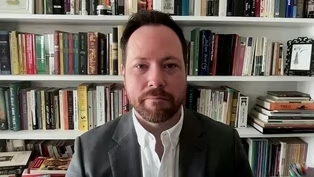
New“Astronauts in Canoes:” Revisiting the Lewis & Clark Expedition
Video has Closed Captions
Craig Fehrman discusses his new book "This Vast Enterprise." (18m 12s)
Providing Support for PBS.org
Learn Moreabout PBS online sponsorship New Episode
- News and Public Affairs

Top journalists deliver compelling original analysis of the hour's headlines.

- News and Public Affairs

FRONTLINE is investigative journalism that questions, explains and changes our world.
 New Episode
 New Episode

 New Episode
 New Episode
 New Episode
 New Episode
 New Episode
Support for PBS provided by: