
What makes Christian McBride the hardest-working man in jazz
Clip: 9/15/2026 | 7m 56sVideo has Closed Captions
What makes Christian McBride the hardest-working man in jazz
As a bass extraordinaire, bandleader, composer and educator, Christian McBride has been called one of the hardest-working men in jazz. He’s as comfortable performing with jazz icons as he is with artists like Sting and Billie Eilish. Senior arts correspondent Jeffrey Brown recently met McBride at his hometown jazz festival for our arts and culture series, CANVAS.
Problems playing video? | Closed Captioning Feedback
Problems playing video? | Closed Captioning Feedback
Major corporate funding for the PBS News Hour is provided by BDO, BNSF, Consumer Cellular, American Cruise Lines, and Raymond James. Funding for the PBS NewsHour Weekend is provided by...
What makes Christian McBride the hardest-working man in jazz
Clip: 9/15/2026 | 7m 56sVideo has Closed Captions
As a bass extraordinaire, bandleader, composer and educator, Christian McBride has been called one of the hardest-working men in jazz. He’s as comfortable performing with jazz icons as he is with artists like Sting and Billie Eilish. Senior arts correspondent Jeffrey Brown recently met McBride at his hometown jazz festival for our arts and culture series, CANVAS.
Problems playing video? | Closed Captioning Feedback
Where to Watch PBS News Hour
PBS News Hour is available to stream on pbs.org and the PBS app.
Providing Support for PBS.org
Learn Moreabout PBS online sponsorshipAMNA NAWAZ: As a bass player extraordinaire, band leader, composer, and educator, Christian McBride has been called one of the hardest-working men in jazz.
And he's as comfortable performing with jazz icons as he is with pop artists, like Sting and Billie Eilish.
Senior arts correspondent Jeffrey Brown recently met McBride at his home and at his hometown jazz festival for our arts and culture series, Canvas.
JEFFREY BROWN: Headlining the Montclair Jazz Festival in Northern New Jersey, Christian McBride leads his 17-strong big band.
CHRISTIAN MCBRIDE, Musician: It's not the '30s or the '40s, where big bands were standard, you know?
JEFFREY BROWN: Yes.
CHRISTIAN MCBRIDE: So if you play in a big band now, you're part of a very lucky group of musicians.
JEFFREY BROWN: As composer, bassist, and band leader for the ensemble, McBride is keeping a more than century-old art form alive.
But it's just one of his many hats.
He fronts smaller groups like his quintet, and has been a regular side man performing with countless others, including such legends as pianist McCoy Tyner and trumpet player Freddie Hubbard.
He's played on more than 400 recordings and beyond jazz as well, including with one of his heroes, James Brown.
CHRISTIAN MCBRIDE: I also want to ask you about Art Tatum.
JEFFREY BROWN: He also hosts NPR's long-running "Jazz Night in America."
And earlier this year, he won his 10th and 11 Grammys.
How does he describe himself?
CHRISTIAN MCBRIDE: I'm a professional musician.
JEFFREY BROWN: Yes?
CHRISTIAN MCBRIDE: You get called for a gig, you play the gig.
I like to think of myself as like a HVAC guy.
You know, what do you need me to do?
All right, let's do this.
Let's fix this.
JEFFREY BROWN: Practical, yes, but also educational, even evangelical.
CHRISTIAN MCBRIDE: When you guys was just kind of putting it together, think in terms of phrases.
JEFFREY BROWN: As artistic director for Jazz House Kids, a nonprofit in New Jersey that provides classes and programming for young musicians, McBride spreads the gospel of his music through the most direct hands-on guidance.
CHRISTIAN MCBRIDE: Right.
You don't have to play no crazy lines.
Just make sure whatever you play, you play with conviction.
JEFFREY BROWN: At one point you said, really, really if you're going to play, you got to play with conviction.
CHRISTIAN MCBRIDE: That's right.
JEFFREY BROWN: What does that mean?
CHRISTIAN MCBRIDE: You know, if you're going to make a mistake, make it loudly.
Nothing sounds... JEFFREY BROWN: Yes.
You mean, mean it.
CHRISTIAN MCBRIDE: Yes.
Nothing sounds worse than making a mistake and admitting you made a mistake.
JEFFREY BROWN: And is that easy to convey?
CHRISTIAN MCBRIDE: Well, it's easy to convey.
It's not always easy to practice.
You know what I mean?
But playing with conviction is really at the base level of what all great musicians have.
JEFFREY BROWN: McBride came from a musical family.
Both his father and great uncle were bass players.
He attended a magnet school for the arts in Philadelphia, graduating in the same class as members of The Roots.
And he's been playing professionally since he was 17.
When you're starting out, are you trying to create your own voice, your own style?
CHRISTIAN MCBRIDE: No.
No.
JEFFREY BROWN: No.
CHRISTIAN MCBRIDE: I was not trying to create anything other than opportunity.
JEFFREY BROWN: Yes.
CHRISTIAN MCBRIDE: You're in New York City now.
You're 17 years old, you need a job.
You need a gig.
And then once you get the gig, now you can start slowly turning it into yours.
JEFFREY BROWN: McBride's partner in jazz education and in life is his wife, Melissa Walker, a vocalist and the founder of Jazz House Kids... MELISSA WALKER, Jazz House Kids: You know, you really just let that story evolve over the lines.
JEFFREY BROWN: ... which has now grown from a small in-school program in Newark 25 years ago to a program that today serves about 2,500 annually with classes taught by professional musicians.
MELISSA WALKER: We're going to give an authentic experience through this music.
That's number one.
And, number two, you put the very best practitioners that are not only playing and making a living out of this music, but they're great educators.
They know how to reach young people where they are.
JEFFREY BROWN: What do you think it is about jazz that is so vibrant about meeting young people where they live?
MELISSA WALKER: Right.
It really is a folk music.
It is something that is passed down from one to another.
It's not something that only happens in the hollowed halls of great universities and big stages.
That's not what it is.
It's the music of the people.
JEFFREY BROWN: Jazz House Kids programming includes a two-week summer program, classes and performing ensembles for 150 young students, starting quite young.
CHRISTIAN MCBRIDE: I feel that being particularly a jazz musician, the basic skills that you need to be just good, not great, but just good, are the same attributes that lead you to being successful in any endeavor, listening, teamwork, having empathy, being able to harmonize.
JEFFREY BROWN: Almost 20 years ago, one of the first summer programs ended with a small concert in a local park.
MELISSA WALKER: I didn't even know that you needed a permit to do something in the park.
And we had our first little performance.
JEFFREY BROWN: For a handful of people.
MELISSA WALKER: Correct, because there were about 40 students and their parents, and a couple of people dropped by.
And Christian and I looked at one another and we said, we know it, something great when we have it.
And that became the Montclair Jazz Festival.
JEFFREY BROWN: Today, it's grown to one of the largest free jazz festivals in the country, this summer attracting a record 32,000 music lovers to hear big-name musicians and the young ones from Jazz House Kids.
This year, the festival also partnered with the Smithsonian, hosting an oral history project for the country's 250th celebration.
For the hardworking professional Christian McBride, it's all part of playing what you love and letting others in.
CHRISTIAN MCBRIDE: If you're in a position to go out and advocate for it, that's what you're supposed to do.
That's what Wynton Marsalis has done all of these years.
Before him, that's what Louis Armstrong did.
That's what Dizzy Gillespie did.
And I'm glad to be in the position where I can spread the message, so to speak, and in all different kinds of ways.
What I loved most about jazz, even as a young child, was you can actually hear and feel a person's personality through their playing.
Human beings doing excellent things is never going to go out of style.
JEFFREY BROWN: Christian McBride releases a new album with his quintet, Ursa Major, this fall.
For the "PBS News Hour," I'm Jeffrey Brown in Montclair, New Jersey.
 New
NewAnalyzing the Supreme Court's mail-in voting decision
Video has Closed Captions
Analyzing the Supreme Court's mail-in voting decision and Trump's reaction (3m 42s)
 New
NewElection officials get mail-in voting clarity from court
Video has Closed Captions
Election officials get mail-in voting clarity after Supreme Court decision (4m 47s)
 New
NewNATO shoots down drone as Russia continues to provoke Europe
Video has Closed Captions
NATO jets shoot down drone in Lithuania as Russia continues to provoke Europe (8m 41s)
 New
NewNews Wrap: Senate Democrats block crypto bill
Video has Closed Captions
News Wrap: Democrats block crypto bill, demand limits on Trump's investments (5m 26s)
 New
NewOcean at the front door: Coastal communities battle erosion
Video has Closed Captions
Ocean at the front door: East Coast communities race to protect homes from erosion (7m 15s)
 New
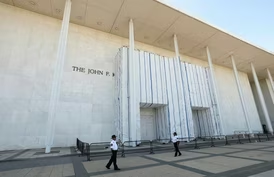
NewTrump-aligned Kennedy Center board votes to close
Video has Closed Captions
Kennedy Center board votes to close after judge blocks Trump's name from building (4m 32s)
 New
NewWarner says U.S. can pursue safety without losing AI race
Video has Closed Captions
Sen. Mark Warner says U.S. can strengthen AI safety without losing race to China (9m 7s)
Providing Support for PBS.org
Learn Moreabout PBS online sponsorship New Episode
- News and Public Affairs

Today's top journalists discuss Washington's current political events and public affairs.

- News and Public Affairs

FRONTLINE is investigative journalism that questions, explains and changes our world.
 New Episode
 New Episode
 New Episode
 New Episode
 New Episode
 New Episode
 New Episode
 New Episode
Support for PBS provided by:
Major corporate funding for the PBS News Hour is provided by BDO, BNSF, Consumer Cellular, American Cruise Lines, and Raymond James. Funding for the PBS NewsHour Weekend is provided by...