
February 19th, 2026
Season 2026 Episode 8 | 28m 45sVideo has Closed Captions
Spring Schedule @ DeBartolo, A Midsummer Night's Dream, 150 Years of Art Raclin Murphy MOA
This week on Experience Michiana, we are diving deep into the arts with a milestone museum celebration, a historic Shakespearean debut, and a look ahead at a packed performing arts season! 🎨🎭✨Here is what’s featured in this week’s episode:150 Years of Art at Notre DameWe celebrate a monumental anniversary at the Raclin Murphy Museum of Art. Museum Director Joseph Be...
Problems playing video? | Closed Captioning Feedback
Problems playing video? | Closed Captioning Feedback
Experience Michiana is a local public television program presented by PBS Michiana
February 19th, 2026
Season 2026 Episode 8 | 28m 45sVideo has Closed Captions
This week on Experience Michiana, we are diving deep into the arts with a milestone museum celebration, a historic Shakespearean debut, and a look ahead at a packed performing arts season! 🎨🎭✨Here is what’s featured in this week’s episode:150 Years of Art at Notre DameWe celebrate a monumental anniversary at the Raclin Murphy Museum of Art. Museum Director Joseph Be...
Problems playing video? | Closed Captioning Feedback
How to Watch Experience Michiana
Experience Michiana is available to stream on pbs.org and the free PBS App, available on iPhone, Apple TV, Android TV, Android smartphones, Amazon Fire TV, Amazon Fire Tablet, Roku, Samsung Smart TV, and Vizio.
Providing Support for PBS.org
Learn Moreabout PBS online sponsorship1234.
Get my shoes in.
Out the door.
Five.
I'm lost.
Six.
Seven.
Eight.
Feels great.
I'm gonna shine.
After I do what I'm gonna do.
I do it again.
Yeah.
Look at the sky with the beautiful color.
But never just for me.
You gotta share it with another.
I got to show, to give.
Let I want singing show.
Take a look and say a beautiful morning that turns into a beautiful evening.
And together make beautiful art.
And if you wanna see that, come along with me.
That's right.
Welcome to Experience Michiana.
I'm up on stage here at the DeBartolo Performing Arts Center.
They have some amazing stuff that's coming up here.
You want to make sure that you get your tickets for all the wonderful performances and cinema that is going to be happening in the next couple of months here.
Also, we're going to be talking today on the show about a first for the Elkhart Civic Theater.
They're bringing Shakespeare to the stage.
Midsummer Night's Dream is going to be performing.
You want to make sure you get your tickets for those too.
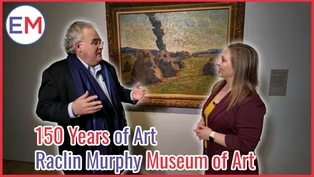
But first up, we're heading just next door over to the Raclin Murphy Museum of Art, where they are celebrating 150 years of art right here on campus.
Okay.
Obviously art has been around for centuries, but here at Notre Dame, we are celebrating our 150 years at the Raclin Murphy Museum of Art.
And I have with me my friend Joe.
It's so good to see you again.
Welcome back.
This is a tremendous milestone for art here at Notre Dame.
Talk to us about the significance of 150 years.
Sure.
A lot of people don't know this, but there was a museum at Notre Dame going back to 1875.
We are one of the oldest and one of the largest university art museums in the country.
I think we're the fifth of the six.
And that's what I was going to ask you.
How many other, you know, universities.
Well, there's more than 400 now, but we were in that first, initial group in the 19th century, typical of Notre Dame.
Right?
Right, right.
Right.
Right.
Right.
Right, right.
And I think it had a lot to do with sort of the, European sensibilities of the CSC coming here, setting things up.
And it was really, initiated by Luigi Gori, who's the individual that painted the, stations of the cross and the ceilings in the basilica.
So there's a long, long, long connection.
That's incredible.
Now we are standing in front of just one beautiful piece, but the collection is quite vast.
Talk to us about how you, Because as everything here that we're seeing new to the collection.
Are you pulling some things out?
Everything that's in the galleries right now is a recent gift to the collection.
That's the purpose of this exhibition.
So maybe some things that people haven't seen if they haven't been here.
Yeah, I think that most things people would not have, seen.
So lots of, lots of new treasures, lots of new surprises.
Oh, I like that word.
Yeah.
And so talk to us about because I know there's, like, 150 gifts that were given to you guys, but the collection is even more vast than that.
So we began this campaign, in the spring of 2022, when we realized that we had this major milestone on the horizon.
And the concept was, let's seek 150 gifts, for 150 years now, a gift could be one work of art, or it could be an entire collection.
And, we ended the campaign in December, this December, and we ended up with 168 gifts.
But the number of works of art is about 1300, so.
Oh, my God, it was an incredibly successful, campaign for many, many, many donors, across the country, around the world, and even here in the South Bend region.
That's amazing.
And so how many are you displayed?
I mean, are all 1300 here?
No, no no, no, this is this is just, a little sampling.
About 100 works are in the galleries.
However, there are some pieces that are downstairs in the teaching gallery, which, faculty have already requested.
There are also pieces throughout the galleries with a special little sticker on them designating 150.
And then there's a complete list that's available online through the QR code.
And yeah, and that's what I was going to add to when I walked through, I noticed there was a QR code on the door.
So what does that take me to?
That takes you to the, whole list.
So, for example, one collector may have given us a 100, individual prints, but we only showing three, here as a part of this exhibition.
So this is really a sampling of some of the great, generosity that we've experienced.
Absolutely.
And what would you say is the range of arts?
Sure, sure.
So you have things that are centuries and centuries and centuries old.
You have some things that are, more recent.
I think that one of the highlights for this exhibition are probably the things that came to us from Mrs.
Ragland.
Okay.
We received the Ernie Raclin bequest, including this great, impressionist, painting.
She, I think, always had it in her mind that she would give her collection, which is superb, to the university.
And, she's certainly, here, present in this exhibition.
Absolutely.
Let's talk about this piece.
This is a beautiful.
Sure, sure.
So this is, Armand Diamond, and he was one of the, Impressionists.
He participated, I believe, in five of the Impressionist, exhibitions.
And, these are his wheat stacks.
Not haystacks like Monet, but these are his wheat stacks, which he actually did before Monet started doing his, haystacks.
And one of the great things about, this painting is that the Impressionists believed that there was no such thing as a black shadow or a dark shadow, that it was just the absence of light.
And if you really look in some of these shadow areas, you can see that there are some fantastic purples and browns and grays.
It really is quite a lovely painting.
Impressionism is my favorite form of right, I have to tell you that.
Right?
Right.
So can we go walk and see more Absolutely.
Lets go head on down And this just continues.
It does continue I love this and I can't imagine these pieces where they came from.
You know was this in someone's front living room?
No.
This was actually in a plaza in, in New York City.
And it was quiet for the museum.
It will eventually go into the sculpture park.
We thought it would be fun to see something this big in this dramatic in the in the galleries.
Absolutely.
Now there's a variety of different correct artwork.
Correct textile work as well.
Correct.
You know, literally every aspect of the collection, from ancient Mesoamerica to contemporary, indigenous, North American artists, you know, 18th century prints, 19th century paintings, they're all a part of this gift.
So it's not just that it went in one direction.
It went in, multiple directions, which I love, because when I've been to other galleries, they're kind of condensed into those periods or timeframes or stylistics and coming in here, it gives you just a wide variety.
Thank you.
And, it's very perceptive here because, you know, we want people to, reflect on just how broad and how diverse this collection is and basically how lucky we are.
Absolutely.
I know you guys have already had your opening reception.
Yes, but this is a limited time opportunity.
Sure.
How long will these be on display?
This, exhibition is open through early June, so we've got a couple of months, ahead of us.
I'd encourage everybody to check out our website about programs that we have scheduled.
We've got some really significant things happening over the course of the next few months.
And, you know, there is so much to see here and there is so much diversity among the objects.
I think the reality is coming back again and again and again.
It's going to be very rewarding.
It's going to be rewarding.
Can we talk about this piece?
Sure, sure, sure.
I mean, obviously it's large and it catches your eye, but there I see a lot with it in my in my opinion.
Right.
So this is a, really significant gift, of a painting by Jim Dine, the famous, American pop artist.
And for a very brief period of time, in the 2000 teens, about two, three years, he stopped painting recognizable images, and he just started using color and texture and brushwork as the subject, itself.
So it's a very, very rare, painting.
And what's great is that it's got so much scale, it's got so much mass.
And it really, calls attention to just what a wonderful gallery space this is.
And I know I always come in, but your gallery space is just incredible.
You guys move some stuff around, though.
We move walls, we paint walls, we change it up, and, it makes it exciting for us.
A little tiring, but it's exciting for us.
I see a piece over there.
Can we go?
Absolutely.
Absolutely.
Catching my eye to make sure the piece over here is, recent, work that we're thrilled to have by David Martin, who's a member of the, pagan Potawatomi and David.
So this is kind of like local art.
Absolutely, absolutely.
And there are many, indigenous objects.
And we really wanted to make this, quite significant.
It's actually a kind of landscape map.
So the design that is, on the front is actually about this region.
And this blue squiggle coming down and around is the Saint Joe River.
So, this work is unique among all the works in this, exhibition because this was actually made to be played and it will be played into existence, this, coming week.
We'll use it for ceremonial events here.
But, you know, we have a long, commitment to the again, to the Potawatomi, to celebrating indigenous art of North America.
This is a great addition.
And I see that this is actually half pine, which I know him as a all, but he's also tremendous artist.
How cool to have that here.
Yeah, we're we're thrilled.
He's been a great friend of the museum.
And I'm glad that he is, sharing in this space with us.
Now in this space, I want to remind people that it is free to come and visit.
Absolutely.
Public space.
Absolutely.
You know, I think that one of the great things that we do is we offer all of the galleries, for free.
You know, we're here for everyone.
And so, you know, if you want to come and spend an hour or if you want to come and spend a half an hour, if you want to come and spend five hours, it doesn't matter.
Yeah.
You can just come in and you can enjoy.
And this new location, you know, we've been here for about two years is fantastic because, you know, we are sort of welcoming the community in we're very easy to access.
We've got drop off areas in the front.
We've got parking in the back.
So you know, come enjoy I hope you do.
And again, this exhibit is going to be available until the beginning of June.
All right.
So do come and see all the tremendous art that's available.
Thank you for being here.
Thank you Joe.
Come back soon.
Yeah.
Well.
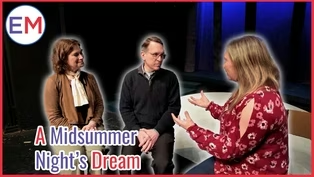
Well, we are back up on stage here at the Elkhart Civic Theater doing something a little bit new for this particular theater.
We're bringing in Shakespeare, and I'm so excited for you guys doing this.
I have some friends here with me and that you and I have met before.
Yes, yes.
Okay, okay.
I recognize you in front.
Thank you so much for joining us.
You're one of the actors as well.
Midsummer night's dream.
I mean, bringing Shakespeare to this stage and at.
Tell me a little bit what what that looks like because this hasn't been done.
Maybe ever.
I think maybe not ever.
Here.
Yeah, except for some things with some kids.
Some fun bits with kids.
But, yeah, it's, It's been so exciting.
I love Shakespeare, I just, I always have, and so it's, it's just a joy for me to see this go on stage and, Yeah.
So what?
It looks like it's just a lot of work.
Like we started back in December.
Just working with the language so that we can make sure that, that it's not scary for anybody, that it's very easily understood and accessible.
And are you guys doing it kind of more of a traditional format?
Are there any different unique changes that you're making?
Really all we're doing is just doing it in modern dress.
And so just, you know, modern, modern, gestures or, you know, things like that.
Yes.
And more of that.
Yeah.
Exactly, exactly.
Yeah.
Perfect.
Okay, so you guys doing this, tell us a little bit about and what is your role?
I'm Oberon, king of the fairies.
King of the fairies.
Okay.
There's a lot of magic in this story line too, right?
For those people who maybe aren't as familiar with them in Midsummer Night's Dream, tell us a little bit more about what the story is all about.
Yeah, well, I'll tell the story from Oberon perspective on that.
All right.
Okay.
Yes.
Yeah.
Titania has something that I want, and she's not giving it to me.
Titania is the queen.
Of course, my spouse.
And and we're fighting about it, and it's causing all kinds of problems in the human world.
Causing ruckus, causing a ruckus.
Right?
So there's there's a whole variety of things that Oberon tries to do.
Some of these are geared toward getting Titania to give him what he wants.
And some of these are geared toward seeing humans stumbling into the fairy world and, and sort of playing with them and well-meaning but not entirely effective ways.
Now, I have to ask you, based on your own personal relations outside of the theater, like, how are you drawing from that to pull it into your character?
Oh my goodness.
Well, okay, so my parents, when I was a kid, we would often say things like, well, she started it.
Yes.
Right.
And the response was always, well you can stop it.
Oh, I love it.
Like, I'm, I'm very much drawing on that.
Although although it's directed at Titania, like, yeah, you can stop it, right.
You know, you should have to do it.
I get it, I get it.
And now how many people are in the cast for this one?
There are 21, 21, 22.
Okay, so, I could say it's cast.
Yeah, because it's actually not all about the fairies.
Okay.
All right, give us the rest of the, the story.
Well, it's also about some lovers, so it's about there's, Theseus and Hippolyta who have had just a battle, which in our play is just a corporate battle.
But they've fallen in love, and they're getting married.
But then there's these four young lovers, who are all in love with each other in varying degrees.
And, Hermia and Lysander want to get married, but Hermia, mom wants her to marry Demetrius instead.
So they run off into the woods.
Demetrius follows them.
Helena, who's in love with Demetrius, follows him.
And then, Yeah, they inadvertently put themselves under the power of the fairies, who kind of mess everything in the magic, High jinks ensue.
Yeah.
And there's also a group called.
We call them the Rude Mechanicals.
They're a bunch of people.
Just.
Just basic work, working people who are trying to put on a play.
They've never done anything like this.
Play a play?
Yeah.
Yep.
In honor of Theseus wedding day.
And, they come out into the woods to practice the play, and, the fairies kind of mess with them a little bit.
Hey, what do you think some of the bigger challenges in kind of balancing, you know, the romance, the comedy and the magic in in your direction?
Yeah.
So the, you know, when I was in high school, I remember them telling my teacher, telling me Shakespeare's comedies aren't meant to be funny.
They're just they just need to have a happy ending.
But let me tell you, that's not true.
Like this.
You know, finding the humor throughout to play like the Rude mechanicals are supposed to be kind of a comic relief, but.
But actually, everybody is comic relief, you know?
I mean, there's just fun all the way through, and that definitely, I would say is more important than the romance.
The romance takes a second seat.
But but it is still there.
And, you know, hopefully you'll be rooting for everything to work out for the lovers.
If you guys have a beautiful set going on back here, I know you guys always do a great job with this too.
How has it been working with us?
And I know you guys are opening this weekend.
This is exciting.
So how has it been to actually be on the stage with the set?
Yeah.
It's great.
It's easy to use.
It's, it's effective.
I think there's we're doing fun interactive elements with the set.
So the performers are engaging with set pieces.
And Shakespeare traditionally is like round style, right?
Like, isn't that traditionally Shakespeare more of a thrust I think.
Yeah.
Okay.
Yeah, yeah.
But I mean, we have a little bit of an extension, but we can't really do thrust here, but you incorporate it nonetheless, right.
And it's great to be out there.
Tell us how it is.
Is this your first time doing any theater performances here with Elkhart?
Oh, no, I've done I've done things here.
You have.
Okay, so tell us what.
If anybody out there has never auditioned or volunteered here, what do you want them to know about this experience?
Yeah, it is real easy and real friendly.
Like that's at least that's been my experience.
I think that auditions are actually fun, not threatening, which is, a wonderful experience.
Just it feels like you're just sort of hanging out and doing a thing that is enjoyable.
I think volunteering is easy to get into.
I'm also, a volunteer coordinator of sorts.
So, like, if you see people who are ushering for the show, it's because I asked them to do it and they said yes.
So they might be contacting you then if they want.
I love right.
Yeah.
Okay.
Very good to know.
Very good to know.
Well, now this stage is happening this weekend.
And tell us when the performances are happening.
So they'll be, Friday and Saturday, the 20th and 21st and then the following weekend, Friday, Saturday, Sunday, the 27th, 28th and March 1st.
Okay.
And of course, how do people get their tickets?
By calling the box office.
I have org and this is going to be a big deal for you guys doing the first time you're doing Shakespeare here at Elkhart Civic Theater.
You know, what do you think the audience is going to how are they going to perceive this?
Like how are they going to take it in and run with it?
Yeah, I just really hope that they come here and they say, you know what?
I thought Shakespeare was intimidating and stuffy and boy, it is not.
It is fun and accessible.
It is.
And is this particular story, would you say it's family friendly or is it more geared towards like a 13 and up?
Oh, that's a really good question.
That's a good question.
It depends on what funny we find.
I mean, yeah, Shakespeare does get a little bit, you know, more off color humor.
I would say that's a good word for it.
Okay.
So, you know, parents and parents, a decision on that one.
All right.
Well, thank you guys so much for showing us a little bit of that.
And I think maybe we if we have some photos or our video to share, we'll, we'll see some of that here.
Now too.
Oh.
Awesome.
Right.
We are putting rafters from upstairs, so I'll follow you.
I'll leave you with that wrap through ball through bush break through Brier sometime.
I guess I'll be such.
How a half?
I had to spare some time of fire and play.
And fire.
And grabbed it raw and burned.
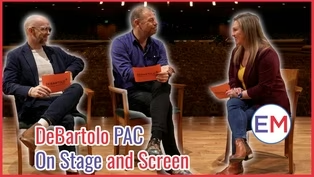
But we are back at DeBartolo Performing Arts Center.
It's a Notre Dame Day today, I guess, but I have my friends here with me, and I can't believe how fast this year's already going by.
You guys are into the spring semester and moving along with all the performances that you have in place, and I'm so glad and excited to share it with you so well.
Thank you for coming.
I always love to see you.
It's good to see you guys too.
All right, tell us what's on the lineup.
Well, we have a lot of movies that are coming in.
Some new, some old.
So I'll run through some of the classics first.
And one is our learning.
Be on the classics series is continuing.
If you've been watching Experience Michiana, we've talked about this before.
And it's looking at French actresses or French language actresses and the role that they played in the films that allowed a broader post-colonial, like, French language cinema to exist.
the ones that we have coming up are Jane B for Agnes V, which is an Agnes Varda film, who is part of the French New Wave, and then Michael Haneke's, The Piano Teacher with Isabelle Hooper, and then going back in time a little bit and looking, an African director and, the some black girl that's kind of in conversation with where we're going in the more recent films.
But all of these are both disruptive in terms of their form that they're taking they're doing something or they're doing something new with movies.
Well, they're also injecting it with a new kind of political lens.
Okay.
Awesome.
All right.
And then you have some other.
I see some classics in here.
Yeah.
So, Mary Kearney teaches a class on gender and rock, and the screenings are public.
And coming up in that, we have a bunch of documentaries.
School of Rock, not a documentary.
I was gonna say.
Okay, that was about that time I, went to, But this Saint Joe I didn't know this about.
Okay, so I guitar, but the jackpot.
Classic school of rock.
And then we have sisters with transistors, which is about the early formation of techno music, electronic music and how women were crucial to that.
And at the four and avant garde of that, Moonage Daydream, the David Bowie documentary that came out after he passed away, and then the concert film, Stop making Sense by Talking Heads.
Oh, wow.
So lots of rock and there lots of rock.
And if you like live performance, we also have the opera, with a, with a live performance of Arabella Strauss.
And that, is a big, beautiful production itself.
And then our Finklefunder series also has some classics.
Let's talk about those.
This semester we are looking at sports movies for kids, which is perfect timing for the Olympics.
Perfect, perfect weather.
And we got some Olympic movies.
Okay.
Well, first of all, we have McFarland, USA, which is about running.
So we did different sports each week.
And then we get into an Olympics rock block with merkel about the US Olympic team in 1980 when they played the Soviet Union, and Lake Placid.
I won't spoil it for the kids who haven't seen it.
And Cool Runnings, the bobsled film about Jamaica coming up next and then, the cutting Edge, which is, you know, every seven year olds favorite perfect and famous that year I think of under that that's one that is really accessible.
Yep.
All right a dollar to get in a dollar for dollar for popcorn every Sunday at 1 p.m.
I love it.
Talk to it I love it.
All right I know you guys have some amazing performances coming up.
So great live performances coming up, including this weekend.
We have the Urban Bush women.
Now.
This is a dance company, that's been around for over 40 years.
Started it.
Yeah, started in New York City.
And really, it's taking the idea of the African diaspora, urban bush women taking movement from, you know, African dance and putting it into today's terms, and taking a look sort of socially and politically what that means.
And so, you know, it's this combination of dance and activism all within art.
If you're fans of Uzma, you know, our local African American.
Me.
Yeah, that's what I'm kind of very much see elements of that on the stage.
But with a little political message here and there.
That's all right.
What else do you have?
We have Max.
Terence Blanchard is a jazz musician.
And most people will know him for that.
Or, composing the films to a, the scores to a bunch of spike Lee films.
But he actually composed an opera called fire Shut Up in My Bones that the Met Opera did, in 2022.
So a few years ago.
And this is a concert version.
So instead of being three hours long, it's about 90 minutes.
They'll be a couple opera singers.
Terence Blanchard and his group called the E collective, and then the Turtle Island String Quartet.
So they're all on stage here.
There's going to be some, visuals and imagery, on the screen and so, again, a really great sort of accessible way to experience opera in a concert version, I love that.
Yeah, yeah.
And then next up, we jump ahead to March.
We can't be.
I mean, it's Saint Patrick's Day.
I was going to say something about that.
I can't be here at the campus of Notre Dame without doing something Irish in March.
So we actually have Martin Hayes, who is the the world's probably, you know, preeminent Irish fiddler coming.
And so he's he's going to be here with a group about 50 musicians, called the Common Ground Ensemble.
They're going to be Irish dancing.
Great, traditional Irish music.
Martin Hayes, has a famous group he put together called The Gloaming.
Some people may be familiar with that group.
So, you know, he's someone that's out there if you know Irish music, you know Martin Hayes.
So we're so excited to have you on my slate.
So.
Exactly.
Yeah, I get it.
And then finally at the end of March and I'm sure we'll, we'll talk about this again.
But part of the reason Ricky is doing this look at French film is because there's a French conference coming at the end of March here, here on campus.
So academics from across the world are coming.
Notre Dame's French department, romance languages put on this conference.
So we're tying into that.
And with that, we have a couple of jazz artist Jack Schwartz, Bart and, Carla, Henri, Maurice say, so in this throughout this, conference weekend, this is a performance that we're really glad to be putting on our series because these are just top notch, wonderful jazz musicians.
And so, so there'll be a lot of French speaking, but there'll be plenty of translation and jazz and music.
Exactly.
That's it is some language.
Awesome.
And people can get tickets on the website or at the box office.
Correct.
And that's performing arts dot ND dot EDU for all of the tickets and more information.
Okay.
Perfect.
Do you have a few more things to tell us about your cinema program?
We do.
We have some new films that are recently released that people can check out.
We have a bunch of films that are nominated for Oscars.
For example, the voice of Hendra Shabaab, which is a Polynesian Tunisian found.
So the director, Kotaro Ben Hania is Tunisian by way of Paris.
But, has this, film about, hinders Rob, who was a young girl in Palestine whose car comes under fire, from Israeli military, and she called the Red Crescent and was on the phone trying to get help.
And this takes her phone call, the dialog from it and recreates the call in.
So it's almost like a rescue 911 type reenactment.
Okay.
But is incredibly powerful, like the most powerful film I've seen in 15 years.
This is one you guys, I want to I recommend that, but also amazing is, clever.
Mendoza is, new film The Secret agent for people who know and still bear the Brazilian film that did well at the Oscars last year.
This is a very similar film.
Okay, with slightly different style.
And then we have black news terms and conditions, which are making all of the undergrads come see.
They can rip it off and make cool movies like Super cool, smart, film about, black arts and repatriation and how we return, objects, to, their ancestors and the people who made them, Hamnet, which is the new college out now for Shakespeare fans or just generally people who need to weep.
Yeah.
Okay, let's get it out of your system.
And then Eddington, which is a more polemical Ari Aster film that looks at the tensions of Covid and what was happening in 2020.
If you want to revisit it right.
And come watch it with people.
And we have some short films, too.
Oh, we do so again for the Oscar heads.
The, short films that are nominated for animated Oscar shorts, live action shorts and documentary shorts.
We put those in programs.
For those who want to come to the animated shorts sometimes, it's tough to know how adult they are.
These are somewhere between PG and PG 13.
Good to know.
Good to know.
And then lastly, we are hosting an event for Performing Media Festival.
This is a wonderful event that is put on by Ryan Keith Olivier and AOSp because performances around South Bend, it's a real gem of South Bend, and we'll have short films and live scores and some really cool art.
On March, Friday the 13th.
Okay, good to know.
And as a reminder, all of these are open to the public here at the DeBartolo and the Performing Arts Center.
So thank you so much for showcasing what you guys have coming up.
Well, thank you so much for joining us this week.
We'll see you again next time here on Experience Michiana.
Want more from Courtney, Dave and Kelly?
Follow us on social media and visit our website for exclusive behind the scenes content, extended interviews, and full length features.
Stay connected and experience it all today.
This WNIT local production has been made possible in part by viewers like you.
Thank you.
 New
New150 Years of Art Raclin Museum Murphy Museum of Art
Video has Closed Captions
Clip: S2026 Ep8 | 9m 14s | No description (9m 14s)
 New
NewVideo has Closed Captions
Clip: S2026 Ep8 | 7m 48s | No description (7m 48s)
Providing Support for PBS.org
Learn Moreabout PBS online sponsorship













Support for PBS provided by:
Experience Michiana is a local public television program presented by PBS Michiana