
Adm. William McRaven reflects on American spirit in new book
Clip: 4/24/2026 | 9m 1sVideo has Closed Captions
Adm. William McRaven reflects on American spirit and the nation’s future in new book
Retired Navy Adm. William McRaven served for nearly four decades in a highly decorated career, from Navy SEAL to commander of the Joint Special Operations Command. He is also widely known for his 2014 speech, “Make Your Bed.” More of his speeches are collected in “Duty, Honor, Country & Life: A Tribute to the American Spirit." McRaven joined Amna Nawaz to discuss the new book.
Problems playing video? | Closed Captioning Feedback
Problems playing video? | Closed Captioning Feedback
Major corporate funding for the PBS News Hour is provided by BDO, BNSF, Consumer Cellular, American Cruise Lines, and Raymond James. Funding for the PBS NewsHour Weekend is provided by...
Adm. William McRaven reflects on American spirit in new book
Clip: 4/24/2026 | 9m 1sVideo has Closed Captions
Retired Navy Adm. William McRaven served for nearly four decades in a highly decorated career, from Navy SEAL to commander of the Joint Special Operations Command. He is also widely known for his 2014 speech, “Make Your Bed.” More of his speeches are collected in “Duty, Honor, Country & Life: A Tribute to the American Spirit." McRaven joined Amna Nawaz to discuss the new book.
Problems playing video? | Closed Captioning Feedback
How to Watch PBS News Hour
PBS News Hour is available to stream on pbs.org and the free PBS App, available on iPhone, Apple TV, Android TV, Android smartphones, Amazon Fire TV, Amazon Fire Tablet, Roku, Samsung Smart TV, LG TV, and Vizio.
Providing Support for PBS.org
Learn Moreabout PBS online sponsorshipAMNA NAWAZ: U.S.
Navy Admiral William McRaven served for nearly four decades in a highly decorated career from Navy SEAL to commander of the Joint Special Operations Command.
Since then, he's been a chancellor of a major university system at the University of Texas, a professor at their LBJ School, and a bestselling author.
And while history holds a place for him as the man behind the high-stakes raid that brought Osama bin Laden to justice, McRaven is also widely known for his 2014 speech, "Make Your Bed," which went viral.
Many of his speeches are collected in his new book called "Duty, Honor, Country & Life."
And he joins us now.
Admiral, welcome to the "News Hour."
ADM.
WILLIAM H. MCRAVEN (RET.
), Former Commander, U.S.
Special Operations: It's great to be with you.
Thanks.
AMNA NAWAZ: Thanks for being here.
I do want to lean into your expertise while we have you and ask you about this ongoing war in Iran.
AMNA NAWAZ: Because we have heard President Trump predict the war would be over soon, a matter of days, a matter of weeks.
Just yesterday, he said "Don't rush me" when he was asked about a timeline.
How long do you think this war is going to continue?
ADM.
WILLIAM H. MCRAVEN (RET.
): Right now, I think it depends on how long we want to continue to enforce the blockade.
The problem we have right now is, the Iranians don't really want to come to the negotiating table until we lift the blockade.
Conversely, President Trump doesn't want to lift the blockade because that's really his leverage.
So somebody's going to have to blink.
Now, they are talking about the foreign minister coming to Pakistan to meet with Steve Witkoff and Jared Kushner.
And so maybe there will be some progress there.
But, at the end of the day, the president has to get to a point, what I think is a strategic point, where the straits are open back in, and he somehow gets the Iranians to agree not to enrich the uranium beyond a certain point.
That's only going to happen I think if at some point in time we lift the blockade.
Now, you can lift the blockade for the cease-fire and then flip a switch and turn it right back on if the Iranians don't comply.
AMNA NAWAZ: I mean, this does have some hallmarks of what I'd call cautionary tales of the past, right?
We have no really clear goal, shifting timelines.
Do you worry this is going to just turn into another prolonged conflict?
ADM.
WILLIAM H. MCRAVEN (RET.
): Yes, I don't think it'll be terribly prolonged, but it's certainly going to go on for another couple of weeks and maybe a month or so.
Again, this is because we are at this impasse, and I know what will happen at the negotiations.
We will say these are the things we want done, and the Iranians will say, no, we don't agree to that.
If you look at the JCPOA, it took 18 months to negotiate the JCPOA, the nuclear plan under the Obama administration, and that was people that were professional negotiators.
So this idea that somehow with a couple of meetings between a representative from Iran and a couple of representatives from the U.S., that somehow we're going to magically kind of come to an agreement, I hope so.
I mean, I hope that plays out.
I hope they open the straits back up.
I hope the Iranians kind of settle down a little bit, but hope is not a strategy.
So, again, I think the president can use the blockade as a little bit of leverage to get what he needs.
AMNA NAWAZ: I want to ask you about this book and the title specifically.
AMNA NAWAZ: Because it comes from a quote from General MacArthur, the duty, honor, and country part.
You added the word life, though.
ADM.
WILLIAM H. MCRAVEN (RET.
): I did.
AMNA NAWAZ: Tell me about that.
Why?
ADM.
WILLIAM H. MCRAVEN (RET.
): Well, in MacArthur's 1962 speech to West Point, he talks about duty, honor, country.
And it's a -- if you haven't heard it, it's a fabulous speech.
And he's 82 years old.
So this is -- he is an old man reflecting on his time really as a soldier.
But he says, duty, honor country.
He says, these three hallowed words are what you ought to be, what you can be, and what you will be.
And he says, they are rallying points to build courage when courage seems to fail, to regain faith when you lose faith, and to give you hope when hope is forlorn.
And so when I thought about, hey, how do you build courage, or how do you inspire people with courage and faith and hope, but I realized there's a little bit of life as well.
We not only want to talk about duty, honor, and country, but we all have lives to lead that kind of go beyond some of that.
And it was important, I think, to add life, because we ought to reflect duty, honor, country within our lives.
AMNA NAWAZ: You do write in the book this one line.
You write: "We're far from perfect as a nation."
AMNA NAWAZ: "But our values are as close to perfect as any nation is going to come."
It also seems like we're in a moment where some of those values are sort of up for debate, right?
AMNA NAWAZ: At least up for discussion.
Who gets to be an American?
What should be America's place in the world?
Do we still have shared values in this country right now?
ADM.
WILLIAM H. MCRAVEN (RET.
): Yes.
Yes, I think we do.
I'm kind of the eternal optimist.
And sometimes I get accused of being too optimistic and too Pollyannish, but far from it.
I mean, I have traveled the world.
I spend four days a week on the road meeting with young people all across the country, and they still have these values.
Their parents, their guardians, their teachers, their coaches are still trying to instill in the young men and women and some of us older folks these values of equality and justice and the rule of law and civility and perseverance, things that I think are important for all of us to have.
At the end of the day, we, as Americans, I think still believe we want to be the good guys.
I know every soldier, sailor, airman, Marine out there, everybody in the government service wants to be the good guys in the world.
So, while you see it coming from Washington, and all you do is watch the 24-hour news cycle or you listen to one of the right or left side, you feel like we have lost our way.
But when you speak with a lot of the other people in the country, I think we're doing OK, actually.
AMNA NAWAZ: You also wrote in an op-ed, I should note, back in 2019, it was a title -- the op-ed was titled "Our Republic Is Under Attack by the President."
AMNA NAWAZ: And you talked about a lot of the things you talk about in the book now, about defending U.S.
values abroad, about the abandoning of allies, the attacks on democratic institutions.
And you said in that back then that: "If this president doesn't demonstrate the leadership American needs, it's time for a new person in the Oval Office."
That was back in Trump's first term.
AMNA NAWAZ: What do you make of his second?
ADM.
WILLIAM H. MCRAVEN (RET.
): Well, I'm certainly not a fan of the president.
I don't think that's a - - that comes as a surprise to anybody.
But at this point in time -- and I have been very careful because we are at war, so I want to make sure that any of the military officers, enlisted that are out there that are listening, they have an obligation to fulfill their oath, and they have an obligation to the president of the United States as the commander in chief.
And while I personally don't like the president and I'm not thrilled with Secretary Hegseth, we have a responsibility to follow lawful orders.
Now, if it's not a lawful order, then you also have a responsibility not to follow it.
But I think, at this point in time, until we can get past this conflict, again, the military needs to be aligned, get the job done for the American people.
AMNA NAWAZ: You include a lot of poetry in this book, which may surprise people.
And we talked a little bit about our shared love of poetry, but poetry your mother shared with you, poetry you yourself write.
AMNA NAWAZ: There's a poem in there called "Departing Afghanistan," which you note... AMNA NAWAZ: ... was written before the Taliban had reclaimed power in 2021.
AMNA NAWAZ: But there's a line in there that struck me.
You said: "The fight was a good one, noble and right."
AMNA NAWAZ: I wonder how you look at this moment we're in now, when the U.S.
is considering sending hundreds of Afghans, interpreters and others, who helped us in the U.S.
effort to Afghanistan or to the Democratic Republic of Congo, not the U.S.
ADM.
WILLIAM H. MCRAVEN (RET.
): Yes, that's painful.
I hope that doesn't happen.
I mean, the Afghans that supported the U.S.
military, much like the Iraqis that supported the U.S.
military, we need to take care of them as well as we took care of our soldiers.
The fact of the matter is, these young men and women that were translators, that were with us on the battlefield, they deserve the exact same support that our soldiers coming back home do.
And it would be a tragedy, a tragedy and, again, would not put America in a good light if we send these Afghan refugees to the DRC or back to Afghanistan.
AMNA NAWAZ: You write in the book about some intensely personal poems too, which strike me, because, in contrast to all of the speeches that you have in there, which are about country and duty and honor, these seem to be really personal to you, one in particular about your mother, in which you write: "She died too young to see me grow into the man who on bended knee she'd prayed and prayed for me to be."
AMNA NAWAZ: I just wonder why you chose to share that with everyone.
ADM.
WILLIAM H. MCRAVEN (RET.
): Yes.
It's -- of course, as I told you, it's not good for my tough guy SEAL image to be writing poetry.
But I have written poetry my whole life.
I just haven't put it in a bounded copy.
And, as you know, poetry can be pretty cathartic.
And, of course, it can be very personal.
And my mother died when I was 30.
And at the time, I was a Navy lieutenant.
She probably didn't think I had much of a career.
I was married with two young kids at the time.
And I was struggling.
And she passed away from lung cancer.
And I like to think, since that time, the trajectory of my life has gone in a very good direction.
And so I think she's still looking out after me.
AMNA NAWAZ: Admiral Bill McRaven.
The book is "Duty, Honor, Country & Life."
Thank you so much for being here today.
ADM.
WILLIAM H. MCRAVEN (RET.
): My pleasure.
Great to be with you.
 New
NewArrest over Maduro raid bet fuels insider trading concerns
Video has Closed Captions
Soldier’s arrest over Polymarket bet on Maduro raid fuels insider trading concerns (5m 53s)
 New
NewBrooks and Capehart on the partisan redistricting battle
Video has Closed Captions
Brooks and Capehart on the partisan redistricting battle (11m 22s)
 New
NewDelegations head to Pakistan, renewing hopes for end to war
Video has Closed Captions
U.S., Iranian delegations head to Pakistan, renewing hopes for diplomatic end to war (3m 20s)
 New
NewInside Chornobyl, 40 years after the nuclear disaster
Video has Closed Captions
Inside Chornobyl, 40 years after the world's worst nuclear disaster (9m 57s)
 New
NewNews Wrap: DOJ drops criminal probe into Jerome Powell
Video has Closed Captions
News Wrap: DOJ drops criminal probe into Jerome Powell (5m 3s)
 New
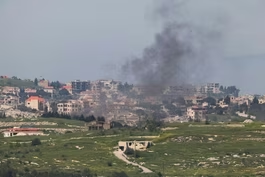
NewSouthern Lebanon weighs losses as ceasefire hangs by thread
Video has Closed Captions
Southern Lebanon weighs losses from Israeli strikes as ceasefire hangs by a thread (6m 1s)
Providing Support for PBS.org
Learn Moreabout PBS online sponsorship
- News and Public Affairs

FRONTLINE is investigative journalism that questions, explains and changes our world.

- News and Public Affairs

Each week, explore science, health, and technology headlines with leading experts.












Support for PBS provided by:
Major corporate funding for the PBS News Hour is provided by BDO, BNSF, Consumer Cellular, American Cruise Lines, and Raymond James. Funding for the PBS NewsHour Weekend is provided by...