
Whose Names Are Unknown
Season 25 Episode 8 | 26m 46sVideo has Closed Captions
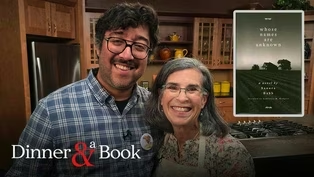
April Lidinsky welcomes Francisco Robles to discuss "Whose Names Are Unknown."
Sanora Babb’s work with refugee farmers during the Dust Bowl provided her with first-hand material for her brilliant novel, Whose Names are Unknown. Publishing politics kept her book out of print for many years and offers a perspective quite different from John Steinbeck’s better-known book. April Lidinsky welcomes Francisco Robles, Associate Professor of English at the Uni...
Problems playing video? | Closed Captioning Feedback
Problems playing video? | Closed Captioning Feedback
Dinner & A Book is a local public television program presented by PBS Michiana
Whose Names Are Unknown
Season 25 Episode 8 | 26m 46sVideo has Closed Captions
Sanora Babb’s work with refugee farmers during the Dust Bowl provided her with first-hand material for her brilliant novel, Whose Names are Unknown. Publishing politics kept her book out of print for many years and offers a perspective quite different from John Steinbeck’s better-known book. April Lidinsky welcomes Francisco Robles, Associate Professor of English at the Uni...
Problems playing video? | Closed Captioning Feedback
How to Watch Dinner & A Book
Dinner & A Book is available to stream on pbs.org and the free PBS App, available on iPhone, Apple TV, Android TV, Android smartphones, Amazon Fire TV, Amazon Fire Tablet, Roku, Samsung Smart TV, and Vizio.
Providing Support for PBS.org
Learn Moreabout PBS online sponsorshipDinner and a book is supported by the Rex and Alice A. Martin Foundation of Elkhart, celebrating the spirit of Alice Martin and her love of good food and good friends.
Sonora Babb’s work with refugee farmers during the dustbowl.
Provided her with firsthand material for her brilliant novel, whose names are unknown.
Publishing politics kept her book out of print for many years, so I am grateful to my guest, Francisco Robles, associate professor of English at the University of Notre Dame for introducing me and now you to this gorgeously layered novel.
Welcome, Francisco.
Hi, April.
I'm really glad to be here.
I'm so excited to talk about this novel, which is totally new to me.
So how did you get introduced to this beautiful novel and the writer?
Yeah, well, I first learned about it watching promos for the Ken Burns Dustbowl documentary, and I was just really interested in watching it because I wanted to write part of my dissertation on John Steinbeck's The Grapes of Wrath, and as soon as I watched it, I learned about this amazing novel called Whose Names Are Unknown.
And I knew I needed to read it, especially because it had been out of print for so many years.
And it's, now it's going to be available in our public library.
It's absolutely gorgeous.
I'm.
I studied this period and I had no idea who she was.
So, so inspirational.
So in the spirit of, foods from the era, we're making very thrifty foods.
So what are you fixing?
So today I'm making on the just about done boiling a black beluga lentils with bloomed spices.
And I'm also going to make a savory vegan succotash.
Okay.
Marvelous.
And I am making something amazingly called water pie.
One of these very thrifty desserts.
And the main ingredient is indeed water.
I'll show you, and then later I'm making some greens and beans.
So why don't you talk about what you're getting started with?
And I'm going to, just let you know the first thing this starts with, just an uncooked pie shell.
I made the dough, and you just have to look away.
Oh, my God, you pour a cup and a half of water directly in here.
So what are you getting started with?
Well, what I'm doing is finishing up these lentils.
And what I'm going to start doing now is pouring the oil in to help bloom the spices.
Oh, that's the blooming.
So, after I do that, I'm going to drain the lentils just right here very quickly.
But the water mostly came down, which is great.
They smell fantastic.
Even just just on their own.
And this is just sugar and flour.
So these are all the idea of this pie is if you've got just, you know, a few staples in your larder, here's, sweet pie you can make.
So you mix it in the pie shell, which, you know, this goes against all, everything we believe.
You, shake this directly into the water, and then it's just two teaspoons of vanilla, and the instructions say, do not stir.
Francisco, this is so wrong.
You bake it at 400 degrees, and then you lower it to 375 for an hour and chill it.
And it is sort of the texture of, like gooey butter cakes.
It's in one of these kind of cream cream pie kinds of pies, but no cream, no eggs.
So, and you float some butter on the top.
So how are your spices?
It's like you're heating up the oil.
The oil is heating up.
And what I'm gonna do now is just take the lentils off and drain them very quickly to make sure there's not too much excess water.
Okay.
Partially because I want the oils to really mix in with the lentils.
One of the biggest issues I find with cooking lentils are a lot of people's assumptions about lentils is that they're there's not much flavor in them.
Or people often will cook the lentils with the spices directly in them, with the water.
So what often happens is the oils or the oil and the spices sort of get diffused too much.
Yeah.
But if you do it this way, what happens is that everything gets sort of infused in here.
It layers into the lentils and suddenly you've got an incredible dish.
And I, I have found that it's really transformed how how I think about lentils.
So what I've done is I put mustard seeds.
Okay.
This special spices, when prepared, by Michael Twitty and then garlic salt, some curry powder and some new Mexican chili.
Oh my gosh, a lot of people who can do you can do just about anything here.
Sometimes they'll put dried cilantro or I'll put, coriander seeds or other things that you can put in here.
Just kind of depends on your flavor profile.
Okay, good.
So it's, so we're going to as soon as he puts it in here, there is going to be just this bloom of scent.
I want to be here for it.
And what you need to do, importantly, is stir it a lot.
You can it takes about a minute.
So you don't want to overcook it.
You don't want to undercook it either.
But it's.
There it is.
Yeah.
It's just like, what a great hit.
So I'm going to put this in the oven right now, and it just could not look more horrifying.
But it really does work.
So I'm going to put this in a very hot oven.
I think it helps a lot to make it on a cookie sheet.
And of course you could make this with, you could make it with a frozen pie crust, but, you know, it's always better to make your own.
So that goes in for, for 30 minutes here.
And I'm just going to show you what it looks like when it's cooked and then chilled.
It really does.
It all comes together and chills and it's a, you know, sugary the vanilla, gives it some, flavor.
And it really is delicious.
So and this is going to town.
Here it is.
So I took it off because you really it is very easy sometimes to overcook these spices.
So I just pour them into the lentils which are now done cooking.
And that's pretty much all I do.
And then stir them around.
And suddenly the lentils have this incredible savory flavor though.
They're beautiful lentils.
So they smell great.
So let's talk about this novel.
Absolutely.
So, part of the reason I didn't know about Sanora Babb is that she was it was a, first not published and then out of print for a long time.
So can you talk a little bit about the publishing history of this?
Absolutely.
So she was a worker for the Farm Security Administration.
So the FSA and she worked out was it was called the Weed Patch Camp, which for anybody who's read John Steinbeck's novel, that's a really important part of it.
The Joad family ends up at the Weed Patch camp.
Now.
She actually worked there.
She was a government sociologist, essentially, and social worker, and was a data keeper and would work with the family.
So her bosses, was this man named Tom Collins and that who's who.
Funnily enough, Steinbeck's novel The Grapes of Wrath is dedicated to.
Oh, all right, the plot thickens.
It does.
And the thickening plot.
So she had a contract to publish this book.
And as part of this, she had to deliver her manuscript by 1939 to Bennett for publisher.
Okay.
However, in the interim, John Steinbeck visited the Weed Patch camp to learn more about the plight of the refugees there.
The dustbowl refugees.
Tom Collins knew he had this promising young writer, this promising young woman who was working with him.
And he offered, this is, as far as we know, what?
He offered her notes to Steinbeck.
And so Nora had probably included the whole manuscript.
So he basically took wholesale.
He did not fully plagiarize.
I don't want to imply that.
Yeah, but he took a lot of ideas.
He took a lot of specific notes.
He took a lot of the details about this camp and how it worked from from her labor, from her novel.
Yeah.
As a result, she thought this would be totally fine.
There'd be two dustbowl novels, one told from the sort of biblical Grapes of Wrath perspective.
The other one was a very detailed look at a family and their friends.
Her publishers had known that they would not be able to bear two books on the topic in the market, and by this point, Steinbeck's was selling.
It was like gangbusters, and it became a film the very next year.
Directed by John Ford.
So it was a cultural phenomenon in a way that Whose Names are Unknown, never got the chance to be.
So she got to be.
Absolutely.
It's it's an incredible book.
It does things so beautifully.
It gives us the details of these families.
They're real people.
They're not just sort of literary symbols.
Right.
And it's a remarkable sort of contrast.
And I often think complement, with The Grapes of Wrath.
Reading the two of them together is actually a really big joy.
Well, now that I've read this, I just was feeling all stinky about Steinbeck.
But of course you can enjoy both.
You don't have to.
You don't have to pick them.
But what really struck me about this was how, as you said, just how real these characters are, three dimensional.
Even the children.
So can you talk a little bit about why that is?
Because it's really based on her own lived experience.
Well, while I'm doing that, what I'm going to do actually a little bit start preparing some of these things because these will go into the succotash later.
Okay.
And what I find is that even though it's a very quick, even though it's a very quick preparation to do the, a quick cook, I mean, to do the preparation for a big lead up is a big lead up.
So you want to make sure everything's cut everything a cut?
Well, I washed everything beforehand.
I really love okra.
Partially because of the texture that people don't like.
I love that you love okra.
And I aspire to be like, you know, so binds these flavors together.
And what are the things I love about it?
I love cutting in on the bias to get it more interesting.
Nice surface.
Okay.
And you said you like to kind of blacken it or really, I do get it kind of burnished in the pan and we'll see it on the second part.
I will absolutely, put these in even before the onions.
Okay.
What.
Okay.
So and I'm just prepping some, kale for my, because you can see the pie takes just a moment to make.
And I will say, regarding your question with the characters in Whose Names are Unknown.
So a lot of these are based partially on her real life.
Yeah.
Loni and Myra, the two girls.
Loni is, a form of her sister, Dorothy.
Myra is Sanora.
Their grandfather, Conkey was a real person named Alonzo.
And there is a really sweet photo that exists of the three of them together, which we'll see.
Yeah.
Yeah.
Yeah, they're there's such tenderness in here.
I think the, every character has desires and motivations.
Even the children have this sweet relationship between them.
The relationship with the grandfather is just heartrending, how important he was to the girls.
And knowing, as I've just found out, that he was really based on her own experience, just gives you such deep compassion for these figures who over and over going to make arguments about the dignity of, even people who are poor and really understand kind of the, you know, the accident of fate that has placed people in this position in this impossible moment to be alive.
Right?
Absolutely.
And one of the big differences between the two novels, and a really important one, is that for Steinbeck, a lot of the characters become these big symbols to help us understand all these humongous things that are happening historically.
So the Joad family, they all kind of stand in for bigger political ideas, right?
But for Babbs novel, one of the things that I really love is everybody has these political feelings, but they're so specifically themselves.
Yeah, they're not a bigger symbol and, and very clearly focused around women and women's experiences.
So we'll say a little bit more about that later.
We're going to take just a little break here.
And you'll be able to see some images of Barb, who lived a really long life, published a lot images of her, her family and the setting.
She grew up in Oklahoma.
So, see some of those, and then we will be right back.
I'm so happy to be here with Francisco Robles, enjoying this gorgeous novel by Sonora Babb.
And what really struck me is just the beauty of this language.
So let's hear a little passage, just so you can get a taste of absolutely how much more there is to enjoy in this novel.
So I do that.
I'm going to start the, the oil.
So I'm going here the same thing.
But what I'll do is I'll read a moment when the, the done family, the main family at the heart of it, they're about to leave, Colorado, where they are, to go to California to find other jobs.
And this is a to give you a sense of just how beautifully Sonara Babb writes, “Outside.
They put their arms around his neck when he stopped to kiss them.” This is their grandfather, Conky.
“Not quite realizing the finality of their goodbyes, Myra began to cry and the old man could not console her.
She clung to him, sobbing.
She refused to get in the car.
Tears ran down his brown weathered face as he loose her arms and lifted her into the backseat, where Lonnie was already squeezed among the quilts.
He closed the door and pecked on the glass with his long, bony fingers, trying to make them smile.” So that's just a sense of, the sort of extreme detail that she puts into these.
To give you a sense of how sad a lot of these were.
The young family, they're about to leave their grandfather behind just to stay on the farm.
Yeah, the richness of that.
And it's just filled, filled to the brim.
So I'm just going to show you the, the pie.
This, water pie cooks for a long time, so it gets kind of, caramelized in there.
So you really do need to protect the, the pastry.
So I've got a little, you know, pastry protector, but of course, you could just use oil, and that will allow the middle to get fully cooked, and cooked down.
And it is just like a little caramelly sugar miracle.
But just a testament to the scrappiness of these people who, you know, they wanted a sweet, but there were a lot of times, as we saw in the novel, where there certainly was no, no fruit to be had.
So I'm getting some aromatics started here.
And you are starting your succotash.
I am so am the succotash.
The main key.
Three ingredients of the three sisters, okay.
The squash, the corn and the beans.
All right.
And primarily people use Lima beans or we're also called butter beans.
So you can get them in canned form.
You can also get them dried.
And what I did is I made them in my pressure cooker.
I love my pressure cooker.
So I did make them, last night to be prepared for this.. They look so delicious.
They are incredible.
Especially if you make them fresh.
Yeah, and right now.
So I'm just starting everything that takes a little bit of time to cook the squash, the okra and, purple onions.
Okay.
Red onions.
It's already beautiful.
It is.
And so another thing of this, I roasted some corn and I was going to show how to do that.
It's okay to get fresh corn if you leave the bottom part on right, instead of sort of sticking it with anything, you kind of handle have a handle.
And what you do is just listen to it, pop.
Oh, and then right over the flame.
Absolutely.
Just put it right on the flame.
I like, try this at home.
That's awesome.
Do indeed try this out.
Yes yes yes.
So and I'm putting in some aromatics of mine.
This has some rosemary and garlic and then look at this fun fennel.
I'm, I was, hoping to do things with fennel.
So it gives it a nice anise flavor.
If you don't like that, of course you could, just use some celery, so that you've got the crunch.
And just another layer of flavor.
But it kind of works the same way in here.
And then I'll.
Then I'll do the stems of the, of the greens, as well here.
So that's I heard a pop.
And what's really lovely about doing it directly on the stovetop, see, rather than boiling it, you can almost directly see it starting to turn from a sort of dull color to that golden color.
Yeah.
There's no butter on this.
Yes.
No.
Nothing whatsoever.
It's just starting to plump up and get juicy and, crisp.
All right.
Smells so good.
So.
So let's talk a little bit about the, there.
It's really good.
The politics of this novel.
So it's about certainly the human experience and family relationships.
This is very exciting here.
It is exciting.
But her politics are also sewn throughout.
And these people who have so many other deprivations are absolutely astute.
They are about what's happening.
So let's maybe they are not that at least one of the things that unlike, say, the Joad family, that's a compare it positively to Grapes of Wrath again.
But the Joad family, for example, we're told they don't know what toilets are.
They don't know how to do simple arithmetic.
They barely know how to spell.
They're these sort of symbols of degradation.
Yeah.
Sonaor Babb’s, farmers, on the other hand, they know how to do their own math.
They figure out how much they owe for groceries.
Yeah, they can keep accounts.
Thanks very much.
Know how to spell?
So there's this sort of idea that they don't need to be, sort of debased in order to have sympathy.
Yeah.
Instead, there are people who are very self-aware of what they need, what they want, of what actually their farms needs to thrive.
Yeah.
So the experiment with different types of corn, with different seasons to, plant things in and so on, so forth.
It's really, they're a very astute, very knowledgeable group of people.
Yeah.
And very, I would say in contrast to Steinbeck, it's so women centered.
I mean, absolutely.
I would call this a feminist novel.
Yes.
You just, I would and the men, the men to feminist men who are attuned to the work that women do, to the experiences there are pregnancies in the midst of absolute, you know, desperate hunger and terrible circumstances.
And, and desire.
So very sweet, positive relationships between men and women and sexuality.
Yeah, absolutely.
And the everyone is, as you have put it, talking to me before there, everyone seems to be unashamed.
Yes.
Yeah.
They're all just know that they're people and they only they're people living lives that, they want to explore fully.
So whether it's the young couples like the Brownell, Brennaman girl or whether it's Julia and Milt Dunnes, they learn to respect and love each other.
And they learn that each other's desires or each other's wants really do matter.
Yeah.
And they're poets, so I'm just adding some pepper flakes and garlic.
This is so exciting for us.
And you already took your corn off.
So did yours fast.
You don't actually.
Whoa.
This is very quick.
Getting getting some garlic here.
I'll see.
Just like the lentils, the succotash is a very fast dish to make.
So you can see why people, especially the depression era, did make succotash.
Now, this is an indigenous dish that has existed for hundreds of years.
And so, when people first made it, they included things like, for example, bison meat or bear meat Okay.
In addition to everything else in here, we don't have that and I don't, because I am a vegan, so I don't cook with bear meat.
Obviously.
But one of the things I find is that, the oil and the okra come together to provide this nice creaminess, with everything.
And that's, you know, if you're not an okra fan, you can substitute something else.
But these are very similar.
I put the stems in and just to cook a little bit extra and then I'm going to put these are greens I grew in my front yard and have washed and put this in and then just some vegetable broth and some already cooked beans and you just finish it with a little bit of lemon and parmesan and you've got a really delicious dish here.
And one of the things I remember, April, the reasons that we thought about doing the greens is because there's a very famous scene, where one of the young girls tests they're so hungry that she walks into an enormous field, an alfalfa field, right.
And takes greens for the family.
Yeah.
And initially, they're very angry.
Right.
They say, how could I do this?
Yes, but they're so desperate to eat.
And so we thought that maybe doing greens is another side to the novel and a really great moment in it.
Yeah.
Beautiful people.
People are starving and they, they deserve something better.
So, there is organizing in this novel.
Yes, there is, kind of waking up to the injustice really all through the novel.
I would, I shouldn't say waking up, but once they're in these migrant camps where the, you know, their company owns, you know, there's so little, people are just hamstrung, you know, and stuck in these camps.
And people start to, yes, talk about a union.
They do they start to talk about a union.
They start talk about sanitation and also prenatal care, as you mentioned, they talk about prenatal vitamins and supplements.
They talk about various forms of making sure that both children, mothers and the whole family, they're eating, sort of full vitamin type health.
Yes.
And also, as you mentioned, there's organizing and there's a really important moment where Milt and a man named Garrison, They had this moment of Cross-ra organizing.
Yeah.
Which is a very unique part of Sanora Babb's story.
So she's also very good friends with a very famous Filipino novelist, Carlos Belo, son, and one of the characters.
And there's actually based on Carlos.
Oh, so they they have photos together.
They hung out together.
She actually, she and her sister helped nursed him back to health in Los Angeles once.
But so you've got Filipino, African American, Mexican American and Okie so-called Okie.
Yeah, farmers all coming together to fight for their own rights as farmworkers.
Yeah, really, the the camps themselves, which I didn't realize, were racially segregated.
They were it was people meeting in the fields and starting to talk to one another.
Yes.
So I don't have okra in mind, but you can, create a sort of thickened sauce.
This will need to cook for a little while just by mashing some of the beans right into the right into the sauce here.
So these are going to cook down here.
And yours as well.
So I love the beautiful colors of it too.
And then I do have these garnishes where I'm going to put some parsley, some microgreens, which a lot of the stuff comes from Story Family Farms, which is local.
So the, the peppers that I put in there, the corn, these tomatoes that are also going to be a fresh sort of addition.
A lot of these things are coming from that small farm here in South.
Excellent theme for the novel.
So we're going to take a break here and show you some of the other short stories and novels that Sanora Babb wrote.
We hope you will, enjoy looking at those.
We'll be right back.
Francisco and I have had a great time making food inspired by Sanora Babb’s gorgeous novel whose lives are unknown.
And let's talk about your dishes.
What did you make?
Yes.
So I made the savory vegan succotash for sharing.
And to finish off with just a little bit of lime here, some acidity and then a spritz of spice seasoning salt.
Okay, one of my favorite seasonings of all time.
I'll do the same with the beluga lentils okay.
Which are just shining.
Looks like caviar for vegans.
And I've made the improbable but delicious water pie from the era and some greens, which play a large role in the book.
And some beans as well.
I'm gonna finish this with a little bit of parm.
And there's a beautiful scene in the novel, with some watermelon.
So we've got that on the table as well.
So why has this book meant so much to you?
But as a scholar and maybe as a reader Whose Names are Unknown, means so much to me as a scholar and as a reader, because it's a really gorgeous, detailed look at family life during this era and one that has long been forgotten.
It's also because it does something as a book that not many others do, even up to the present moment.
So for my own book, which is called Coalition Literature, it features centrally alongside people like Carlos Lawson or Woody Guthrie or Carlos Rivera as just offering us a different way of understanding how an author can actually write about people.
Okay, had a moment where so much was changing, speaks to our present moment, and I would say, for sure.
So a book club, it would be such an interesting thing to do to read Steinbeck and Babb next to one another, to know that they shared so many of the same facts, many of them gathered by her in her own work.
But really different kinds of stories.
And again, I would say Babb’s.
The closing of this novel is right up there with he closing of Their Eyes.
We're Watching God by Zora Neale Hurston.
For me, I read it over and over.
I read it aloud.
Absolutely beautiful.
So thank you so much for introducing me to this novel.
Otherwise I wouldn't have known about her.
Yeah.
Thank you for this.
This is really a pleasure.
Well.
Thank you.
Cheers to you.
We're drinking water.
And cheers to all of you.
Thank you so much for joining us.
We hope you continue to cook Adventurously read widely and we'll see you next time on dinner and a book.
This WNIT local production has been made possible in part by viewers like you.
Thank you.
and a book is supported by the Rex and Alice A. Martin Foundation of Elkhart, celebrating the spirit of Alice Martin and her love of good food and good friends.
Almost there.
Okay.
So I don't mention Steinbeck here.
So that promo is going to run during the week.
This is so you know, the the background on publishing and Steinbeck would be good to start with.
Oh no.
I have to burp.
Right.
Just a second.
I'm drinking seltzer, but the seltzer.
Okay.
Standby.
Let's have fun right now.
And three.
All right.
And you're making.
Just for a moment to show people that I'm putting this on for the second half, but otherwise all I'm doing is cutting.
Is that okay?
Yeah.
Beginning or I'll do it.
As soon as just as we're talking about the food so near the top of the hour, you're going to talk about it.
I'm going to say, here's a, you know, because it because it bakes for so long, you really do need to put a shield or foil and I'll.
Okay, here I go.
I'll go like this.
Soon I'm going to go to the oven.
What are you going to read?
Oh you know there's the that one about the his Mills family.
But then there's also, you know, my favorite passage, the one where Concu is tapping on the glass.
Read your favorite passage.
So just set it up fast.
Yeah.
And, because I. And that's how we'll start.
I'm here with Francisco, and let's just get a sense of the texture of this gorgeous language.
So, lay some beauty on us in this passage.
So you read that, and then we'll talk about what we're making, and then on to the politics.
And I also want to we didn't really get a chance to talk about this.
The, that women are at the center of this novel, and women's experiences and reproductive experiences, and desire.
Yeah.
So maybe that's the link to being unashamed and feeling that, you know, it's the bread and roses aspect of this, that people need food, but they need poetry and beauty and flowers and all of that.
That's also part of this.
Okay, April, when you're done with your salt.
Yes.
Move it.
I'll actually.
It doesn't even need to be here.
How's my how's my light?
Been looking for the sunshine into the pan.
Oh.
Very nice.
Okay.
Ready?
Here.
Yes.
In.
You have your spoon right.
One out and three.
All right.
Gosh, the corn just smells so good.
I think it's the most beautiful dish.
Yes.
Providing Support for PBS.org
Learn Moreabout PBS online sponsorship














Support for PBS provided by:
Dinner & A Book is a local public television program presented by PBS Michiana