
What Kind of Paradise
Season 25 Episode 20 | 26m 46sVideo has Closed Captions
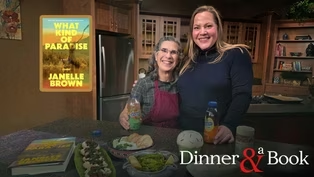
In her 2025 novel, What Kind of Paradise, best-selling author Janelle Brown
In her 2025 novel, What Kind of Paradise, best-selling author Janelle Brown sends us back to the 1990s, when tech companies changed all our lives in unimaginable ways. Readers, like our teenage protagonist, Jane, have to wrestle with what’s good – and bad – about technology’s reach into our humanity. WNIT President and General Manager Amanda Miller Kelley joins April Li...
Problems playing video? | Closed Captioning Feedback
Problems playing video? | Closed Captioning Feedback
Dinner & A Book is a local public television program presented by PBS Michiana
What Kind of Paradise
Season 25 Episode 20 | 26m 46sVideo has Closed Captions
In her 2025 novel, What Kind of Paradise, best-selling author Janelle Brown sends us back to the 1990s, when tech companies changed all our lives in unimaginable ways. Readers, like our teenage protagonist, Jane, have to wrestle with what’s good – and bad – about technology’s reach into our humanity. WNIT President and General Manager Amanda Miller Kelley joins April Li...
Problems playing video? | Closed Captioning Feedback
Where to Watch Dinner & A Book
Dinner & A Book is available to stream on pbs.org and the PBS app.
Providing Support for PBS.org
Learn Moreabout PBS online sponsorshipDinner and A Book is supported by the Rex and Alice A. Martin Foundation of Elkhart, celebrating the spirit of Alice Martin and her love of good food and good friends.
in her.
2025 novel.
What Kind of Paradise, Best selling author Janelle Brown sends us back to the 1990s, when tech companies changed all of our lives in unimaginable ways.
Readers like our teenage protagonist, Jane, have to wrestle with what's good and bad about technology's reach into our humanity.
I've got a very special guest in the kitchen today.
WNIT President and General Manager Amanda Miller Kelley, who suggested this novel.
Welcome to this side of the kitchen.
Amanda, thank you so much.
I can't believe I get to be back here with all the tools.
It's a dream.
So, like your imagination about this novel.
So I think I love a book that is off the grid, but I also love a book that gives us insight into something we lived through.
It's terrifying to me that the 90s is historical fiction now, but here we are, and this book had both of that.
You had the beginning where they're off the grid and then you have the, the well, the second half where you're really getting insight into this kind of part of history that we've lived through.
Yeah.
Silicon Valley, what an insight.
You know, what a great view into that.
There's lots to talk about.
And in the theme of our cooking today is foods of the 90s, which was so fun to think about.
Vintage.
So what... Obviously Yes.
So what are you making?
So I was a child in the 90s, and when we first started talking about 90s foods, the first thing that came to mind and then did not leave my mind was a little snack called Duncan Roos, which were these little cookies that you dipped into frosting.
Truly, the cookies are the vehicle for the frosting.
But so that's what I'm making today.
And I guess the secret to it is you replace half of your regular flour for the cookies with graham crackers and a little bit of cinnamon.
It looks like a lot of cinnamon, actually, but we're going for it.
So that's been duped to get that sort of manufactured in the factory.
To get the Dunkaroo vibe.
You have to do the good while you're getting started with that, I'm making.
So I was an adult.
I was in my 20s in the 1990s and watching PBS, learning about cooking.
So I watched Pierre Franey.
I watched Julia Child, Julia and Jack.
And when I was kind of reminiscing with my family about flavors that we were introduced to in the 1990s, we thought of.
So my saying that, okay, very Italian goat, goat cheese, sun dried tomatoes, Shishito peppers.
So I'll be making those a little bit later.
And oh yeah, cilantro in a, in a dip that I'll be making.
So these I'm going to toast these just a little bit.
I have some of them toasted.
And then I'm going to rub these with garlic.
You're getting started on that.
So let's get a just a little overview of what this novel is about.
We have a protagonist, Jane, who's a teenager, late teens, and we suspect that we have an unreliable narrator.
I love an unreliable narrator, and she really tells you right from the beginning.
Yes.
This is colored by her relationship with her father and everything that came afterwards.
And so having someone just write in the beginning, say you might not be able to trust all of this is one of the ways to really bring me into a book.
That's great.
And we will.
I'm just rubbing this some of these that have been toasted with some raw garlic and the garlic right on there.
Yes, indeed.
Not for the faint of heart.
So we're going to work very hard to avoid plot spoilers.
This is a, in your words, propulsive novel.
It does just sort of drive forward, and there's a lot of twists and turns that sort of set in two different locations.
So maybe let's talk a little bit about Jane's childhood and what that was like in rural Montana and really off the grid.
So it's Jane and her, her dad, Saul, and it is as though technology in the future are not there.
You know, they have a television, but they're not allowed to watch it.
She watches it.
Yeah.
Without her?
Yes.
Which is great for a child.
Every kid wants that.
But he.
He has really set up a life where they don't interact with a lot of people, where they don't have a lot of.
Yeah, outside contact.
And you kind of know from the beginning, right, that something is amiss.
Right?
Yeah.
Right.
Which I love to, you know.
So lots of little hints.
And in his I mean the title reverberates some kind of Paradise because in a way it is a Paradise.
There's a purity of it.
He's not a he's not a creepy father, you know, it's warm.
I think you often find in these off the grid novels where there's a girl and he's not doing this, you know, because he's trying to hide abuse or because he's trying to hide, you know, keep her away from something specific.
It's.
This is.
He's he's.
Well, he's a Luddite.
We learn that later.
He's not interested.
Anti-technology.
Yes.
So she has this kind of classic great books.
Yes, yes.
Where he's doing Socratic dialogs with her.
I'm just putting a little bit of goat cheese.
The taste of the 90s on here before I do some.
I was going to save my mixer for the frosting, and now I'm really regretting that.
Oh, it looks great.
It's going.
It's as they say.
It's coming together nicely.
So it looks.
And I love that you're just going to make those little tiny cookies.
They're going to be little.
Because you know what the point of them is just to get the frosting and small enough to scoop.
If you were a child of the 90s, you remember that feeling.
So we have some we start to have some hints that something is amiss.
As you said, her father starts going away on leaving trips.
Yes, he has a zine, which also very 90s has a zine.
He's trying to get carried.
Yes.
That is and and the theme is his Luddite manifesto.
This idea that technology, there's something profoundly bad unsettling about it.
Right.
And then.
But this is when he opens up the world for her.
Right.
Is when he then comes home with technology because he wants to spread the word of his Luddite manifesto.
And he says here, learn how to code, which was such an interesting, like, protected Jane forever until I need my word spread.
Right?
So he brings in a computer and her world, as you say, just opens up.
And so we're thinking, you know, you might remember that moment in the 90s where, you know, we would we knew there were these giant computers, but, you know, people would say one day there, you know, each home will have their own computer.
That's not possible.
How will it fit?
So she, you know, also the the internet was rudimentary enough that it really was possible that a teenager could, with a book that her father hands or learn how to code, make a basic website, which she does.
She does.
But of course, it doesn't stop there.
Once she's connected to the internet, she's she's she's on a roll.
And that's where she kind of meets her first introduction to the world.
She doesn't really have any friends in Montana because she doesn't go to school.
She's got one, right?
One friend.
And that's where she realizes there's more people.
There are, and they live in AOL chat rooms.
That's right.
That's.
Oh, I spent a lot of time in AOL.
Really?
Yeah yeah yeah yeah, yeah.
So and this I would say is also, you know, there are parts of the story that are definitely it is a sort of domestic terrorism story, but the there is not a I don't think it's a spoiler alert to say there is no monster in a chat room.
No, no, no, no.
She meets kind of a like minded person.
They're sort of a real sweetheart.
You who really is the first person, I think, who helps her put, like a pin in the fact that this is not a really normal way for a teenage girl to live, right?
She seems to.
Doesn't really know anything else.
Yes, she's known it that maybe this isn't totally normal, but he says, you know, if you ever need anything, you know where to find me.
Yes.
Yeah.
So a very first friend.
So maybe we can talk just a little bit about.
Let's see Jane's building sense that her father is up to something, a little bit of suspicion.
There's a little bit of not I wouldn't, I'm not sure thriller is the my word, but there's a real suspense build in this part of it.
Yes.
And she she knows that.
And then he she really knows it when he comes and he says, hey, we're going to, we're going to go on a trip because.
Oh, and when she got so excited and was like looking up what they could, you know, visit and see and it was a real you really saw how sheltered she is.
Yes.
So they begin to they're going to go to Silicon Valley.
So I'm going to put on here a little bit of balsamic drizzle.
And then if we were in the the time of year where we had beautiful basil, I would put that on top.
But instead I'm just going to do some fresh parsley.
So let's talk about our own.
You know, this is sort of nice that we have two different, you know, sort of a generation difference here.
I remember, you know kind of my attention span pre-internet.
I remember what it was like to do work without email.
What do you remember as a, as a kid kind of coming of age.
There were some chat rooms.
Yeah.
We were fairly early adopters of, of the internet.
I think part of that had to do with just what what my parents did for a living.
We were fairly early adopters and I. I still remember, though.
I mean, we were also a household that we had a set of encyclopedias that we used pretty much every day.
We were a household that if there was a debate at the dinner table, we would call the library to find out who was right.
So for us, there was a real benefit of like, you had all this information at your fingertips and that was that was a great piece of it.
But I do think it also kind of helped make the world feel a little bit smaller, that it helped make you realize how much information was available to you.
Yes.
And some of that is just amazing.
Yes, there's a real benefit to it.
And then there's also like, well, what about safety and what about fact checking and what about you?
So and I think that there is a real reflection.
We'll probably get more into this later, but I think there's a real reflection on kind of where we are right now in a new frontier of standing on the cusp of technology.
Yeah.
With AI.
Absolutely, absolutely.
So lots to get to.
It really is a philosophical novel while being propulsive.
So we're going to take a little break here and you'll see some images of both Montana and Silicon Valley in those early burgeoning days.
We'll be right back.
All right.
Amanda is in the next stage of production.
So tell us what's happening.
The multi-step process.
So I am shaping the cookies.
Now, if you were someone who has, like, small cookie cutters, you could roll it out really thin and do that.
I am not someone who has small cookie cutters, so we are just sort of shaping them.
I'm doing this rolling on the edges thing that that April just taught me a little pro tidy.
Those look great.
And then they will go in the oven for like 8 to 10 minutes.
We have one batch in there right now and it's smelling so cozy.
I have the graham crackers really making crackers in the cinnamon.
It smells like childhood.
It looks great.
This probably doesn't.
So this was really a. Well that's true.
Well.
Well said.
So this is a very simple appetizer that I think kind of hit the scene in the 90s when all of us were discovering small plates.
So this is could not be simpler sort of medium pan here.
And this little tip to rather than putting all in the pan.
The peppers have lots of little dimples.
So nice to kind of get all of the all of the surfaces coated in a little bit of olive oil, and then we'll do the pan.
Probably should have been a little off.
So but the idea here is to let them blister.
So hopefully we'll hear some exciting popping.
So you don't mess with them too much.
We'll let those let go.
Yes.
Well we were talking and you said that we were talking about our memories of the 90s, and you said that you had just started making tapas in the 90s.
So is this like it was part of.
The idea that you would order just a plate of peppers with nothing but a little sea salt.
Kind of blew our minds.
And that was, you know, of course, many people had been eating tapas for a long time, but this is dishes that kind of came to the Midwest.
This is already having a nice little perfume.
It doesn't.
So it's a little bit of a road novel.
There's a complicated road trip for our heroine to get to Silicon Valley.
Let's talk a little bit about that Paradise.
The kind of optimism of the tech world and mostly tech men.
Yes.
She's one of the few women she gets a job at this.
Really?
Learning all that coding paid off because she was able to just right away landed the coding, landing a job, even though her upbringing was really humanity's kind of great books.
But she's a critical thinker.
I'm just chopping up while these are cooking.
I'm going to make some cilantro lime dip with bagel chips.
Bagel chips.
Oh, that is bagel.
Everything.
Oh, I love to bagel.
So if you are moved to make bagel pizzas after this, we will not see that jingle.
I won't, but I was impressed with how many jingles you have.
That's true.
That would be some nice outtakes.
Nobody needs to hear that.
So, yeah, I think that the the kind of transition of her life from totally off the grid in Montana to be very on the grid in Silicon Valley was.
Kind of a story of youth, really, because how quickly could you make that that transition now?
It would take me a long time.
Oh, absolutely.
Make that just like, okay, this is life now.
And she's she's also seeing very critically her father's perspective as a Luddite.
She's seeing all of the the value.
Let's see.
Do you want to check your Dunkaroos or shall I take a look, see if they're they're so tiny.
They're getting there.
They have grown in the oven.
They have.
Oh, they smell so good.
Yay!
Okay, where's the best place to give you a little.
There you go.
Put it right here.
See?
Like, do you know this?
Here we go.
We'll be able to admire them.
Oh, great.
Her father's perspective, too, I think, is an interesting because you and I read this book in different ways.
Yes, I'm a big listener to books, so I listened on audiobook and April, read a hard copy of the book, and I mentioned that I don't often listen to books with a full cast because it feels more like a play than a book.
But in this one, yeah, there were two narrators because the father's journals and his manifesto were read by a different voice actor.
And then you told me that in the book.
Yes.
They use a different font.
So it was interesting.
I mean, I just I both read hard copies and I listen.
And this is the first time anyone has told me what the hard copy version was like with your friends who consume these in different ways.
Different ways.
You can see these are blistering blistering nicely.
Oh, they smell.
They do smell really good and aren't very spicy.
They got a little bit of spice to them.
But now these are going in these again.
Okay, so another eight minutes or so.
These look totally fantastic.
They almost look like snickerdoodles.
They do sort of they crack a little bit on top.
I cannot wait to to try them with the frosting.
So what is the story of the Dunkaroo frosting?
The signature.
You know, the whole point of the Dunkaroo is the frosting.
And so it has it's just a regular kind of butter, powdered sugar with some milk.
But it's the sprinkles that are really.
Yes.
You throw in the sprinkles, which were all over food of the 90s.
There was something I had just repressed Cosmic Brownies.
Oh, yeah.
Oh, they still make those times on at the store the other day.
So sealed and individual.
Lots of sealed, so much plastic.
We really wanted our snack foods to never touch anything else.
And so many just.
Gosh, what did we know?
We knew nothing.
All of this sugar free.
Oh, yeah.
Food that.
Then people were like, why am I not losing weight?
I just ate a box of sugar free, sugar free cookies.
Or the fat free.
Yes.
Yeah, yeah.
Fat free.
That was.
Yeah.
So.
So Jane is starting to, as she's discovering kind of the value of the internet.
She's also discovering more about her family of origin.
And there has been some some cover ups along the way, including meeting her mother, who is one of the few women in the field and actually one of the few women in the novel as well, which, oh interesting point.
Yes.
You know, our protagonist is is female, but most people that she encounters are are not.
Yes.
And you know, the mother, there's almost a caricature aspect to the mother that.
Yeah, she's cold and she's career driven.
And I thought that was interesting choice to make about a woman in tech in the 90s.
Yeah.
There was that's an area where I felt like we could have had a little more depth.
I would agree, I think there's some yeah, critiques of the novel that way.
This has a nice base mixture of you can't go wrong with sour cream and mayo together.
So and from a tube, you know, I know this is my ode to the 90s, although I was served that way.
So so Jane starts to really question almost everything.
Everything to the her identity, her what she's taught, what she's, you know, what she's learned kind of her her role in things that have happened that her father has.
Well, yes.
So we were treading carefully there.
But she's definitely implicated in.
Domestic terrorism.
Yes.
And that her father seems in some way to be connected to a few lines here.
And I feel like.
This is the this is the part where, where Jane kind of first starts to think of herself as separate from her father, both because of what she's she's discovered about their history and their past, but also just because of who she's meeting and who she's getting to know and the perspective that she's getting.
These are going to be very vanilla, because I just added more vanilla than I was supposed to, but that's all right.
So this this is a nostalgic piece, but it also is coming out.
You alluded to this earlier in the age of AI.
And so maybe we could just talk a little bit about what that feels like reading now, some of the same worries that people had about the early internet.
Absolutely.
It's where we are now, where we're seeing the effects, which is what her father was afraid of.
Right.
That it was it's not just a way of doing work.
It might actually affect what kind of people we are.
Well, there's a story that her father tells about coming home and finding his wife and daughter playing together.
And she says, we're building me a friend, which I thought, given what we know now about people's relationships with their generative AI.
Was a very.
I don't know.
Yeah, precedent that would that would be a good word for it.
And here in the media world.
Right.
Which is where, where, where we are right now, I think it's really changed the way people not only consume media, but also how they trust media and how they feel about where they're getting their media.
So it's, you know, it's certainly something.
Okay.
I'm dumping the sprinkles in.
It's certainly something that we think about every day here, what role AI plays.
And we're standing at a similar precipice as they were in in this novel.
Yeah.
So both the throwback and extremely timely and again, very philosophical, I think any reader would is going to be reflecting on their own use of, of these tools.
So we're going to take a little break and set the table for the 1990s.
We will see some images from Janelle Brown's website and we will be right back.
Amanda and I have made a feast from the 90s.
Smells great.
So tell us what you fixed over here.
So these are the Dunkaroos.
They are cookies with graham crackers.
The frosting, which is really the key part of it.
I will say that if you had small cookie cutters, these could be even cuter, but I think that they will still do the job of getting the frosting into your mouth.
Which sprinkles are the key?
The sprinkles are so cute!
Festive!
And I made three small plates so tastes of the 90s.
Some Shishito peppers, blistered with a little bit of lemon and flaky sea salt, some cilantro lime dressing with bagel chips, hello 90s and some little crostini with sun dried tomato and goat cheese.
Taste of the 90s too.
It smells amazing.
Well, one day we'll get smell a vision.
So.
So this book is written in 2025, reminiscent of the 90s.
Takes us back and forth.
Why would you recommend it to someone?
I'm so glad that you recommended it to me.
So I recommended it to you because I thought that it was such a great snapshot of a period in time.
So for anyone who I think can handle hearing that the 90s are now historical fiction, it opens up so many conversations about what what technology means to us and how it changes lives.
Yes, and all the more prescient as a word we use to just talk about what it would be like to maybe discuss this with a book group now on the cusp of absolutely on the cusp of AI, another big leap forward where there's positives.
I mean, the book is really leaves you thinking it's not a it's not a black and white kind of argument.
So you want to think about the humanities and other things that make us human.
So we're drinking Snapple here and it has just been a blast to have you.
Cheers, cheers, and thank you so much for joining us.
We hope you will continue to read widely.
Cook adventurously and we'll see you next time on Dinner and a Book.
Cheers to you.
Well done.
This WNIT local production has been made possible in part by viewers like you.
Thank you.
Dinner and A Book is supported by the Rex and Alice A. Martin Foundation of Elkhart, celebrating the spirit of Alice Martin and her love of good food and good friends.
Providing Support for PBS.org
Learn Moreabout PBS online sponsorship












Support for PBS provided by:
Dinner & A Book is a local public television program presented by PBS Michiana