
The Stardust Road
Season 25 Episode 10 | 26m 46sVideo has Closed Captions
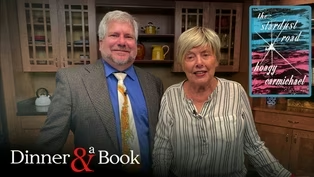
Bill Firstenberger joins Gail Martin to discuss "The Stardust Road."
The Stardust Road shines a huge spotlight on Hoagy Carmichael, Hoosier composer and performer, movie star and golfer. Bill Firstenberger joins Gail Martin to discuss Hoagy's formative years at Indiana University Bloomington where he helped usher in the jazz age with famous musicians such as Tommy Dorsey, Paul Whiteman and Louis Armstrong.
Problems playing video? | Closed Captioning Feedback
Problems playing video? | Closed Captioning Feedback
Dinner & A Book is a local public television program presented by PBS Michiana
The Stardust Road
Season 25 Episode 10 | 26m 46sVideo has Closed Captions
The Stardust Road shines a huge spotlight on Hoagy Carmichael, Hoosier composer and performer, movie star and golfer. Bill Firstenberger joins Gail Martin to discuss Hoagy's formative years at Indiana University Bloomington where he helped usher in the jazz age with famous musicians such as Tommy Dorsey, Paul Whiteman and Louis Armstrong.
Problems playing video? | Closed Captioning Feedback
How to Watch Dinner & A Book
Dinner & A Book is available to stream on pbs.org and the free PBS App, available on iPhone, Apple TV, Android TV, Android smartphones, Amazon Fire TV, Amazon Fire Tablet, Roku, Samsung Smart TV, and Vizio.
Providing Support for PBS.org
Learn Moreabout PBS online sponsorshipDinner and a book is supported by the Rex and Alice A. Martin Foundation of Elkhart, celebrating the spirit of Alice Martin and her love of good food and good friends.
This book, The Stardust Road, shines a huge spotlight on Hoagy Carmichael, Hoosier composer and performer, movie star and golfer.
I loved this book.
Just to find out more about this very famous composer and singer.
Joining me today is another Hoosier who loves his state.
I don't know if he plays the piano, but let's welcome Bill Firstenberger who probably visited the Book Nook bar as Hoagy Carmichael did Welcome.
Thank you Gail, thanks for having me here.
It's good to have you because you're a Hoosier.
You went to well, you went IUSB, but you've been down.
Oh, sure, sure I did.
I visited IU campus many times.
Yeah.
And so, but the book nook sadly was gone before I ever arrived on campus.
I believe that it closed in the early 1970s.
And so, but, yeah, it was quite a place.
Oh, you know what?
I just I love the book because of the good feelings of the people in the book, even though they were hard times in Indiana, it was after the depression, and they all Hokie and his friends took advantage of the opportunity to play, learn music and enjoy each other.
Well, it was such a critical time in the development of, jazz music in the Jazz Age, and I love that the book pointed out that Bloomington, Indiana, at that point in time, in the 1920s when he was there, was the demographic center of the United States.
And so this movement that was going across the entire country was was centered in terms of population based in Bloomington, Indiana.
And so that's why a lot of jazz things happened in Indiana, because of all that, the transverse and they could go up to Chicago.
It really lay down Louisiana, New Orleans, Florida, Saint Louis.
So it was a hotbed.
It was a hotbed, absolutely.
And great music.
Some of these people were fabulous here in Indiana.
But, you know, now, IU is known for its music, of course.
Yeah.
And mainly classical.
Yeah.
We tap into that all the time.
Everything.
Yeah.
And so very, very happy that that's so close by and such a rich resource for us.
Yes, it really is.
And I can't begin to say I don't know why it doesn't get more attention in the newspapers.
It's probably the most famous music school in the United States.
I'm saying that knowing Juilliard, people will say, oh, wait a minute, wait a minute, but we're not going to be, oh, you know, oh, not at all.
So, well, you know, let's talk about our menu before we get.
Absolutely.
I'm going to get started cutting up some vegetables.
I've got a long way to go here.
And so what do you have here.
So we're going to be making what's called sheet pan Hoosier stew I like that and it's not very stew ish but it's it's, very easy to cook.
And so the first thing is, I've got some fresh green beans, carrots, potatoes are already starting to roast, and I added a little zucchini here that I'm going to put in it, and we're going to just put these veggies all in this, mixing bowl and, kind of coat them with olive oil.
And, you know, that's a great way a lot of people now are preparing their vegetables this way.
They're putting them in water.
They're baking, roasting them in the oven.
And I like to do it that way.
I think it's fun.
The timing issue, of course.
You gotta watch them.
You do.
You can't run.
I don't I can't walk out of the kitchen.
And so you're going to do your zucchini, green beans, potatoes, carrots and that's it.
Oh.
And then I'll add some ham to it.
We'll keep the ham kind of separated on the sheet pan.
And when we, you know, we us we would mix it all together.
But maybe you might have a vegetarian in your dinner party and you want to let them separate if they want that.
That's a good way to handle it too.
Just let them decide.
You don't have to worry about stirring.
I just want to say that.
Well, I'm going to be making a, dish of crudités, you know, relishes.
And then it's a strawberry angel food cake because those were very popular at the time.
And relishes are still on the same, but they're not so much served at table time anymore.
But they made up like one third of the meal.
When I was growing up, you stuffed yourself on carrots and celery.
So we're adding that.
And, how are you?
How do you think those potatoes look?
I think they're going to be just perfect.
Oh, I think so, too.
They needed a little head start.
So the potatoes get about an extra 10 to 15 minutes at 425, and then everything cooks at 425.
And, you know, occasionally in this program you will hear his most famous piece, and it was called The Stardust Rose.
And then shorten, Road I mean, right, it was short And then later on to Stardust and everybody sang it, Perry Como and Bing Crosby and and it was know we had a rendition of it performed, this spring by a pianist at, at Ruth Mary in our spring concert series.
And I suppose you announce that you're going to be on television talking about it.
I had no idea at that point.
This is phenomenal.
Oh, that's interesting.
It truly is.
Yes.
Well, you know, who was his first teacher, do you remember?
Well, I think he credited his mother first.
She really was his first teacher.
She was quite a player.
She played at all the silent movies in town to earn some money.
Right.
They they were not well-heeled by any means.
So the father had to find so many different jobs.
He didn't last very long at jobs.
And, Hoagy actually worked at a, Oh, gosh, where you call it where you trim up the beef and.
Oh, yeah, he, he worked at, like, a, a rendering, plant almost.
It was, it was sounded just awful.
And that's something we want to talk about while we're preparing.
No, but you know what other very famous person did the same thing.
He was very poor in New York, Benny Goodman.
Oh, really?
Yes.
Oh, I didn't absolutely.
So these these stories are so interesting.
And I really enjoyed that.
It was set in Indiana and Bloomington.
But, you know, he was being very careful, too.
He was playing music with these fellows for dances, fraternity dances, sorority dances.
But then he thought he should probably study something else that might be more practical, practical and dependable.
But it turned out it wasn't.
But he studied law and he studied in one year after he graduated and is is career never fully blossomed.
He really wanted to be with music, right?
He talks about above that the whole time he's coming back to this story, of of I must get back to the books.
I got it this it's an inner voice.
Yeah.
That is telling this to get back to the law.
Oh, you get back to law.
That's where you're, you know.
Yes.
Your money's going to be made, and it never really was made.
No, he he had difficulties with that because his true love was really music kept.
He kept thinking about it.
He had friends in the fraternity that were musicians.
So, yeah, it's just a fabulous book.
It's.
So what's I find interesting about it, too, is that it doesn't read through.
Chronologically, from beginning to end.
You write an autobiography.
It's around a little bit, a lot, a lot.
And by page 25, he tells you he gives this explanatory paragraph and says, you might be confused by this point at how much this book jumps around.
And the thing that that he said he was using to organize it was how his memories were organized at that point in time in his life.
Yes.
And he considered himself in the mid 40s.
This book was written in 1946 as a composer, that that's what his main job was.
And so he looked back at his memories of the 19 teens and 20s, when he was really cutting his teeth and becoming a jazz performer and songwriter, through that lens.
And it just jump, it jumps from relationships that he had to, with women and also with fellow musicians.
It's just a fascinating way to look at how one person thinks, and sees the world.
Well, he just had a lot on his mind.
He he felt so sorry his young sister died because she couldn't they couldn't afford a good doctor.
And he said, I will never let that happen again.
I will work and I will help my family, and this will never happen again.
And I think many families were living that way and had those.
That was, I think in part at least my opinion was why he kept coming back to the law.
Yeah, practical side, because he had this sort of inner voice of his, lost sister saying, you know, you got to do something that makes sure that food can be on the table.
And yeah, well, that even led to the fact that he liked some girls, but he wasn't going to get involved with them because he knew he had to.
He he doesn't say it out, but you can read between the lines.
He worked to have money to help the family, so nobody would die from a disease.
And it was some kind of, Asian flu.
And, he was tempted a few times to get married and he said, no, I've got to put my life first.
And I think that's very clever and was very knowing at that time.
Well, I have to say it, my parents got married, never lived together for seven years afterwards.
Really?
Yeah.
It was during the depression.
And I have a story about how long it took for me to get him for.
My parents dated for 12 years before they decided, well, I yeah, I really want to do this.
I always felt like I should have been at least 12 years or 11 years older than I was, you know.
But now I'm glad you know.
Well, you know, come back.
It was the same thing when we heard about this.
You went home.
My mother went home to her family, and my dad went home to his family.
They said, well, we just had to plan ahead.
And they both worked.
And she oh, she never lost her job.
It was in the depression because women weren't allowed to work.
So I think I have just a minute to go here.
We're still going to continue working on all of our food and go on to the next segment.
What are you doing?
So I'm dicing up the ham.
Yeah, I will also give it a little coating of olive oil.
And then everything goes into the oven for 425 for about another 20 minutes.
Hold that thought.
Because we're going to take a short break.
In the meantime, we have scads of pictures to show you of Hoagy, Carmichael.
And then we'll be right back.
Well, we're going to finish up our prep here, put it right in the oven, and then we're going to talk a little bit more about this famous man, this Hoosier, this brilliant Hoosier.
I just thought he was so funny.
And he would compare his voice to the scratching twigs in the wind or something like that, and I just.
I really liked it.
So how did he get along with his frat bro?
His fraternity brothers?
Oh, his friends that he liked in the band.
Yeah.
I mean, that's something that he, talks at length about, by the way.
Well, just a little light seasoning.
I'm doing kind of the things that I like.
Okay.
Maybe it's not what you like, but, a little bit of lemon pepper, and I'm a big old Bay fan.
I'm.
Try being very careful not to get this on the, ham.
It's already salty enough.
You know, I think you're smart, right?
And, too much salt.
A little extra pepper, though.
And that can get on me.
And this is going into the oven for how many minutes?
Probably about another 20 minutes.
Another 20 minutes.
Okay.
All right.
So back way back to the you're going to take this and I'm going to putting it in the oven.
All right.
And back to your question.
Our top, the, college friends.
Yeah.
And let me get, the foil.
You know, many of us have this same experience where we meet people.
We and we're friends for life.
You know, Bill, you probably have the same experience, but this is this is an amazing, an amazing, episode.
Well, you build really strong relationships in college years, right?
And the you're crushing together with these people that, you know, you didn't know before.
And sometimes you have some conflicts, but a lot of times you build lifelong relationships out of it.
It's one of the first times where you have to learn how to work around any conflicts and how to settle them.
And there's a it's a good place to start and test yourself.
And, I think and his family was very loving.
So that all worked together.
And, and I think that's why I like him as well as I do as much as I do.
So what are you doing here?
What takes me back to my college days?
Oh, we couldn't drink at Depauw Where we're going to celebrate hoagie here with, a brew from Bloomington Brewing Company.
This is called, rising bloom.
Rising bloom.
And it's an amber ale.
It's a beautiful color.
And I love these beers because, well, the company took the time to put some really creative, labels on them that are very pretty and, very nice.
Beautiful.
So you have what they're.
Well.
Oh, there's a whole range here of, of of different, beers from Bloomington Brewing Company, but things like, this is the Quarrymen.
This is Empire, with the, you know, the building, the New York.
Yes.
Empire State, and by that one, the Empire State Building, because the Empire State Building was made with Indiana limestone.
Yeah.
So let's have a let's have a toast.
Toast to our Hoosier star.
Thank you.
Thank you for your bringing this beer and and and another thing.
And the food to another thing.
So.
Yes.
Oh, nice.
Oh, this is nice.
It has a little sweetness to it.
Just a little bit.
Is that is that out how all amber beers taste a little bit I think I'm, it's well I, you know I this one does.
That's enough.
That's good enough.
So.
Yeah.
So it's time marches on.
Hoagie is moving.
He's playing down in Florida.
He's playing up in Chicago.
And they go to New York.
Oh yes.
They become famous because he's playing he's playing with good players.
I mean, that's a lesson if you're going to try to play in a jazz band, find good players.
Well, they found him.
You know, they they he was a nobody at first.
And he would just show up and start playing the piano.
When at these places where famous bands were going to be playing.
Oh, you want to join in, boy?
Yeah.
So be going.
And so yeah, yeah.
Don't you know, say I can play, you know, three keys here for you.
And he took advantage.
He just loved it so much.
And he could never read music.
Yes, never.
He never read music.
He did it all by ear.
And so it was one of the.
He was just a natural genius.
He was he was.
We were glad he's from Indiana.
I remember seeing him in a movie with, Lauren Bacall and Hoagy.
Not Hoagy.
That's Hoagy hoagies in it.
Bogart.
Oh, Humphrey.
Humphrey.
Humphrey Bogart.
And he's playing the piano, and he's got his hat on, and she's singing next to him and and Bogart sitting in a chair watching.
And that's where he kind of broke out to.
That's the kind of thing he started doing when when the music style changed.
It was no longer this kind of music.
For a while, there was a lot of blues and and other styles.
Well, big band style was, was sort of consuming, you think of the Warriors and, yeah, Benny Goodman and things like that, Glenn Miller band.
And so.
Yeah, but but Hoagy stayed relevant, all through the 50s and into the 60s for sure.
And was.
Yeah, was a regular feature in the, Hollywood.
Well, he I don't know if he said one day, you know, this movie's changing.
I'll go to the movies.
I think he just he said, oh, there was a particular piece that somebody heard him sing, and that's how he got started in, in the movies.
And, and so he, he was a fun person to I think he, he took care of his mother, took care of his father.
He was very good to them.
And then he had, he got married, went to California.
It took him a long time to get married, right?
Because he married for a very, very long time.
And a lot of people thought he was going to be a lifelong bachelor.
And, but he's just saying, no, I was just, you know, waiting for the, the right song to kind of show him who to who to find and, yeah.
So it's a fabulous story.
And he, he kind of weaves this, his own sort of downhome poetic style into things like, what was it, the phrase he the year has pants.
Yes.
He uses this phrase like at least ten of the show.
The movement of time, the movement of time.
The year had pants.
But, I think that that also was a reference to letting the reader know that he was going to be shifting gears.
With, you know, he's going to be jumping around.
He might be talking about, his times with Bix Beiderbecke, the tragic, story of, young, you know, another genius trumpeter.
Yes.
Who, who was became an alcoholic and lost his life young.
And so, yeah, there were a lot of names in there, a lot of very good names of musicians and actors and lyricists.
And he his wife, he his first wife encouraged him to go out in public and meet people, make connections.
He had never really done that.
And they didn't stay married.
The second wife.
Oh, wait, which one did he have?
The children.
The first bird.
I, the he doesn't talk a lot about this because it comes along so late in the book, but he does credit his wife as being the person that pushed him out into social circles, because otherwise he would just be happy with hanging with musicians.
All day long.
And, his piano.
Well, and that's right.
And this book is so interesting.
It's so much fun.
As I said, I read it three times, so.
And every time I would discover something new.
Yeah, he must have taken a lot of good notes.
Well, you inspired me to, you know, get another first edition.
So when you said, let's do this book, Bill, I went scouring the internet and I was able to, find one for a reasonable amount.
And, you've been happy to collect.
It's added to the collection.
I the people who will maybe have seen, a past episode that you've been nice enough to have me.
I know that my ideal is that I like to read old books.
In in the context of reading an old book I don't own, you know, the tablet software where you can, you know, read it on a tablet and then just download it.
I don't think that's fun.
No, it's that I like that for me, I like the hold the book.
Hey, we got a lot of read here today.
Yeah.
And so how many more minutes do you have in here?
Oh, another probably ten minutes or so.
Oh, okay.
Well, you know, I love the pictures in this book too, because they show him.
He said he was kind of like an old twig.
He was so thin.
An old twig and and leafy and noisy.
And his singing style was not the bravest.
Not the most.
Yeah.
You know, musical.
But people loved it.
It it was a little bit like that white haired, bearded guy that sang later on.
I can't remember his name.
Burl Ives.
Well, that one.
And then there's been more, but he, he he did that.
Moved to California at the right time for his life.
In his career, he had two boys, and they just adored him, and he spent time with them, but he was always busy.
So anyway he did he the grass did not grow underneath his feet as they say.
They he he was always finding new creative ways for, for his outlets of energy and I think just somebody that, that we as Indiana Hoosiers can be proud of, I think we should be.
Yes, absolutely.
Well, we have, we have just a few minutes.
Let's take a look at our menu, and then we'll be right back.
Well, we made it.
We're at the final segment here with our Hoosier meal!
That's right.
Hoosier stew.
Yes.
With, a little bit of, I did a sweet, smoky glaze on the ham, as a final topper for that.
So.
But the the vegetables, roasted vegetables, it's really modern looking to.
It's not just 1940s.
It's got that roasted vegetable feel.
And of course, we have the good old fashioned relishes plain.
There are any dips, from the 40s and 50s.
And then a strawberry cake.
The healthiest thing.
It is.
Yes.
And normally I would slice the strawberries and put them inside and make a strawberry, sauce so that down the edges.
But we just we had so much fun talking about this book and then this wonderful book, Stardust Road.
And I really the libraries have it.
It's in demand.
I do recommend you spend an afternoon reading it.
It's only about 150 pages.
Yeah.
So tell us what you're holding on.
Well.
Your hand.
Oh, I said that I was lucky enough to get an A first edition copy, and and so, again, I, you can get any copy that you want from the library or anywhere that you'd like.
And they've been doing reprints now for over 50 years.
But, I like reading historical copies of books that make me feel like I'm transported back in time to when it was written.
So, yeah, I'm glad you did that.
That's a good thing.
It's too late.
I've been too many books and I couldn't find the first ones.
So we we had a good time learning more about Hoagy Carmichael, or maybe even learning something more about him.
And, I just think he's a treasure.
I think we should, in Indiana, you know, celebrate him.
And I'd like to see some celebrations down there for not just Ernie Pyle or, one of the, you know, somebody else, Cole Porter.
Gene.
Yeah.
Gene Stratton Porter.
Unrelated.
This was so nice to have him included in in this.
And I recommend that you get the book.
It's a fast read.
It's charming.
It doesn't really stand well with interruptions though because so much is going on.
It's it's a great window into his mind and how he thought.
And so for that standpoint alone, you think about all the great songs that he wrote.
It's really interesting.
So yeah.
Okay.
I just want to thank you for coming.
Bringing your Stardust Roads special book.
Yeah, sure.
And your tie, which is so charming.
Well, you know, fits right in you have to do something of the Jazz Age when I come on.
Well, yes.
Yes, yes.
And thank you for joining us.
And come back another time.
We invite you and join us.
We have more books to talk about.
Remember, good food, good friends, good books make for a super good life.
We'll see you next time.
Thanks, Bill.
Thank you.
This WNIT local production has been made possible in part by viewers like you.
Thank you.
Dinner and a book is supported by the Rex and Alice A. Martin Foundation of Elkhart, celebrating the spirit of Alice Martin and her love of good food and good friends.
I.
Providing Support for PBS.org
Learn Moreabout PBS online sponsorship

- News and Public Affairs

Top journalists deliver compelling original analysis of the hour's headlines.













Support for PBS provided by:
Dinner & A Book is a local public television program presented by PBS Michiana