
The Art of Resonance
Season 25 Episode 17 | 26m 46sVideo has Closed Captions
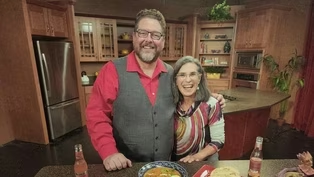
April Lidinsky welcomes back Aaron Nichols.
In The Art of Resonance, renowned theater director Anne Bogart delves into the powerful, fleeting connections forged during live performance - moments that stir both actor and audience. In this episode, April Lidinsky welcomes back Aaron Nichols, Executive Director of the South Bend Civic Theatre, for a dynamic conversation on the enduring magic, meaning and impact of the theat...
Problems playing video? | Closed Captioning Feedback
Problems playing video? | Closed Captioning Feedback
Dinner & A Book is a local public television program presented by PBS Michiana
The Art of Resonance
Season 25 Episode 17 | 26m 46sVideo has Closed Captions
In The Art of Resonance, renowned theater director Anne Bogart delves into the powerful, fleeting connections forged during live performance - moments that stir both actor and audience. In this episode, April Lidinsky welcomes back Aaron Nichols, Executive Director of the South Bend Civic Theatre, for a dynamic conversation on the enduring magic, meaning and impact of the theat...
Problems playing video? | Closed Captioning Feedback
How to Watch Dinner & A Book
Dinner & A Book is available to stream on pbs.org and the free PBS App, available on iPhone, Apple TV, Android TV, Android smartphones, Amazon Fire TV, Amazon Fire Tablet, Roku, Samsung Smart TV, LG TV, and Vizio.
Providing Support for PBS.org
Learn Moreabout PBS online sponsorshipDinner and A Book is supported by the Rex and Alice A. Martin Foundation of Elkhart, celebrating the spirit of Alice Martin and her love of good food and good friends.
Legendary theater director Anne Bogart made good use of the pandemic lockdown by writing her thought provoking collection of essays titled The Art of Resonance.
In it, she explains her ideas about the serendipity of live theater and puts words to the unique experiences we've all had in theatrical spaces.
There's no better person to discuss these resonating ideas with than Aaron Nichols, executive director of South Bend Civic Theatre.
Aaron, welcome back to the WNIT Kitchen.
Thank you so much, April.
I'm glad to be here.
And you knew who Anne Bogart was, but I didn't.
So.
Well, she is definitely one of the seminal directors of kind of the postmodern theater.
She, along with Tina Landau, actually a Chicago Steppenwolf alum, is created something called Viewpoints.
And that is just the ways of looking at theater space movement.
How you kind of belong and connect.
And that has been so important to me as a theater maker.
And I think it can be important to all of us as we find out how to use those lessons in our daily lives, and using those lessons in how we work within our relationships with others.
Oh, nice.
Yeah.
So you can already see it's about the theater, but it's about so much more as well.
There's resonance in daily life.
So in honor of this, we are making a resonating menu.
And what are you?
I am doing a curried lentil, tomato and coconut soup, which again, talks about resonance is more than just, what you see.
It's all of the senses and how they combine together and how they sometimes surprise you with their combinations.
Yeah.
And I think that kind of leads to what you're doing as well.
So tell us what you're doing.
This is this is resonating.
I'm making a flower lists, a show stopping Erin, a show stopping, flower list, chocolate cake, that will then be chilled and then I'm also going to make a Yotam Ottolenghi composed salad with both roasted and raw cauliflower and pomegranates and all manner of herbs.
And they will do some very fancy plating for, for the, for the finish.
So.
And I'm just getting started, here over a, some hot water, I'm melting the very quickly some butter and semi-sweet chocolate chips and then, you know the substance of this, since there's no flour comes from eggs.
So I'll be separating some eggs and having some gooey hands here.
And what are you getting started with here?
Some onion.
We're going to start simmering that and getting it kind of burning down and having a nice burning burning down the house.
So speak with some sauteed resonant onion.
Yes okay.
That's great.
So, when you, when you have a moment to pause there, what's your, your, your, onions and then let's get a definition of resonance because I think we, why don't you go ahead and put the onions in so they can get started?
But this it's a it's an idea that, of course, you know, lots of us are familiar with things that resonate, but she, has a very particular definition that will want to talk about some of these in a will slide into the book, and we can actually get some, definitions, which are always good as we start.
Okay.
And there's the sizzle.
There's this is part of the free zone of the theater.
Exactly.
Well well said.
And I think that's when you talk about the result.
I think it talks about resonance in a way very often.
Anne Bogart talks about how not just you hear something, but how it affects you, affects the senses.
You ever in a theater, have you gotten goosebumps, right, or have got magic?
Yeah, yeah, yeah.
So let me define what she calls it.
She says it in, in using the Oxford Dictionary.
Resonance is responding to vibrations of a particular frequency, especially by itself, strongly vibrating.
And I'll take that a little further by saying it's kind of the ripples, it's the ripples and radiations from what you encounter.
And so that impact is contingent upon the way the work resonates with our audiences and then spreads out those ripples again into the world.
And then the last thing I wanted to say is those reverberations engendered in the moment of artistic encounter.
So you can tell an is definitely an academic theater maker in that those, those ripples and, and and vibrations and, the, the ideas of how the encounter of the theatrical experience then affects you in your life.
And that's something that I think as theater makers, hopefully all of us encounter.
I've had some really wonderful experiences in the theater where I may not remember exactly what happened.
Yeah, in the theater, but I remember how I feel and how that experience helps me to engage then throughout my life with other people.
Yeah.
So I think that's important to remember.
It's not just the memory of the experience, but it's the the way it affects you.
And I think that's how resonance is beyond just a simple, oh, I remember a certain line or I remember a moment.
It's how it makes you feel as a whole.
Yeah, yeah, yeah.
So the I mean, it's so fun to kind of prepare for this talking, talking about these ideas with you because you've got experience as an actor, as a producer, as a director.
But so much resonated with me.
With me just as somebody who's been in theater and, you know, for example, I remember being a teenager and being in a theater, production of The Tempest, and they released rose scented, incense at one point.
And it was just, you know, my hair standing up just thinking about it.
Do I remember the lines now?
I mean, I did write a paper about it later, but, But those those are, you know, you cannot reproduce that.
It's what we were missing in the pandemic.
You know, you could, you know, people were viewing productions.
But what it feels like to be in the theater is something completely different in the relationship that that an audience has with the actors.
They talk about theater well, and talks about theater as being the place of seeing or the seeing place is how many people define theater itself.
And that idea of being the seeing place.
She takes one step further and says, not only are we seeing, but we're going to the theater as audience to watch the actors see.
Yeah.
So it's one step further.
And I just did a play called The Velocity of Autumn.
It was a wonderful experience at South Bend Civic Theatre, and there's this one moment I remember where I'm describing being in this Native American ceremony and watching this beautiful sand art piece being put together and I can feel the resonance between myself, the story I'm telling, and the audience listening to me tell the story.
Yeah, and and kind of viewing that act of creation together.
You may not remember that story, but you remember that connection that we all had to the art of or the act of creation.
Yeah.
And that's just a beautiful experience.
Yeah.
So I'm just going to catch you up to speed here.
You're up.
Yeah.
They're doing well.
They're not burning.
They're setting very nicely I was I was worried I am not the world's best chef but I can do like one on.
You are doing great.
So I just added some sugar a little pinch of salt.
Some Dutch cocoa powder that I've sifted.
And this has, this is optional, but come on a little bit of, pretzel powder and some vanilla.
And I'll stir that together and then, fold in a little bit of whipped cream, which I will whip with my immersion blender.
So, and what are you doing over there?
Well, I'm moving on to doing some, working with the ginger, getting that grated.
We're going to be adding that there's some beautiful flavors that are going to be coming into this soup.
One of those is some curry powder.
We have some, some red pepper flakes, some garlic, lentils, coconut milk.
Oh, it's just going to be a flavorful and of course, resonant soup.
Oh yeah.
Very nice.
So I want to talk about pick up on something you said about, the feeling of being in the theater is a nice little passage in there where she, slightly mocks maybe people who say, what is this play about?
And part of it is, you know, it's about listening.
I guess I do want my whisk here.
Let's see if I can get this going.
It's different every night.
Yeah.
Part of, you know, it's about whatever happens when, each night, the the responses of the audience change things.
Of course, then there is actually a book that is one of my works that I go to often as a director.
It's called Different Every Night by Malcolm, sorry, by Mike Alfreds.
And if you just take it on face value, the actual title of the book itself, different.
Every night you think about a play that's rehearsed and you think, oh, when I go to see that play, it's going to be exactly the same.
If I go on opening night, or if I go on closing night, or if I go on a, school show to the field trip.
It's going to be the exact same show.
And I will tell you as a theater practitioner that that is not true.
Yeah, yeah.
So the role the audience has, some work to do here, they absolutely do using, this is a new to me trick that maybe some of you know, but you can use your immersion blender to, to whip cream.
And that's especially nice if you've got just a small amount of cream to it.
So this is a, just a half a cup, and, you know, you don't get out your KitchenAid for half a cup, do you, Aaron I do not.
Do you ever get out your kitchen either?
I our family does, but I do not.
But I guess I guess following up on that different every night, allowing the moments in the theater to affect you as an actor.
When an audience responds differently to a piece, or when an actor delivers a line in a different way, you need to allow that to affect your performance, to affect your, your way of of responding to that.
And that allows the theater to live and breathe in the moment.
And that's, I think, what makes theater so resonant compared to other, other ways of telling stories.
Yeah.
If you see a film, that film exists in the same way every time you view it.
Oh, nice.
And I think that that is a reason to go to the theater, to be part of that ephemeral experience.
And that is exactly what we're doing in the kitchen as well.
This will taste a little different than other onions.
That take will taste different than other takes.
And isn't that a beautiful thing?
All right.
So I've just put that in the oven at 350.
We're going to let that cook.
We're going to let these saute down.
We're going to take a little break.
And you can see some pictures of Anne Bogart at work.
We'll be right back.
All right.
Just taking this out of the oven.
It's got a little jiggle to it here.
So I guess that's a resignation as well.
And I've been, having these, all stewing together.
We added, if you can see the crushed tomatoes.
And now we're going to be adding some more spices into this.
We have the beautiful pepper flakes that will add a little bit of heat to it.
We have some curry powder and we're going to add that into the mix.
Again some garlic that's been minced which is a lovely flavor.
And then just a hearty pinch of salt to have the flavors combined.
Oh the curry just hit me.
Yeah.
Fantastic.
Yeah.
Very, resonant indeed.
And while the cake cools, you're going to want to chill that before you serve it.
But we'll let that come to room temperature.
And I'm making you, madam Ottolenghis.
Cauliflower composed salad that has both, roasted cauliflower with a little bit of, onion in there.
And, one of the things I've really learned from him is to play with my vegetables.
Oh, so he, recommends, like, roast the leaves, roast some of the stems you can eat.
So much of the vegetable that we often don't eat.
And then that's chopped together with some, herbs and pomegranate seeds and a little bit of cumin and some of the raw cauliflower.
Speaking of herbs or adding some cilantro into our mix.
We also added veggies, coconut milk.
And I think that idea of play with our food is definitely kind of connecting us to the spirit of play in the theater.
As well.
And and the spirit of connection.
I think, the book really does talk about how there is a relationship.
We talked about that little bit in the first section about the relationship between the audience and the actor, and how there's an agreement kind of, at the beginning that that we we're going to go into a vulnerable place and we're going to go there together.
And what she says is it's a collaborative venture between performer and audience.
The word I really like the phrase I loved was a mutual entanglement.
Oh that's nice.
And that's kind of what cooking is to, you know, we're entangling all of these flavors, all of these dishes into something that that stirs us as we stir the soup up.
All right.
I can't top that.
So, so.
And that part of.
Yeah, I like the idea that that calls the audience to be present.
It also, she really encourages us not to think of theater as simply go and plan to be entertained.
We're in this mutual project and dissonance, as she says, is not consonance.
It's not always comfortable agreement.
And part of what she does in her own theatrical performances is place the audience in uncomfortable positions.
Correct?
Yes.
Have you ever had that experience in the show?
I have, thank you for asking.
Yeah.
And I think probably lots of people have seen Richard the third.
Shakespeare's Richard III.
You're in this position of, you know, the protagonist is loathsome.
You know, he he is physically unattractive, according to history and Shakespeare.
But when a performer plays that well, you understand why he's such a charismatic leader.
And I had a very conflicted experience watching being both attracted and repulsed.
And it was a Bogart moment before I before I knew about her.
How about you as an actor or as a, I think, performer?
One of the things Bogart talks about in dissonance is also this idea of not necessarily needing to be settled.
I think so many experiences these days, for whatever reason, we like a nice bow to be tied at the end, and I think there is value in the struggle, in the idea of how am I supposed to feel a certain way?
Is is my experience, is my is my lived experience, affecting my feelings about this?
We had a performance of, Alfred Hitchcock's The Birds, or actually, it was the Daphne du Maurier.
novel that was, turned into a play.
And at the end, the the people who have been stuck in this cabin just leave, and we don't know.
We don't know what happened.
And some of it is.
Okay, how do we wrestle with that feeling of of the non resolution.
And I think that is important when you're talking about resonance.
Again it's not the memory of the thing but how you felt.
And that visceral somatic experience is so important.
There come the the the goose bumps.
Goose bumps.
Yeah I need a little one of those really lovely passages.
And I think this is good enough that I wanted to share, with our audience was she talks about in the theater, you are required to hold your seat by the sheer fact of sitting next to strangers, by the necessity of turning off your phone and screen, by not bothering other people, by listening, by having faith, by holding still and by exercising.
I love this empathetic responsiveness.
Empathetic responsiveness, by holding your heart and mind, by thinking together and imagining together and laughing together.
The mere act of going to the theater requires you to express respect for other human beings.
The engagement demands physical intentionality and transformation.
Yeah.
Nothing less.
Right?
And that's what we're doing here in the kitchen as well.
Transforming just as a collections of ingredients into more than the sum of their parts.
Right.
And that is what happens in the theater if we allow it.
And I think that opening oneself to the experience is an essential element.
So when you go to the theater, lovely patrons, lovely audience.
Open yourself to that experience.
So you're not just a passive, a passive receiver, right.
But you truly are engaging both directions with the experience.
Yeah.
Yeah.
So, Aaron, I'm going to invite you to do the other drop drama of yes.
So we're going to be playing the, chilled, florals chocolate cake.
Yes.
And the, the plating experience can be lots of different things.
So Aaron's got four different plates to play with and, improvised.
And you've got some cream, you've got some raspberry coulis and there's herbs and flowers and cream.
So you just go crazy over.
Yeah.
And that idea of play, one of the things that Bogart talks about is, the, the new, I guess, urban sport of, of parkour or urban running, I think they call it.
But it's the way of encountering your environment and saying, I am not going to just resolve myself to to use this environment in the way that the architect of that space intended.
I'm going to say this is mine to explore.
Right.
And that is a very theatrical conceit as well.
Like, I'm going to use this environment and engage with it in creative ways.
Again, different every night, different every time.
And that's the playfulness that we hope to have in the kitchen as well.
When we're doing things like you're doing right now.
This is fun to make.
But, you know, as you're looking like you can use all kinds of different implements, instruments like for now, I'm using these, these little wooden, these, these toothpicks to then like, take what we have and pull through that, you know, making interesting patterns, being playful with it.
So when you put that piece of cake on, it's not just a piece of cake, but it's an experience, right?
Oh, absolutely.
And so, she also just for those of us, again, who are mostly audience members, she talks about play in terms of, oh, there's some hot pepper jelly.
Oh, that looks very cool.
We're going to see where we're being playful.
Let's see what happens.
It's a it's a fun experience right.
And practice.
We'll just see.
She talks about the the the experience of rehearsal, which I love reading about.
So and she uses this phrase, the, the thickening of the connections between cast members.
What's your experience with the like?
Trust is one of those experiences that you have to have in the rehearsal environment, because it's the space where you're building something together and you're being vulnerable again together.
And if you don't have that, that, that congealing, if you will, of a group of people into a common goal, then it's it doesn't work.
It's just lines on the page being delivered.
And, you know, if that's the bare minimum, that's a pretty low bar, you know.
So as you have those, those the memorization occurs.
Then the, the the engagement with the text and the meaning and the dramaturgy and all of the things that the director brings to the table and that the stage manager brings to the table, and each actor brings to the table all of those affect, again, the resonance of the piece as a whole.
Yeah.
So I think that's, a beautiful way of kind of entangling one another, you know, in, in the work itself.
So yes.
And I'm just finishing putting some, tarragon and parsley and, a little bit of salt and a little more lemon juice.
She talks about close to the end of the book, why theater is more important than ever.
Now, maybe we can talk about that.
Yeah, I think that's that's so important that we don't miss that.
The relationship, in a theatrical environment is very much the same as in our civic engagement as, as citizens.
There's a really beautiful piece that they talk about that it's it's crucial to consciously choose how to respond and how to treat the space in between.
Yeah.
You talk about distance in between, especially with the pandemic.
That was something she was dealing with as she was writing these essays.
You know, we had that six feet of negotiated space, and it made us so much more aware of that.
And now that we're post-pandemic, we have to kind of bring ourselves back together, you know?
Right.
Yeah, yeah.
And that relationship, we can either respond to others with fear and selfishness or we can project and communicate respect, friendliness and good humor.
Yes, and I April, I didn't ski is the best at good humor, having a great time together.
So we're going to take a little break here.
You'll see some of the innovative sets that Anne Bogart has designed, and we'll be right back.
Aaron Nichols and I have, had fun playing chess and, made a feast inspired by Anne Bogart's.
The Art of Resonance.
And part of that magic is what happens in the moment.
And so now, I think, for the first time.
Oh, okay.
In the WNIT kitchen, we are doing sparklers as a way of finishing the chocolate cake.
Come on baby.
And, there we go.
Let's see.
Oh, we can do this one.
So we made a flawless chocolate cake and a. Here we go.
Come on.
And a what?
What kind of soup did you make?
Oh, it's a lovely tomato, coconut and curry soup.
And this is just saying, you can always be playful in the kitchen, just like in theater.
And theater is such an important thing for all of us.
Because when we go in, we leave changed.
Nice.
And that's, I think, what Anne Bogart and her book, the Art of Resonance teaches us is to be open to that change, be open to allowing the experience to to move you and to help you engage with the world in new ways to see your neighbors, your friends, your community as, that that communal lived world that we all share together.
Yeah.
And the power of sitting next to strangers and, having an experience and that idea of of company and closeness and not to be afraid of that.
And I think one of the best phrases to close us out was, in the end of the book, she talks about E.M.
Forster and an author that she enjoys.
But one of the quotes that he is best known for is this idea of just connect, only connect.
Only connect.
Those two words only connect.
If we only connect with one another, then all of the issues that that run in us will will disappear because we're we're willing to engage and commune with each other.
And this beautiful communion of dishes.
You.
Why don't you tell us one more time about what we made today, where some soup and some chocolate cake and a beautiful composed salad.
The theater of the everyday life.
So inspired by Anne Bogart.
We hope you, cook Adventurously read widely and go to the theater.
So we will see you next time on dinner and a book.
Cheers.
Thank you for joining me.
Yeah, thanks.
Thanks to you too.
This WNIT local production has been made possible in part by viewers like you.
Thank you.
Dinner and A Book is supported by the Rex and Alice A. Martin Foundation of Elkhart, celebrating the spirit of Alice Martin and her love of good food and good friends.
Providing Support for PBS.org
Learn Moreabout PBS online sponsorship
 New Episode
- News and Public Affairs

Top journalists deliver compelling original analysis of the hour's headlines.
 New Episode










Support for PBS provided by:
Dinner & A Book is a local public television program presented by PBS Michiana