
Shop Class As Soulcraft
Season 25 Episode 15 | 26m 46sVideo has Closed Captions
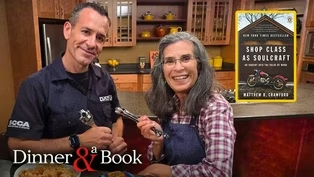
April Lidinsky and Sam Centellas discuss "Shop Class As Soulcraft."
In his bestselling nonfiction book Shop Class as Soulcraft, Matthew B. Crawford explores the deeper value of manual labor. Joining April Lidinsky to cook up shop-inspired dishes and delve into the ethics of repair is Sam Centellas, a fellow mechanical expert who shares Crawford’s passion for hands-on work. <h2>Menu:</h2><ul><li>Traditional Panzanella</li><li>South American Fu...
Problems playing video? | Closed Captioning Feedback
Problems playing video? | Closed Captioning Feedback
Dinner & A Book is a local public television program presented by PBS Michiana
Shop Class As Soulcraft
Season 25 Episode 15 | 26m 46sVideo has Closed Captions
In his bestselling nonfiction book Shop Class as Soulcraft, Matthew B. Crawford explores the deeper value of manual labor. Joining April Lidinsky to cook up shop-inspired dishes and delve into the ethics of repair is Sam Centellas, a fellow mechanical expert who shares Crawford’s passion for hands-on work. <h2>Menu:</h2><ul><li>Traditional Panzanella</li><li>South American Fu...
Problems playing video? | Closed Captioning Feedback
How to Watch Dinner & A Book
Dinner & A Book is available to stream on pbs.org and the free PBS App, available on iPhone, Apple TV, Android TV, Android smartphones, Amazon Fire TV, Amazon Fire Tablet, Roku, Samsung Smart TV, and Vizio.
Providing Support for PBS.org
Learn Moreabout PBS online sponsorshipDinner and A Book is supported by the Rex and Alice A. Martin Foundation of Elkhart, celebrating the spirit of Alice Martin and her love of good food and good friends.
Author Matthew B Crawford's 2009 nonfiction book, Shop Class as Soul Craft An Inquiry into the Value of Work remains a powerful reflection on what we lose when we lose connections to our material and mechanical world.
I am delighted to be joined in the studio with longtime local nonprofit, community leader and advocate for positive community change, Sam Centellas to discuss the eth and pleasures of repair as we fix dishes to nourish working bodies.
Welcome, Sam.
Glad to be here, April.
Thanks for saying yes to this site.
Is excited to do this.
I was so interesting to read this book.
How did you choose it?
So actually my my older brother, who's a professor, who's not super mechanically inclined, but learn how to work on, motorcycles in college.
He gifted me the book.
Okay.
I've been a long time car guy.
I love car stuff and have always been connected and involved there.
And so this was a great book, and I read it and it really it really it spoke to me.
So I've always loved that book.
As I read it, I thought about it speaking to you so, and you've got so much experience here.
So let's talk about what we're making and then we'll dig into the book.
So.
So what's happening here?
I am working on chicken wings and what I'm going to do that's unique with the chicken wings when I'm cutting them all in half.
And so I've gotten a couple ready here.
And I am doing South American inspired, okay.
With my Bolivian roots here.
And so I've, I've cut a bunch in half and I actually put them in a bowl here.
And I generally do I do this all kind of by eye and ear nose.
I do about a teaspoon of what is called aji Amarillo.
Okay.
It's yellow pepper.
That's local to the Andes mountains.
So it's a beautiful color.
It smells fantastic.
It's not super spicy.
It's more tangy than spicy.
But some of them can get pretty spicy.
And I'm seasoning with that and a little bit of kindness.
Other mix also just kind of done by eye and then a little bit of olive oil so they don't burn once I get them in the air fryer here.
Okay.
Awesome.
So and I'm getting started with a rustic peach galette.
So one of the themes in this book is, you know, remembering kind of lost crafts and arts and, and especially remembering, you know, maybe how our parents and grandparents knew to make the most of whatever was around them.
So in that spirit, while we're filming this, there's just a peach avalanche in, in town right now.
But a lot of them are these little tiny peaches.
They've got little blemishes on them.
I've talked with a lot of people who say, like, I don't really know what to do with these.
They're perfect for cooking.
And so I'm going to make this open face tart.
It's very easy.
And I'm going to show you how to make a pie crust, which of course, you can buy.
But I'm going to tell you anybody can do it with the right tool, which is what another theme in the book.
And also it's just a billion times better.
That is a mathematical equation.
So I'm going to check your math.
Yes.
So I've got a little I've cut up some peaches here.
I've got a little bit of arrowroot to thicken this mixture, a little bit of sugar and cardamom and cinnamon.
I'm going to put just a little bit of lemon juice in here.
And then I'm going to let these, peaches kind of, stew in their juices.
Well, I show you how to make the, how to make the crust.
So and you're further, dismembering the... I'm about ready to about ready to put my first batch in, so.
Oh, you are all ready.
Yeah.
So they take a little while to cook.
So I've got this first batch ready.
I try to get about this reasonable color.
I'm going to put maybe a little more of my carne asada seasoning on it and mix that up.
And then I'm going to throw them in an air fryer here okay.
Awesome.
All right.
So this book and maybe I'll just very quickly before we start talking about the book, the super simple to make a pie crust in a Cuisinart.
And the key is, you're not touching it.
So if you want a really crisp pie crust, you've got to get the fat incorporated in there without warming it up.
So this is, flour, salt and a little bit of sugar.
You've got frozen cubes of butter here.
I'm going to pulse this, and then you just, I'll be adding a little bit of, vinegar and ice water just to get it to a, just to get it to a malleable thing.
And you don't touch it with your hands.
So, so let's let me talk about the general argument in this book, which, you know, I this was written in 2009.
People keep talking about it.
It was recently quoted in a New York Times op ed as people were trying to puzzle through what is motivating Gen Z. This kind of reaction against corporate office life, this re embracing of, learning how to make things kind of those lost arts.
What how would you capture what it is that he's trying to teach us in this book?
I think a lot of it for me is about the value of work.
And that's something that, you know, I learn from, you know, my grandpa who is a mechanic.
But the value of being able to take some time with your hands and touch something fixed, something being able to know how something works, even at a basic.
Yes.
Yeah.
It's really important.
And that's, I think, part of the core and how we got away from that and talking about trying to get back to that a little bit more that he's got.
So, you know, true confession.
I am not a mechanic.
Sam is.
So we'll talk about that a little bit.
But there's footholds that any of us can make I think especially in the way he talks about how quickly most of us have lost mechanical, expertise.
So, for example, just one point that really stuck with me.
The disappearance of the dipstick, that it's really almost impossible now to check your own, stop your own oil, or the detail that a Sears Roebuck catalog used to when you bought a mixer or something.
It always came with a repair manual.
And the assumption was you've got tools at home.
You know, with the right instructions, you'll be able to open this up and repair it.
And that is just so far from the planned obsolescence of so many electronics and things now, where so many electronics don't even come with screws to take it apart.
Yes.
Let alone the thought that you would do, you would service it and you would take care of it.
Yeah.
And most people understanding of even just the basics of how to change your own own oil.
Yeah.
Not that you would need to do it yourself, but just to understand what it what it actually means that they just take the oil out of the car and then they just put new oil in.
Yes.
It's basically what it is, right?
They rocket science.
It's not.
Yeah.
It's not a magical thing that's happening back there.
But if you don't understand that, you are actually not understanding something fundamental about the why it matters to have oil in an engine.
So he's, And you'll see here I've just made this is how quickly it comes together.
So, and to, you want to always keep this chilled.
So I've got another one out here.
Let's put this over to the side and chill it, and I'll make my family a galette later.
And then I'll show you how easy this is to, to roll out.
And, and all I'm doing over here is now turning some wings.
I did, for about seven minutes on one side, and then I'm going to try to do them for about seven minutes on the other side.
And, they'll be about ready.
All right.
I'm about ready.
So the author is a, an academic and.
Yep.
He ends up sort of rejecting that that life for what he finds is just a much more meaningful engagement with the material world.
You know, he gets an academic job, he's bored.
He reopens his, motorcycle mechanic shop.
So it.
And it spoke to me that, you know, I'm an academic as well.
I worked in higher education for a long time.
Yeah, an advanced degree.
We worked together together at IUSB, and I have an advanced degree.
And for me, you know, when I was working at Ivy tech, I decided to take mechanics classes so great and work in the auto shop.
And it really connected me again to that work of the value of figuring out a problem.
Yes.
Of saying sometimes you've got a car up on a lift, and yes, you and a couple of classmates are looking up, going, how are we going to get this gas tank out?
I don't know, but we're we're going to figure it out.
We're going to figure it out.
And then doing that process to, to get that done is what I think is a really valuable thing that we often don't have in working.
Sometimes in the theoretical world, when problems don't end.
Yes, yes.
Like very nice points.
Yeah.
The problem never ends.
Like we're always going to try to figure out how to make something faster or more efficient or change a formula.
And sometimes you just want to be able to lift a car up, pour the oil out and then put it back down and palm oil, oil into it.
And so, yes, easy process, but also all of those things that we teach in higher ed are absolutely part of what he wants to do is remind us that, manual work is intellectual work and that, that scene, which to me was so powerful of having a car up on a list, you know, you're asking for help from others.
There's collaborative work.
There's, puzzling things through.
The stakes are very high.
You know, if if, Yeah, you don't adjust the brakes right?
Yeah.
And I think it is the value and we're seeing a resurgence of that in general now is the value of, of a plumber a value?
Yes, a mechanic, a value of people who work with their hands, who I think we went through a cycle where people who did that were not valued.
Yes.
Yeah.
You know, I tell the story of my grandpa who didn't finish school but opened a garage, was a business owner, but he always felt like, oh, the college kids, those college kids.
And he always felt like he wasn't as good.
Yeah.
And that always.
That always, I think was a chip on my shoulder.
Like, I want to make sure that even though I'm becoming a college kid, I never look back and think like my grandpa was lesser, because of what he what his profession was.
Yeah.
In fact, the opposite in my my father was a union pipefitter.
I grew up in a home where fixing things and mending things was the, you know, was what was expected.
So I'll just show you.
This is so fun.
It's so much more fun than pie.
You just kind of arrange the fruit however you like.
On the flat sheet, you fold it over.
It's a little bit like origami.
And this is just a little bit of egg wash and, so egg yolk and milk, I'm going to put a little bit of turbinado sugar on it.
And then we'll put it in a 375 oven.
And we are going to be so happy in a little bit.
So, you are almost done.
I got a couple more minutes.
Usually I do about seven minutes per side, and then I'll turn them again and kind of see once again, it's just got to go by eye a little bit and smell just like in the butter.
Exactly.
And give it a couple more minutes, a couple more turns.
And then they'll be, they'll be ready.
Okay.
Excellent.
We're going to take a little break and look at some images of Sam's family.
His grandfather's shop, and, Sam at work in the mechanic's garage.
We'll be right back.
Sam and I are cooking up a feast for hardworking people.
And what are you going to be making here with this delicious produce?
So I'm making a fairly traditional guacamole, okay.
Which everybody makes a little bit differently.
Right.
So whether your kids like onions or not or what's in there.
We always know there's avocados in there.
I actually like to eat mine with chicharrones because I'm low carb and I use the chicharron as a chip.
So we're going to have fun making that.
All right?
And lots of people I know are low carb.
I am making a whole high carb dish.
It's, So I'm going to, make a panzanella salad, a bread salad that I think is pretty common to most, most ethnic cooking, where there's always some way to use what's about to go bad in your kitchen.
So a panzanella seller of bread, salad, you toast some bread that might be going stale and you use kind of your juiciest produce that is about to kind of collapse.
And it's perfect for a very, juicy celebration of where we are right now, which is late summer.
So but I'm going to go ahead and pull out this galette, and we'll let that cool down here.
And, you can see that turbinado sugar gives it just a nice little color.
And for the extra little bit of glam, it's nice to have, a little bit of peach jam that you just dab on the top.
And that gives it a very nice, showy.
We got to be showy.
It's like the what would the equivalent be in a garage?
A, final paint job as a wax gloss.
Yes.
Waxing it, but so much more delicious.
Yeah.
All right, so let's talk a little bit, while you're getting your guacamole started, about the kind of revaluing of other kinds of knowledge besides college.
So this is one of the main themes of the book.
The author, has a PhD in political theory.
You know, you can tell he quotes theorists throughout the book.
But he really wants to talk about the kind of the limits of what we're teaching people in college.
And also, I guess, more importantly, the expectation that every single person would go to college and that that's the only way to make a meaningful life.
Well, so let's talk about that a little bit.
Yeah.
And I think some of it's about what and how you learn things and, and putting value to them.
So the easy example I always use for folks is that, you know, no matter how great of a professor you are, you can't teach someone how to ride a bike in a classroom.
Yes.
So you have to get your butt on a bike and go out there and try it.
Yeah.
And some of those lessons are hurt.
And then the outcome is that, you know, you learn how to ride a bike.
Yes.
And so it is, it's a value.
How do we put a value on that type of learning and education?
And then that ties back for me to the book, right, about learning how to fix a car.
Yeah, yeah.
And revaluing that.
So I'll just talk about the base.
This has a vinaigrette base with very pungent garlic.
I don't know if you're getting one.
I can smell it.
Smells good to really release that little bit of olive oil.
A little bit of wine vinegar and, salt and pepper and Dijon.
So a really nice pungent base.
And then I'm going to be putting, the ingredients in this bowl, and then you're going to want to let the, dressing kind of marinate in everything for, you know, for about a half hour before you serve it so that everything, you know, it's a little bit like stuffing at Thanksgiving.
You want some parts to be crispy.
You want some part to be just infused with this extremely pungent, pungent dressing.
So I'm still finishing up my wings from earlier.
The last bit are kind of coming out.
And so I think, I am done there.
So I'm going to move those over here and get these done.
All right.
And those turned out well.
I can smell that.
Here it looks beautiful even to this vegetarian.
So go figure.
Sam had to make sure we we can all have something we like.
You all have some great.
So I'm chopping up.
One of the things I always do with my tomatoes is I leave them a little bit rough cut, because I kind of like them in there a little bit for the flavor, but also for, you know, the look of them when they're in there.
And then, my kids don't like them so they can pick them out.
That is, I guess, yeah.
Thinking practically about who you're who you're cooking for.
So, among the kinds of lessons that Crawford is hoping that we will pay attention to is like the real consequences of some kinds of knowledge.
He described some of the, work that, you know, we kind of train people in college to do cubicle work where there's, you know, maybe it's a little bit like assembly line work where you don't quite know what's going to happen a little further down.
And in fact, he connects that to the, to the really interesting history of the denigration of, of manual labor.
And if you think about, you know, what happens during industrialization, people who were really skilled crafts persons, often kind of had to be retrained to work on an assembly line.
And so somebody who could have, you know, maybe rebuilt a whole engine, understood that, is now being told, you know, your job is to tighten these two bolts and pass it along.
So for lots of us who enjoy history, I found that just really interesting to contemplate.
The origins of the denigration of of manual labor.
And of course, you know, you could connect it to the defense of labor unions.
And, you know, having grown up in the labor home myself, and he wants us to say, it doesn't have to be this way.
We can remember how much expertise people bring to the table and how valuable that is.
Yeah.
And I wrote a blog once, you know, when I was actually going through my program about sometimes the way different people would treat me to a store, if I've come from work and I'm in a blazer and I'm dressed up, versus if I came from a shop class and I was in a Dickies work shirt.
And it is I think that's part of I think the critique came a little bit maybe against higher ed, but really the critique was about how the educated then look at people who are educated differently.
Yes.
Oh nicely put.
Yeah.
Yeah.
Because he's, you know, problem solving, collaboration, all of that is absolutely essential.
And I'm just, you know, this bread salad, just as you're using up your stale bread that's been toasted with a little bit of olive oil and salt and pepper.
You know, this is a good, clean out the refrigerator of anything.
So I've got some peppers.
You can put some zucchini in here.
I've got some basil.
This is what, my in-laws call.
Must go.
Hey, what's the what's for dinner?
Must go.
Except this just makes it all extremely delicious.
And everything can have a use, right?
Everything can have a use.
Yeah, yeah.
And understanding that just because a peach is small and spotted or the pepper is starting to, look a little soft, it still has a place.
So maybe you could talk a little bit about some of the lessons you learned in shop class and what that was like.
Humility is another real theme of the book that, you know, he had a pretty fancy degree.
You've got a graduate degree, and you decided to kind of go back to school.
So, yeah, we talked about that a little bit.
And so it's one of those it's the, you know, I think the same of it in terms of like how we dress and how we think and how we talk, about knowing, understanding different things.
And so I remember my first couple days in class, I had joked that I was a college dropout, right?
I had started a degree and I didn't finish it.
And I went back and I finished it.
And what that meant to be side by side with some students who were younger than me, I had students who are older than me, and saying, like, I don't know how to do this.
And that's I think, I think also the value of learning to do things with your hands is that the experience doesn't always come with with age.
The experience comes with time.
Doing what?
Yes, yes.
Yeah.
So there's a kind of radical equality in the shop.
Yes.
Either you know how to do something or you still need to learn it.
Absolutely.
So he's, I mean, I think we got to say that this is in no way a feminist book.
But the lessons that he brings, I think, you know, for those of us who are probably never going to really touch an engine, really, I think, speak to things that lots of us really value, like the, the importance of repair, of not throwing something away just because it's old.
I certainly grew up in a house and some, just a little bit of, fresh herbs here and a little bit of torn mozzarella.
This is a nice.
Get your hands dirty, okay?
It's not motor oil, but, yeah, but a lot of us, you know, I used to polish the family shoes.
Yeah.
Kind of returns us to this idea that the material world is worth understanding.
And we talked a little bit about.
I learned to drive on a manual car, but, then drove a drove an automatic for a long time.
And then when I inherited my mother's 2002 Mini Cooper, I had to relearn manual transmission.
And it was so interesting to pay attention to the sound of an engine again, to really feel like I was driving, driving a car.
And I'm going to, just put this super pungent dressing in here.
We'll get this started.
Just marinating a little bit, and I'll maybe keep adding just a few more things.
But you can see you can right size this to however many people are going to be at your table.
And I. And so the same as I did earlier, it's all a little bit by by eye and color and what things you like.
I like cilantro, so I always have a lot of stuff that looks so good.
The other thing is, is I always keep a couple of the pits in there.
So it's a thing that I think most people have learned.
If you haven't learned the pits, help it not turn black.
What?
It helps it keep its color so generally when you put it away to keep a pit in there.
So I've got two in here now.
And now we know don't eat the pits though.
So yeah, don't eat the pits there.
And if you if you can eat the pits and that's a whole nother okay.
Another episode.
So we're going to take a little break and show you some pictures of the author and some of the other books that he's written, and we'll be right back.
Samson, Tess and I have made a feast for working people.
It's got a lot of muscle in it.
So talk a little bit about what you've made here.
So we.
We made the guacamole.
I seasoned it at the end here to make sure.
And just kind of what you do, what you put in there.
Also salt pepper.
I put a carne asada seasoning, a little bit of oregano, some fun, and I'm ready to dip it with chicharrones here.
And then we made the South American kind of fusion wings with the ahi Amarillo in there.
And they smell good, so hopefully they're delicious.
Smell amazing.
So.
And I've made, the kinds of foods that maybe we've forgotten to make that you can make with the right tools.
So I really encourage you to try your own pie crust made with butter.
You're just never going to taste anything better.
You make it with the right tools.
Super easy.
And this rough galette is, something that's common to many cultures.
Great way to use up produce and season.
Any time of year.
Things that you might not want to eat out of your hand are always good in an open face.
Galette.
And, similarly, a panzanella salad, a bread salad that makes use of bread that otherwise you might throw away.
Just as Michael Crawford talks a little bit about, Matthew Crawford talks a little bit about, you know, a throwaway culture.
And we want to return to a time where we know how to fix things and make make the most of things.
So this also can use vegetables in season.
So we've got a couple other things here.
Tell us about this beer that.
So I brought some Amistad ale for you.
So this is from South Bend Brew Works.
It's something that when I worked at La Casa, we came up with a great way to kind of celebrate the culture and the place we worked.
It's an agave sweetened cream ale that we designed, and so love that.
All right, you here to try it?
And these are replicas of.
Yes, these are some Hot Wheels.
Right.
So I'm a car person through and through.
And so I like Hot Wheels.
So I have a car that looks exactly like my car.
And I actually keep it as a in my glove box of my car when I'm out racing.
So I have some of my tools that I take with me every time I race, as a way to just make sure I got things ready if I need to fix something.
Okay.
Fantastic.
So why would you recommend this book?
I think it's a great way to strike that balance between higher education, but also just learning to have the value of work and the things that you learn.
Working with your hands.
Okay, that sounds great.
And for all of us, I think there's a way to read this book and think back to the knowledge that our parents, our grandparents had and to be inspired, maybe by Gen Z, these, younger people who are remembering the pleasures of fixing things, of making things the satisfaction of maybe sharing a galette, homemade wings and guacamole with people that you love.
So, Sam, thanks for saying yes.
So the invite to do this with you, I recommend the book highly and hope that you cook Adventurously read widely and we'll see you next time on dinner and a book.
I think we should have a year.
Yeah.
Thank you.
This WNIT local production has been made possible in part by viewers like you.
Thank you.
Dinner and A Book is supported by the Rex and Alice A. Martin Foundation of Elkhart, celebrating the spirit of Alice Martin and her love of good food and good friends.
Providing Support for PBS.org
Learn Moreabout PBS online sponsorship













Support for PBS provided by:
Dinner & A Book is a local public television program presented by PBS Michiana