
Pork Belly Tacos
Season 25 Episode 16 | 26m 46sVideo has Closed Captions
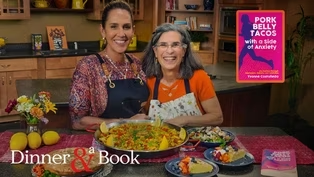
April Lidinsky welcomes Castañeda to discuss "Pork Belly Tacos."
As the daughter of Cuban and Mexican immigrants, Yvonne Castañeda had to navigate an American focus on achievement and appearance in a family that used food as their love language. Her memoir, Pork Belly Tacos with a Side of Anxiety, offers insights about the complexities of the immigrant experience and the way food can carry emotional weight. April Lidinsky welcomes Castañed...
Problems playing video? | Closed Captioning Feedback
Problems playing video? | Closed Captioning Feedback
Dinner & A Book is a local public television program presented by PBS Michiana
Pork Belly Tacos
Season 25 Episode 16 | 26m 46sVideo has Closed Captions
As the daughter of Cuban and Mexican immigrants, Yvonne Castañeda had to navigate an American focus on achievement and appearance in a family that used food as their love language. Her memoir, Pork Belly Tacos with a Side of Anxiety, offers insights about the complexities of the immigrant experience and the way food can carry emotional weight. April Lidinsky welcomes Castañed...
Problems playing video? | Closed Captioning Feedback
How to Watch Dinner & A Book
Dinner & A Book is available to stream on pbs.org and the free PBS App, available on iPhone, Apple TV, Android TV, Android smartphones, Amazon Fire TV, Amazon Fire Tablet, Roku, Samsung Smart TV, LG TV, and Vizio.
Providing Support for PBS.org
Learn Moreabout PBS online sponsorshipDinner and A Book is supported by the Rex and Alice A. Martin Foundation of Elkhart, celebrating the spirit of Alice Martin and her love of good food and good friends.
As the daughter of Cuban and Mexican immigrants, Yvonne Castañeda had to navigate an American focus on achievement and appearance in a family that used food as their love language.
Castañeda writes with humor and warmth about topics that touch all of us as we struggle to find our place in our communities and balance in our lives.
This episode is in partnership with the Saint Joseph County Public Library, and the book is part of the library's Culturally Speaking series.
I am so excited to be able to discuss this rich book with the author herself, and have a chance to fix a healthy meal together.
Welcome, Yvonne.
Hi.
Thank you.
Right.
To see you.
Are you excited to be of the book?
So what was the inspiration?
Well, I don't know if you've heard, but there's this thing called stigma.
Mental health?
Yes.
And as I was working in a community health center in Boston, I realized that there were a lot of individuals that were seeking books on mental health that were written by somebody of our culture.
And I thought, well, what better way than to share what what a perfect opportunity to share my story and kind of like.
It's almost like I wanted to normalize it, like to make it okay that you can talk about these things.
So that was really the inspiration.
It is a delight to read so.
And in honor of what we're cooking, a healthy feast.
So tell me what you're making and I'm we are going to make we're actually going to make vegetarian pie and pie, but fire is actually a Spanish dish.
It's from Spain.
And I love making this dish, first of all, because Spain is magical.
And then secondly, because, you know, my father is Cuban, but our ancestry is from Spain.
Okay.
So there is a personal connection to pie.
All right.
And also, it's actually really easy when people think about pie.
Are they panicked?
Like, it's too complicated?
And this pan is just gorgeous.
So I'm going to be getting started on a, just seven ingredient almond cake, a Spanish cake.
And, starts with breaking some eggs here.
And tell me what you're doing with these lemons.
So we're just, you know, I, we like we'd like it to look pretty, to not just taste good.
And so the lemon is actually just a garnish.
So we we add the lemon and you kind of just brown the edge of it.
That's it.
That's all you're doing.
It's such a great tip that you could use for in the beginning.
We also add some, some coarse salt around the edge of the pan.
All right.
All right.
Looks beautiful.
Yeah.
This is you're going to see.
It's actually quite easy.
It's much easier.
Very, very veg forward.
So, maybe you could.
So this is a memoir, but it's layered with all sorts of takeaways.
And I would say, you know, any of us could, and do learn from.
Maybe you could set the scene a little, do what your childhood was like, this kind of very American mix of, of cultures.
It was, you know, when I look back, when I think about my childhood or when I feel about it, you know, I. It was very warm.
There was a lot of laughing.
My mom has always been hysterical.
Not hysterical like she's not.
Not.
That was, she was just really funny.
And she liked to laugh at herself.
You know, my parents were extremely hard working.
I don't know that they had a choice, but, yeah, I had to be hard working.
And they just.
I always felt very loved, very safe, very cared for.
And so that was, that was kind of like our, our childhood.
I mean, I was born in East Los Angeles, and we moved to Miami when I was seven years old.
And so it's, you know, I tell people, look, Mexican and Cuban are two very, very different cultures.
Yes.
Which really comes out in the books, but they're so good linguistic patterns.
But how would you characterize your your mother and your father coming together in this?
I'm going to put it this way, right.
Like my mom grew up on Spanish telenovelas, soap operas, like literally.
That was her education.
She went to the sixth grade, so she watched soap operas.
And so for her, and especially like the Mexican culture, definitely raised.
The man is the man of the house.
Yeah.
Yeah.
And you don't argue, you don't question.
You just go along with it.
It doesn't matter.
What's interesting about that is that my dad, who is Cuban, completely different culture, the women.
So the women on my Cuban side.
Their attitude was kind of like, I dare you to tell me what to do.
I dare you.
So, yeah, they are some women.
It's very fierce.
So I it was it was very confusing for me.
Sometimes I didn't know if I should be advocating and putting my foot down, or just being really quiet and letting you know, letting men just kind of run the show.
And in the midst of this, it's also American culture in the 1980s.
So I just really appreciate there's all these pop culture references to what's on television, what you're reading.
Yes.
The The Outsiders.
So, so for readers who were, alive and reading in that period, you're going to get a lot of, a lot of tweets there.
This is just smelling so.
So that's what was interesting is that our dad would not let us speak English in the home.
Okay.
He said, you're going to speak Spanish in the home because you're going to need it some day.
And I really appreciate that.
I mean, we we fought it a little bit.
We're like, no, we're American.
We were born in America.
But no.
But then we also watch these, like super 80s movies about the very popular cheerleader and the football player.
It's pretty in pink.
What is he like?
I love the 80s.
Yeah.
Yeah.
So we grew up watching those movies.
So, yeah, we had we just had both really in our home.
And I think both my brother and I be confused.
Yeah.
I mean, it's a mix of all of this.
Let's talk a little bit about your sort of identity formation.
What did that what did that feel like for you?
That was, like, catastrophic, actually.
Yeah.
It was just, this is just some ominous.
Well, I just remember feeling very confused, like.
Or even, like, just not even wanting to be Latino, like, I remember being an adolescent, and we would go to family parties where Cuban music and salsa would be blaring, and my brother and I would be sitting there like, I roll, we want we want to listen to Def Leppard.
We were listening to ACDC.
We wanted sludge, that flavor of the blood here, you know, like we just.
Yeah, I and also like, I just at the time felt like I couldn't identify with the Cuban side because I think I don't if you don't know this about Cubans, not born with a filter.
You know, the filter doesn't exist.
I don't know if you can see this, like, say.
Oh, gorgeous.
On the on the page, you have some of them that have lots of things that you could put that on the side of those kind of grills.
Yeah.
So I'm going to add the oh I'm going to add the vegetables in a moment.
I just have to chop the zucchini.
But so can you talk about the the writerly decision you made?
This is, kind of young adult crossover?
I think somebody any age would enjoy reading this, but the decision to include a lot of Spanish in there is so texturally rich.
I think it brings to life what you're describing as this multicultural, household.
So was that a easy decision to make?
A hard decision?
You know what?
I don't even know that it was a decision as much as it was just my essence.
Like, no, no, no.
For like, really?
That is how I talk.
If I even like doing, if I have to do like a keynote speech, Spanish words just like fly out of my mouth.
And I have stopped fighting it and just kind of embraced it.
It just this just how it showed up in my head.
Well, it's very accessible for readers who have no Spanish.
I'm just putting this very simple batter in a, this is a 9 inch springform.
And I'm going to put some sliced almonds on the top and some turbinado sugar.
And that is at seven, seven.
And so, so I have just a little more zucchini.
And then in a moment you're going to see, I'm going to throw all of this into the pan.
Okay.
I did some smoking over here.
It's awesome.
And we just cook the veggies.
But so let's read the role of food has.
So these very I think the the warmth in your family is very clear.
It's refreshing to read a memoir where there is an antagonism with the parents.
There's a lot of warmth.
But the use of food as a reward as, to talk about that a little bit, which I think will be very familiar to a lot of readers.
Yeah.
I mean, you know, April, even beyond the it.
Yeah, definitely.
When I was like in piano lessons because I, you know, for my family, I was like a unicorn.
I had this, like, out of nowhere talent for the piano.
And I was 100% a teacher's pet and loved school and loved to learn.
And I was a straight-A student.
So I think there was a lot of rewarding, and just, I think a lot of excitement overall that I was clearly going to go was going to bring my family out of poverty.
Yeah.
Oh, really?
Yeah.
You're like the first concert pianist.
Oh my gosh.
No.
First no pressure.
Pressure is real.
But also, you know, beyond, the reward it was also, I recognize that, you know, my mom and my dad, they grew up very poor.
And I'm not talking about just a little bit poor.
I'm talking about catastrophic poverty.
Yeah.
Where, you know, my mom just told me stories that I will never unsee about starving, about not having food and watching her, her siblings be hungry.
Yeah.
And so there was just no way that my mom was ever going to say no to us if we asked for anything like, mommy, can I have chocolate ice cream at 11 p.m.?
And mommy would be like us?
Claro que si?
Of course.
And do you want me to sprinkle some Frosted Flakes on top?
Mommy, can I have a donut?
Si me ha claro!
do you want me to bring you a glass of milk?
Yeah, definitely.
So.
And in the midst of all of this here you are making this absolutely gorgeous, meal.
It's it's the 1980s, you know, all that awful food that was available through, you know, just Ding Dongs and, dairy Queen and all sorts of, Yeah.
Dude, that was just kind of everywhere.
Pizza rolls, all of that.
The Little Debbie diet.
Now the we call it the Little Debbie Diet.
Oh.
That's great.
So, so we I while this cooks down, we're going to take a little break here.
We'll see some images that will illustrate you know, Yvonne's early life with her family.
We will be right back.
Okay.
That looks gorgeous.
All right.
Yvonne Castañeda and I have been cooking up a feast.
Oh, my God, I'm getting a facial.
Yeah.
This aroma.
So tell us what has been happening with this fire to reach this day.
So it's it's.
I'm telling you, it's quite simple.
It's just you.
You sauteed the vegetables, I added the tomatoes and the paprika.
You create like a little a donut, and you put the paprika in the tomato in the middle, and then you cook everything.
It's not hot.
Unless you want your dinner guests to be angry.
But it does give it this sort of woodsy, oh my gosh, this aroma.
And then that's it.
And then once you've got the vegetables sauteed, I added my pre-heated vegetable broth.
And I also add, if you don't know if you can see where I get these little beads of saffron.
And so you add just a little bit, I already added some to the broth.
So you add just a little bit.
And of course April, you tasted it to make sure it was okay.
And so now that it's boiling I'm going to add my rice.
And this is special.
This is bomba.
Yeah.
Bomba rice which is a like a short.
It looks a lot like arborio, but some of it's kind of fat grain that's meant to soak up a lot of things.
Yeah.
And then I just we we do what we call level.
We just level it.
That's it.
Make sure it's even.
And then you wish it well, and then you leave it alone, and it you cook it on high for the eight minutes.
So I'm just going to keep my eye on.
Okay?
Somebody can help us do this.
And then in the meantime, I'm just going to prep these vegetables for when we bring it down to around.
Okay.
And this I've never seen somebody use two spoons.
Just.
Oh, yeah.
It's a whole thing.
I'm.
I'm just making a really simple balsamic, vinaigrette here.
I'm going to put together a salad that's got a little bit of protein, some garbanzo beans, and, fat, and just, you know, vegetables that you like and a little bit of sweetness with some dried cranberries here.
So, so let's talk about the other aspect of the title.
So we got the food, the pork belly tacos, but the side of anxiety.
So where does that come in?
It's connected to the tension that we talked about a little bit that you're experiencing.
Yeah.
So, you know, growing up, my mom, my mom never said she had anxiety.
She didn't know that word.
Yeah.
She would just say, I'm this nervous, which is like my nerves.
And so for us, for me, I, as a first gen first generation, I didn't realize it at the time, but I had a whole lot of pressure.
Yeah.
And so food triggered a lot of anxiety.
Having to be thin triggered a lot of anxiety.
What the heck am I going to do with my life?
Triggered a lot of teenage.
Yeah.
Adolescence.
So much fun.
But I just, you know, my dad, because it's it's kind of like.
What?
What really helped me when I, you know, developed an eating disorder and had all of these maladaptive coping mechanisms.
My dad, we had this mango tree, and my dad would always sit under the mango tree with our neighbors when they had a problem.
And my dad would just sit there listening.
Yeah, my dad would, like, smoke a cigarette, drink his drink, but he wouldn't say much.
And then the guy would talk, and then the guy would leave, and then he'd come back a few days later and say, Mijo!, thank you so much.
You help me and I be like you.
He, like, literally didn't do anything.
But I guess, you know, I asked my dad once, why do they always thank you?
And he said, someday you'll understand.
But with me it was the same.
So when I had anxiety, I would go talk to my dad about the fight with the boyfriend.
Dad, how am I going to pay for college?
Dad, I hate this job.
What should I do?
And my dad would just come.
My dad would sit there and he would nod and he would go, yeah, no that's bad.
And then he would go Mija don't worry.
There's always a solution.
And then he would tap me on the back and say figure it out.
And he would just like leave me the he never quite gave me the solution.
But I realized now looking back that my dad was really telling me that I had the solution.
Right.
It was like his way of saying, I trust that you have.
And also realizing there was nothing he could do.
Really?
Yeah.
To get me to to heal.
It was a very personal journey.
And so that is kind of like what helped me.
And yeah, I'm an immigrant families.
And in, also just in the 80s that time, I think the, you know, there's a sense that something is wrong, but how do you name it if something, you know, so many parents want to fix things, you know, do you need a, you know, something for your headache when things are wrong inside, it's hard to articulate.
So how moving your father, you know, should have been charging $150 an hour.
I always say my dad was a therapist and didn't know it.
He really didn't.
And and to this day, like, as a therapist, that is essentially what I do.
We don't tell people what?
Sure, sure.
And so, yeah.
And I and I know that it's very hard for parents sometimes, especially if if you're a parent and your child has an eating disorder or has anxiety or has depression, I would imagine you just instinct instinctively.
You want to want to fix it.
You want to fix it.
And it's wild that my journey was not that my father never fixed it.
My dad just listened and empowered you.
It sounds like.
Yeah, it just took me 20 years to find that, so.
Well, I'm part of the, second part of the book that, again, I think any reader would really connect to is, you know, you graduate from high school, life is very, very structured.
And then what comes next?
And so you actually took a gap year before people used that language.
You went to Mexico to, to meet your family there.
Yeah.
I always felt very safe, I guess.
I don't know, I felt very welcomed, because my family had been so poor, and my grandmother was raising eight of my cousins.
Their mom had died at 33 years old.
So they were extremely poor.
And I, you know, they just didn't necessarily concerned with appearance.
They were concerned with, what are we going to eat?
And so that was just a nice I was just like a nice reprieve, I suppose.
And and my grandmother, my grandmother was unstoppable.
You know, a true for the women in this book.
I mean, really tender men, powerful women.
Our, Yeah, they're people we want to hear more about.
Definitely.
Yeah.
You know, my grandmother, she said something to me.
I think I wrote this in the book, and I was 17, in Mexico, panicking about what to do with my life.
And she said, Mija, don't worry.
Someday you will know what this life wants from you.
And I have to tell you, April, that was not what I was taught.
I was taught.
Yeah, it's.
Life is going to give you something.
Not that you're going to give it something.
So that too, you know, my dad his way.
And then my grandmother kind of instilling in me this idea that I had value to offer the world, like those two things were really what helped me overcome these awful, behaviors and addictions.
Yeah.
And so, I mean, so many people have, unhealthy relationship to food.
You then sort of go through a series of jobs that you kind of fall into.
But, gosh, one of them is a crew on a cruise ship.
Yeah.
So that was, just as a reader, it was, I mean, you can you can feel the worry of you as a protagonist and all of us, you think about your early 20s and how challenging it is to to find your path.
You somehow tell this with a lot of warmth and humor.
And what was it you think that kind of helped you start to heal besides your your father reflecting?
But you do.
I think it was the, I think it was the seven years of really awful relationships.
I think it was that I mean, it wasn't that it helped me heal.
I think just all of it kind of culminated at a certain point in my life where I realized something.
I it's not just about an eating disorder, and it's not just about maybe alcohol abuse.
It's not the behavior.
I was like, there's something really broke within me, and I better figure out what that is because I don't want to.
I felt enslaved and I didn't want to feel inside, so I wanted to really understand what drove this behavior.
And so it it took me a good I mean, it was just the beginning of the journey, and it was like a good year for me to reflect back on my upbringing with with grace and with kindness and compassion.
Not like, oh, my parents ruined.
Yeah.
No, not at all.
Lots, lots of stuff.
Like this.
And, how do you connect that now with the work that you do as a, I mean, as a social worker and, you know, you how do you connect to those parts of your life?
I think as a social worker now, as a clinician, again, I'm mindful, you know, I always say the social work degree, the masters it wrecks you.
It just wrecks you.
Because never again to you look at the world or people the same.
You see, it's almost like for all of my life, I walk through a forest, right?
And I would just see the trees.
I see the trunk and the branches and the leaves, now.
And that's like with people.
That's all.
You see now I see roots and I see soil, and I see what they were planted in.
Yeah.
And I'm considering all of those things.
And I think that's my way of saying, like, listen, healing is not an overnight.
Yeah.
No.
Yeah.
It's not an overnight.
You really have to understand.
And also like when people are they have addiction or they're struggling.
There's a lot there.
There really is a lot there.
Yeah.
You know.
Yeah.
And so I consider all of that not just in therapy but just in general.
You know, like when I see somebody having, you know, being very angry in public, I'm not judging the person and saying, oh, you know, he's got anger issues.
All I'm thinking is who hurt who hurt that person, you know?
And I know that it's a lot of things.
Your father.
So you're going to add some, pimento roasted peppers and artichokes here.
Yeah.
So what I'm doing here is I just turned it down to low because it was on high for a minute, eight minutes just, and so on.
The low end just really starts.
It starts to soak up the rice or to soak up the liquid.
And then when I see that most of the liquid is gone, I add the artichokes.
I add the beans.
In fact, I can add the beans now, right?
And while you're doing that, we're going to let this cook a little bit more.
The cake still in the oven.
We're going to take a little break and you'll see some more recent pictures of Yvonne as a professional, and your very adventurous life here.
We'll be right back.
Oh, that looks beautiful.
Yvonne Castañeda and I have made a healthy feast inspired by the book.
Tell us what you've made here.
This is a thing of glory.
So this is the vegetarian paella.
It's essentially a rice dish with grilled vegetables.
And the wonderful thing about this is its versatility.
Meaning if you have people that come over that are vegetarian, then you make this.
But if you want to cook some garlic shrimp on the side, or even some chicken or some steak, then you can have that and people can eat it together.
Yeah.
Nice.
Nice social dish.
The saffron, the lemon, the garlic.
It is just absolutely exquisite.
And I made a Spanish, almond cake that you can serve with whipped cream and some fresh berries, if you like.
And then a simple tossed salad with a balsamic dressing with a little almonds to tie everything together here.
So I got to tell you, I just loved reading this book.
The texture of an individual life that has so many connections to universal challenges and experiences.
The back of the book has a lot of, resources that people want to follow up.
So.
So what do you hope people will take from this?
Beautiful.
But I think what I hope people will take away from it is that if you are a person who is struggling, that there is hope, that that you don't have to live that way.
But that it does require a great deal of discomfort.
But I always, as I say to clients, your discomfort is your deliverance.
And so I hope that people can get that from the story.
It takes time, but it's worth it.
It has been wonderful to have you here.
Great to meet you.
Yvonne Castañeda is here as part of the Saint Joseph County Public Library series, Culturally Speaking.
Thank you so much for joining us.
We hope inspired by books like these and dishes like these that you will read widely, cook adventurously and we will see you next time on dinner and a book.
This WNIT Local production has been made possible in part by viewers like you.
Thank you.
Dinner and A Book is supported by the Rex and Alice A. Martin Foundation of Elkhart, celebrating the spirit of Alice Martin and her love of good food and good friends.
Providing Support for PBS.org
Learn Moreabout PBS online sponsorship

- News and Public Affairs

Top journalists deliver compelling original analysis of the hour's headlines.










Support for PBS provided by:
Dinner & A Book is a local public television program presented by PBS Michiana