
I Never Thought of It That Way
Season 25 Episode 18 | 26m 46sVideo has Closed Captions
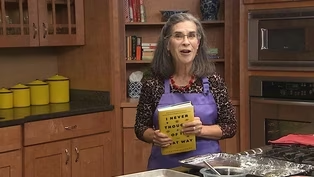
April Lidinsky invites Marchelle Pettit to discuss "I Never Thought of It That Way.&q
Mónica Guzmán is an award-winning journalist whose curiosity about what makes people tick is central to her book, I Never Thought of it That Way: How to have Fearlessly Curious Conversations in Dangerously Divided Times. Guzmán challenges us to lead with curiosity, and offers hope for how those conversations could go. April Lidinsky invites Marchelle Pettit to cook and discu...
Problems playing video? | Closed Captioning Feedback
Problems playing video? | Closed Captioning Feedback
Dinner & A Book is a local public television program presented by PBS Michiana
I Never Thought of It That Way
Season 25 Episode 18 | 26m 46sVideo has Closed Captions
Mónica Guzmán is an award-winning journalist whose curiosity about what makes people tick is central to her book, I Never Thought of it That Way: How to have Fearlessly Curious Conversations in Dangerously Divided Times. Guzmán challenges us to lead with curiosity, and offers hope for how those conversations could go. April Lidinsky invites Marchelle Pettit to cook and discu...
Problems playing video? | Closed Captioning Feedback
How to Watch Dinner & A Book
Dinner & A Book is available to stream on pbs.org and the free PBS App, available on iPhone, Apple TV, Android TV, Android smartphones, Amazon Fire TV, Amazon Fire Tablet, Roku, Samsung Smart TV, LG TV, and Vizio.
Providing Support for PBS.org
Learn Moreabout PBS online sponsorshipDinner and A Book is supported by the Rex and Alice A. Martin Foundation of Elkhart, celebrating the spirit of Alice Martin and her love of good food and good friends.
In her 2022 nonfiction book.
I Never Thought of it That Way.
How to Have Fearlessly Curious Conversations in Dangerously Divided Times.
Journalist Monica Guzman wades right into the difficult discussions we've all had, and helps us see why we often become stuck.
Guzman challenges us to lead with curiosity and offers hope for how those conversations could go.
There's a lot to unpack, so I'm so glad Marchelle Pettit has returned to our kitchen to think through this eye opening book with me.
Thank you.
Marchelle.
Thank you for having me again, April.
So let's just give an overview of what this book is.
It's kind of a how to book when you say, yeah, it's a it's kind of like a guide on how to have conversations with people who don't actually believe like you or look like you, or think like you, and how to call them in and be curious about how they came to the way they're actually thinking about things and how they came to their belief system.
Oh, love and how to call them.
And I love the way you put that.
So, in honor of this book, we're making dishes that reacquaint you with, with ingredients we're going to do to make things in new ways.
So what are you going to be fixing today?
Actually making kale and parmesan, chips.
And I'm actually making, chickpea and sunflower, sandwich.
It takes it's a version of a tuna salad, except for it's vegan.
And then I'll actually, I'll top it off with a mocktail.
It's a spicy, old fashioned, but nonalcoholic.
Okay.
Sounds great.
And, I'm going to be making barbecued tofu.
I'll tell you how I fix this.
And I have some, blue cheese and celery, because you got to have that with barbecue.
And then I'll be making, rice shaved, Brussels Sprout salad.
So let's talk about what you are getting started with.
And I'm going to, start tearing up this.
Yeah.
So in place of, tuna, I use chickpeas.
And I've made this recipe with different versions.
And so this is a version where we actually use sunflowers.
So chickpeas, we cut up some red onions, some dill, some fresh dill, vegan mayo, maple syrup and just a pinch of kosher salt.
And then we just add it all in and we, you know, make it just to make it taste good.
Yeah.
It's good.
So.
And I'm, going to show you how to make this is, this is the tofu dish that I make.
When people think they don't make it, they don't like tofu.
So, my tip that I've learned over the years, when you're making dishes that really, require you to have texture with tofu is to buy extra firm as soon as you get it home, throw it in the freezer.
And, then after it freezes for about a day, thawed out, that gives it a much more texture.
And so for a dish like this, that's really crucial.
It also makes it easy to squeeze out all of the, or most of the moisture.
So the secret behind this, this, barbecue tofu is that you tear it so you get these wonderful kind of jagged edges, and then it's got a dry spice rub on it.
And well roasted at high heat.
And then that means, it sort of imitates that feeling of meat that has, you know, little crispy edges.
It's tender in the middle, and then you dredge the whole thing in, barbecue sauce.
So what's not to love?
So kind of like the same with the, with the chickpea salad, tuna salad variation.
The tuna, the chickpeas kind of give you the feel of having, Tunis.
The textures have kind of like, the same texture.
And then adding the fresh deal.
The fresh herbs really puts a little twist to it.
And, you know, I do also like a teaspoon, half a teaspoon of maple syrup just for like a little sweet little soup is super good.
Lead is always good.
And this is, dry spice rub that has human and garlic powder and, let's see.
Paprika, chili powder, smoked paprika, a little bit of pepper and salt.
And we're going to put a little bit of olive oil in here and dredge this.
And it's going to be very messy.
But you know, that's what happens in the kitchen.
So, so this book is we've said it's it's practical.
She's a journalist.
And so she really leans into her experience of asking questions.
And she starts with a situation many of us have found ourselves in.
So she is, a naturalized citizen.
Her parents are from Mexico.
She was naturalized and she was a teenager.
And she has a very hard time wrapping her brain around the fact that her parents have very different political views than she does.
And so she challenges herself to, sit with them during the presidential, the returns to watch the election returns come in and her friends say, like, oh, you're out of your mind.
Why would you do this?
And this is her kind of a her practice to be fearlessly curious.
Curious?
Yeah.
About what her parents think.
And she really she really.
Instead of calling her parents out, she really pulls them in, and she becomes very curious.
Ask the questions that a lot of us want to know when we're having those difficult conversations about someone who believes different than us.
Like what actually brought you to this?
Like, what was your experiences?
Yes.
Well, you'll find when you have those conversations that it gives you a different perspective too.
And we don't have these conversations necessarily to change our belief system, our mindset, but just to be open to how someone else arrived at, where they came, where they arrived, that.
Yeah.
Yeah, really nicely put.
And she, she starts with things that many of us do agree on, which is, you know, in poll after poll, people on all sides of the political spectrum think that where we are right now is untenable.
This is, you know, these divides are harmful, that much people can agree on.
And she says, you know, people have different kinds of ideas about what will fix this.
Maybe we need, more persuasive tactics or, you know, more education on the more education.
And she says, no, no, no, what we need are more questions.
Which is a really nice, nice place to start here.
So.
Oh, and this is really, I can see just with the fork.
This is very tuna eat.
So it would hold together.
Yeah.
And the texture is key to is key to this is to add texture to this.
So it does resemble if you really like tuna to resemble that.
And sometimes I'll add some seaweed to make it get, you know a little fishy.
Yeah.
That's interesting.
Yeah.
So and as you can see, this is, this is like a little, art project here to put this on, but I find this very soothing, and, and it does mean that these outsides get nice and crispy.
So she talks a little bit about how, the kind of dynamic of us and them, as a journalist, she's also interested in the social science and talks about lots of experiments that probably you've read about before to of people, you know, in camps, you know, children in camps being taught that the people in the other camp were their enemy.
And, there is something in human nature that can sometimes, especially in times of fear, make us resort to thinking about other people as totally different from ourselves.
Yeah.
And sometimes I think that we, as humans, we gravitate towards what we know.
So even when we face when we are in different in our social circles, like when we go to different events, when we go to you know, you know, like board meetings or if we go to like different conferences, if you see someone, you know, you normally gravitate towards that person.
But how beneficial would that be if you went and sat with someone who doesn't look like you and has a different belief system than you and thinks polar opposite, then you you can kind of open up a conversation and get curious.
Like Monica suggests that we do.
Yeah, we are so good.
Yeah, a lot of these are.
It's not all that tricky to be interested in other human beings.
And I love that you brought up that idea of understanding.
She does.
The, gives us the etymology of the word can as well as in, you know, that lies beyond my can, and at least in her telling, it comes from Scottish seafaring people who, talk about that as the horizon of knowledge.
So you can't see beyond your can.
That is, the limits of what you can see sometimes are the limits of what you understand.
Yeah.
Sometimes you can't see what you don't know.
And sometimes we can't view outside of our own lens because we have not been exposed to it.
So oftentimes when we get closer to an object, we can view it different.
And that's the same thing, is how we view people and their belief systems and how they think about other things and how they arrive to believe the way they do.
Yeah.
Very good.
So let's see I'm going to put these in the oven now.
Super hot.
And it's 425.
And you let them get pretty crispy for for about ten minutes and turn them and, so, I think maybe both of us have had some experiences of reaching across the divide.
Oh, you want to talk about an experience you've had?
Yeah.
I, I actually had a friend who has, a different, outlook on spirituality than I do.
And so, admittedly, several years ago, I was kind of stuck, and this is the way someone should believe.
But after being within close proximity with this person and leaning in and having like, authentic conversations, it was really good to see her perspective, her experiences, and why she believes the way she believes, and then comes to the conclusion that it's okay.
It's okay for us to think different.
It's okay for us to believe different because there's space for all of us here.
Yeah, yeah, really lovely to put it that way.
We don't have to necessarily change our minds.
Yeah, sometimes we do.
After 911, I realized I was living in a world of mostly of women.
And so I decided to, take up taekwondo, which was very, very humbling.
It took me seven years, but I got my black belt.
But mostly it was an opportunity for me to spend time on the mat learning with teenage boys.
There were people who were retired military people who were recovering from a variety of addictions for, you know, sometimes martial arts is a great sort of healing mechanism.
And I just listened and I think they were surprised to find a middle aged woman, interested in their lives.
That experience has really stuck with me.
So we're going to take a little break here while this rose.
I cannot wait to try that on bread.
You'll see some images from Monica Guzman's really inspiring Instagram.
We'll be right back.
All right.
My barbecued tofu has just come out of the oven, and I'm going to dredge it in, the barbecue sauce of your choice.
So.
And, what are you making?
This.
What I'm doing is the garlic and parmesan kale chips.
So I try to substitute this for, potato chips.
They're very good.
It's that, you know, people are surprised when they taste it.
They're.
It's very it's a very.
I was very good that way.
Yeah.
They might say I never saw it.
And sometimes it takes a little bit of convincing.
So.
Well, especially so this recipe has, something that I didn't know existed, which is vegan parmesan.
The vegan parmesan.
So I try not to eat dairy.
And so I substitute regular cheese, dairy cheese for vegan cheese for most of my recipes.
And a lot of people are like, what, you use vegan cheese, but.
Yeah, but if you, can convince them, you bring them in for a conversation.
You need a lot of curiosity.
Yes.
You know, they they seem to like it.
Okay.
Because again, we know what we know and we like what we've been taught.
Very nice way to return to the theme of the book.
So and lots of us make kale chips in various ways, but I'm excited to try to try these as well.
It's a pretty slow oven, just, 300.
So I'm going to put these.
Now, you can see once you've dredged this in, in barbecue sauce, I mean, you know, I'd eat my thumb in barbecue sauce, but the texture is wonderful.
And I'm going to just plate this up next to the celery, and then I'm going to put together a homemade blue cheese dressing, which is not at all.
It's not.
It's okay.
But it is very, very good.
Well, thank you for your acceptance.
So, and we were talking just a little bit about how, I mean, both of us like to cook and like to experiment, but in particular, you've been doing, experimenting with things that are just more helpful for you and your family.
Yeah, I've actually been doing a lot more vegan based meals.
So I like to say whole food plant based.
I use a lot of vegetables now in my meals.
And again, you know, not so much dairy.
And so it's really been interesting to see how my family has really tried to incorporate this in their, their, diet now.
Okay.
Any resistance?
You know what?
My I had resistance from my husband at first, but he actually tends to like my recipes now, and I'm sure we, all of us, likely when other people cook for us.
You know, his his palette has changed.
All right.
Yeah.
That's, that.
And all of us can continue to grow, curiosity here.
So this, blue cheese dressing or dip starts with some buttermilk and sour cream.
You could probably try this with vegan alternatives, which would be very interesting to try a little bit of vinegar and worse for sure for some tang.
And garlic and sugar, salt, pepper and of course the crumbled blue cheese.
And then we'll set that up there.
So a lot of this book is actually pretty.
Oh, tell me what you're doing here.
So you massage the camera, I massage the kale.
And then I sprinkled, fresh garlic and some, sea salt.
And then when it comes out of the oven, then we will put the grated parmesan cheese or grate some parmesan cheese.
Vegan, of course, on top of the couch.
Okay, okay.
Very nice.
So, and then this looks just great.
May have tried it on the break.
Yes.
Delicious.
And you're right.
The texture.
It's got the crunch of the onions.
It's got, actually really good.
It's actually really good.
I'm a little biased, but it's good.
It's super, super tasty.
So, do you have a time?
Yes.
Here.
How about, how about a cleaner one than the one I keep doing my barbecue experience on?
So a lot of what she, tells us is actually pretty practical, and I'm actually just going to read this little list.
It's kind of a how to manual.
So she has a little list here, on eight things to try.
So it's practical, not just kind of philosophical.
We should reach across the divide.
So, eight things to try.
Share snapshot opinions.
So small bites of how you feel.
Change the question.
So she's got some models of how to ask different questions.
We can talk about that listen longer.
So most of us need to be quiet and listen a little longer.
Acknowledge agreement or common ground.
Untie thought.
Not so.
A lot of this is our responsibility.
Not saying other people need to change their minds.
Hit reset.
Sometimes in a conversation you just got to say, let's just start over.
Yeah, I do that with my spouse sometimes.
Acknowledge good points and say this is a big one to say, I don't know when you don't know that humility, I think, is really, really important for all of us.
And look how luscious those I know it looks beautiful.
So, so we talked a little bit about, experiences that we've had leading with curiosity and do you want to talk a little bit about parenting adult children, which I think for a lot of us is, it just falls under this, this, these strategies.
Oh, yeah.
Because I think you learn, especially when you have adult children, you learn to you actually learn that you're not parenting anymore.
You are aware that you're still a parent, but you're not parenting anymore.
I think I had a really good example of that in the past month.
You know, our yeah, our youngest, our oldest son, actually, he moved 35 hours away from us.
And so who's counting who's counting?
Right.
And so, you know, I had to have a adult conversation with him, and I had to be able to listen to him.
And as a as a parent, sometimes we forget that our, our children have their own viewpoints and they have their own experiences and they have a life that they want to live.
So I had to I had to actually sit down and have that conversation with him and look at it from his viewpoint on why he wanted to move so far away.
And he's actually thriving.
He's doing well.
All right.
Yeah, that's very, I think for lots of us, that shift is, is just a challenge.
So this I'm going to be mixing this up a little bit, and then I'll start on my slaw and you're.
Oh, look at that.
Beautiful.
Putting some, some tomatoes on there.
So one other thing that Guzman is, part of is an, organization that she now co-leads called Braver Angels, this grassroots project that kind of puts into action what is in this book.
And it reminded me of, something that I got started with.
Let's see, I'm going to put some, this crumbled blue cheese in here, which has gotten nicely soft under these lights, about a half a cup of blue cheese.
So it reminded me of the NPR project, one small step where they connect people with folks who have different perspectives on on things to have a guided conversation.
So mine was guided by Carl Smith.
He did a great job.
And, it was just really fun to I hadn't read Guzman yet, but it was.
Tell me about yourself.
Where did you come to your belief system?
And it turned out I was paired with somebody who had a very different perspective on spirituality, and I made assumptions about what she might think about reproductive health and justice.
And I was very wrong.
I think we do that a lot.
Yeah, I think we do make assumptions, because we don't know.
We have not had that curious conversation.
And so we make assumptions based on who the person is around or where they worship or you know, what you know, events they attend.
And we really don't know that person's belief system until we have that curious conversation with them.
Yeah.
It was very, it's something that will really stay with me.
So I'm now going to shift to making, little dressing.
And maybe I'll start by slicing this, some Brussel Sprouts that we lots of us love.
Brussels Sprouts.
Roasted.
I love Brussels Sprouts anyway, but having them raw, a whole other experience here.
So I'm gonna put this dangerous, thing together here.
Where's my little.
And what I'm doing is I'm going to go ahead, and I'm going to make my mocktail.
It is a, it's a nonalcoholic old fashioned with, okay, Kentucky, spiritless bourbon.
And so it is nonalcoholic, and I like it.
Some people will take some adjusting.
But again, having that conversation with them on why it's important to try new things is really what gets okay.
It's get it's got all of the, nice flavors of a, let's see here.
This is coming out.
This the secret to the slaw is you treat these Brussel Sprouts like little cabbages, which they are.
They're flying all over the place.
So I'll just show how to put some of this together.
It also has some Honeycrisp apple in it, which I'll cut up.
And then it's got a nice kind of mustardy dressing.
And we'll finish it with some, with some toasted almonds here.
And so you've got.
Oh, look.
Yeah.
For my last fashion, I like to use orange bitters.
And I also like to add just a dash of maple syrup with the, nonalcoholic bourbon.
So it gives it a little twist to it.
And so I've come to like, and then I garnish it with a, I dry oranges in my oven and then I use.
So you made them I did make they are gorgeous.
Yes I did make those.
I've seen those in fancy cocktails places.
So and just a reminder that, you know, a beautiful drink is lovely to have.
But this certainly does not have to be alcoholic.
So you know, cut these up in here and we'll, finish putting this the rest of it together.
So some of her final advice in the book is not about changing others, but changing ourselves.
She has this mantra, surprise yourself.
And I think we're doing a very good job of maybe surprising, absolutely surprising our, people who get to taste this, which is us afterwards.
Yeah, we'll take another break.
You'll see some images of Monica Guzman at work.
We'll be right back.
Marshelle Pettit and I have made a feast here inspired by foods that we're thinking of a new way.
So tell us what you prepared here.
What I prepared today was the, nonalcoholic spiced bourbon.
And then.
So it's like an old fashioned.
It is like an old fashioned.
Yes.
It is.
And then, parmesan kale chips, with garlic and a chickpea.
Sunflower, vegan tuna salad.
Okay, so actually, all of yours is vegan.
It is.
Mine is vegetarian.
So this is, barbecue tofu.
So delicious.
Dry rubbed, dredged in your favorite barbecue sauce and some homemade blue cheese dressing.
You got to have some celery with that.
And a shaved Brussel Sprouts salad with Honeycrisp apples.
And, some parm from a cow.
Oh, sorry.
It's okay.
Toasted.
Toasted.
Almonds and some fresh mint.
So you are.
There's a lot of good advice in this book.
What's your big takeaway?
I think my big takeaway in this book is to hold space for conversations and for people who don't think, look, or speak like you.
Yeah.
That's essential.
And it, enriches our lives to reach for the middle.
She's really the consummate, journalist.
Yes.
Thinking about leading with curiosity, asking questions.
So it's a book about learning about other people, but a lot of it is also about learning about ourselves.
Absolutely.
You say so.
Questions we should ask ourselves about what we believe and why and how we came to know what we believe.
Yeah.
Good.
So some curiosity for ourselves as well.
So I would say this would be a great book for a book group, maybe even for a church group or any political group.
Again, really sound advice and historical context and social science that that backs this.
So I just have loved having you on the show again.
We're so glad that you all have joined us, and we hope that this book inspires you to cook Adventurously to read widely, and we are looking forward to seeing you next time on dinner and a book.
Marchelle, thank you so much for the test.
Cheers!
Thank you and cheers to you as well.
Let's give this a try.
Oh, I. This WNIT local production has been made possible in part by viewers like you.
Thank you.
Dinner and A Book is supported by the Rex and Alice A. Martin Foundation of Elkhart, celebrating the spirit of Alice Martin and her love of good food and good friends.
I Never Thought of It That Way Preview
Preview: S25 Ep18 | 19s | I Never Thought of It That Way (19s)
Providing Support for PBS.org
Learn Moreabout PBS online sponsorship
- News and Public Affairs

Top journalists deliver compelling original analysis of the hour's headlines.









Support for PBS provided by:
Dinner & A Book is a local public television program presented by PBS Michiana