
Everything I Learned, I Learned in a Chinese Restaurant
Season 25 Episode 6 | 26m 46sVideo has Closed Captions
Kathy Burnette and April Lidinsky discuss this week's book.
Curtis Chin’s 2023 memoir, Everything I Learned, I Learned in a Chinese Restaurant, reveals an important slice of American history - Chinese immigration to the U.S., and the multigenerational struggle for self-determination. Kathy Burnette, owner of Brain Lair Books and community literacy champion joins April Lidinsky for a sweet, savory and salty examination of the personal ...
Problems playing video? | Closed Captioning Feedback
Problems playing video? | Closed Captioning Feedback
Dinner & A Book is a local public television program presented by PBS Michiana
Everything I Learned, I Learned in a Chinese Restaurant
Season 25 Episode 6 | 26m 46sVideo has Closed Captions
Curtis Chin’s 2023 memoir, Everything I Learned, I Learned in a Chinese Restaurant, reveals an important slice of American history - Chinese immigration to the U.S., and the multigenerational struggle for self-determination. Kathy Burnette, owner of Brain Lair Books and community literacy champion joins April Lidinsky for a sweet, savory and salty examination of the personal ...
Problems playing video? | Closed Captioning Feedback
How to Watch Dinner & A Book
Dinner & A Book is available to stream on pbs.org and the free PBS App, available on iPhone, Apple TV, Android TV, Android smartphones, Amazon Fire TV, Amazon Fire Tablet, Roku, Samsung Smart TV, and Vizio.
Providing Support for PBS.org
Learn Moreabout PBS online sponsorshipDinner and a book is supported by the Rex and Alice A. Martin Foundation of Elkhart, celebrating the spirit of Alice Martin and her love of good food and good friends.
Curtis Chin's 2023 memoir, everything I learned, I Learned in a Chinese Restaurant is a sweet, salty, and savory examination of the personal and political education Chen received about people, culture, and history while growing up in his family's Detroit restaurant.
Kathy Burnette, owner of Brain, Their Books and Community Literacy Champion, selected this book for our discussion and I'm so excited to dig in.
Kathy, thank you for saying yes again.
Thank you for having me.
I love it.
And why this book?
Why this book?
So in I want to say, Marge Curtis came to town for the event that Notre Dame was doing, and I got to meet him and chat with him, and I was just enamored.
Yeah, with him.
So, yeah.
Charming guy, wonderful writer.
So.
And I loved reading this book.
So in the spirit of this book, what are we making today?
I'm going to make the Chinese almond chicken that he talks about in the book with some bok choy.
And a little bit of brown sauce.
Okay.
Sounds great.
And I'm making the vegetarian version of that, sort of kung pao tofu dish that's super spicy, which is one of the themes of the book.
And then also a really crisp, simple, lettuce salad with that ginger carrot dressing that you get sometimes at Chinese restaurants.
And I'll show you how to make it.
So, so let's get started.
You're going to get started on the marinade.
Yes.
Okay.
And I'm going to get started on the dressing here.
So, let's talk just a little bit about who Curtis Chin is because he's more than just, more than just an author.
Well, I mean, he's an author, but he is also a documentary documentarian.
Yes.
Hard word to say.
And I just he also has arranged his own book tour, so he helps other authors, get marketing.
So he's just really a great.
That's another literacy champion.
Champion?
Yeah.
He introduced me to some great organizations that I should reach out to to help us when we're bringing authors.
Yeah.
It's so wonderful that you met him.
And we've got a picture of the two of them together, both beaming.
It's so.
It's so fabulous.
So, And I'm getting started here.
This is made in a Cuisinart.
Start with fresh ginger.
This is peeled and a carrot, and then it's got some oils and seasonings in here.
And we'll wear it for a little while and chill it.
And then that's what will go on.
The top is wonderful.
Bright orange pop.
Mine's very simple.
Is this egg white and some cornstarch.
And then a little bit of almond oil.
And you can also use peanut oil if you want to do that.
And just a little bit of water okay.
A lot of these are pretty adaptable, which was one of the, kind of themes in, working in a Chinese restaurant where you're adapting to the, the tastes of the community.
Right.
And even though you have an extensive menu, a lot of the basics are the same.
So it's easy to add something new.
Yeah, absolutely.
And actually, ours are going to be sister dishes, I think.
So the the book is a memoir.
But it's got kind of an interesting organization.
So I don't know if you want to talk about the table of contents just a little bit.
It's an introduction to the thematic structure of the book.
Well, I love the way he did this.
The, the whole it's like a menu.
Okay.
Yeah, yeah.
It starts with the tea and then we have appetizers and soup rice and noodles, main entrees, the fortune cookie.
Okay, great.
Just like in the restaurant.
Just like in the restaurant.
And this book I just want to say quickly is signed by Curtis.
Oh, man.
Let's see.
Thanks for supporting writers.
It is true you all right?
My copy is from the library.
Hopefully you didn't sign up.
Yes.
He did not sign that one.
So, it's a memoir that starts right at the, you know, right at the beginning of his life.
I think he's about the same age as both of us, so that's kind of fun.
Yeah, I thought that was really exciting.
Interested in pop culture of the 70s and 80s.
And I sort of loved how he talked about, in the 70s, there was a lot of conversation about latchkey kids.
Yes.
And he said, okay, there's a whole other genre, which is restaurant kids, all these kids who grew up in, in their parents restaurants and, you know, started to this was kind of the theme of the book, how much he learned about food, for sure, but also about people right when he was young.
So, yes, we were lucky in that we got to stay at school.
They had like one of the first after school program.
So we were there when we couldn't go home.
So that when you grew up in a sort of similar neighborhood, but in Chicago.
Yes.
You grew up on the South Side of Chicago.
And the projects, actually, they would call the Washington Park Homes.
And it was right down the street from the school.
There's like a little park and everything.
So it was really, at least when I was growing up, there was really it was nice because it was just had been built.
Right, right, right.
I remember that.
So a lot of parallels for you as you were reading about the community and, and what was important at that time, like what what was happening in the community at that time was very similar.
Yeah.
That's good.
Yeah, I enjoyed that.
Yeah.
Including there's a lot about history in here.
So he talks you know, probably lots of, you know, about the Chinese Exclusion Act.
But the what he really gives us insight into is what that looks like in a multigenerational family.
So the impact on his grandparents, on his parents, the kind of bicultural experience that he grew up with and then experiencing the Detroit riots, you know, which his parents told him about.
And, similar to some of the experiences in Chicago.
Yes.
Yeah, yeah.
And one thing I mean, as every family, each generation has its own burden that it thinks you're going to face and so teaches you that way.
And what I liked was his dad seemed really open.
Yeah.
New things.
Yeah.
I think that that was really helpful.
Yeah.
Especially when you were looking at, the riots there and he decided to, side with the African-Americans, which wasn't usual in Chinese.
Yeah, yeah, there's a really powerful moment in there where, chin describes, I guess, his father telling him that when the riots were happening, their family restaurant and many other restaurants in Detroit put signs in their window that said, we are your brothers.
So you get I mean, it's actually making my hair.
Yeah.
Not to think about this moment because they felt his family felt very vulnerable, felt very precarious.
But on the other hand, you know, they were a locus of connection for immigrant families, of all kinds, right.
Who came in, I think.
And that was one of the themes I felt throughout the book is that they were really about community.
Yeah.
Nice.
Total.
Yeah.
So I'm going to let this run for a little bit, and then I'm going to turn it off, because you got to run it for about two minutes to get it super smooth.
But there's a little bit of sugar a little bit of salt, a little bit of rice vinegar.
And this gets you, really smooth, but also toothsome.
You could say that, dressing.
That's more than a dressing.
It's actually some of the ingredients.
And what's your your, chicken bathing in here?
It's bathing in.
It's like a cornstarch and water mixture.
Okay.
And that will you let that marinate a little bit, and then both of us will take about 15 minutes to marinate.
Have some doing.
Doing pans in the second half here.
And I'm just going to make a really simple salad here.
This is very crisp romaine lettuce.
And the only other ingredients are this this beautiful dressing, which when it's smooth, you know, is, bright orange pop.
So I'll wait to dress it until right before we serve it.
And then it has this beautiful fresh mint on it as well.
So it's a really it's got a little, I don't know, sweet, spicy.
Not maybe not savory, but we'll do savory in the second in the second part.
So so let's talk a little bit more about other lessons that he learned.
He sees people coming in.
He sees his father navigating.
If we think about his childhood, what else did he start to learn in that?
In that space, working with different kinds of, customers?
For one thing, navigating when you go to work in the front, the difference between working in the front of the store.
Good.
And working in the back of the store.
So even just restaurant management, he also learned that.
Yeah.
And that there were certain customers that would order the same thing all the time.
So like, all of us, probably.
Right?
Right.
I do have my number dishes that I like when I go there, you know, so that that was a fascinating behind.
But he, he also got to learn about the history of his parents and his grandparents at the same time that.
Yeah, yeah, especially when he's working in the back because he's working with his grandmother.
Back there.
I thought that was interesting.
Yahoo's slightly terrifying.
So, only slightly.
And he talks about, you know, he starts to he learns how to cook, both from his mother, who a by the book person and from his father, who is, you know, you got to get the feel of things.
So there's lots of lots of failed dishes, but the failed dishes, I believe, from his father, gave him the confidence to try new things.
So I thought that was really amazing.
Because that's not usually the case, right?
You're like, oh, that turned out terrible.
So I blew it.
Yeah.
Instead it instead of like, just keep trying.
Maybe this will be the one that works.
And he picked up that from his dad.
Let's try different things.
And I think that makes a difference for him throughout the book.
Yeah for sure.
His father is, an innovator.
So and I'm just going to start here doing a little bit of the, vegetables for the sauté in the second half.
And I'm going to cut up some bok choy that we're going to use later, too.
Okay.
That sounds that sounds great.
And this gives it a little crunch.
A little.
Yeah.
Well the stems gives it a little bit of, chewiness.
Okay.
Yeah.
Nice.
Yeah.
Little.
And then the crunch comes from, the bottom part of it does give it a crunch and just a mild flavor.
It's really.
I like a a light tasting.
Yeah.
Chinese dish.
And so this kind of gives us, it brings that in.
Okay.
You can use bamboo shoots if you want it to use.
Nice.
Okay.
Adapting.
So, broccoli and we start to get just a little bit, in the first part of the book about, his burgeoning sense of sexuality and the worry about how he's going to, to manage that.
So we're going to take a little break here and see some images from his website.
Lots of interesting information there, including a couple documentaries, one of which is Streamable on PBS.
We will be right back.
Right.
Cathy has been marinating some chicken here.
Tell us the story of where your dishes right now.
Okay.
So we've spent 15 minutes marinating the chicken and some cornstarch and water and some nice pepper.
Yeah it's about doing that.
And now we also cut up the vegetables that we need.
So we separated the stems from the leaves.
Okay.
The bok choy.
And now it's time to.
You know what?
I made the sauce.
So we started making the brown sauce.
And we're going to put okay okay.
And we're going to the dishes will be sister dishes I think mine's my cousin.
So tofu has a similar sort of, savory umami sauce thickened with cornstarch.
And a little bit of vegetables.
Mine contrast a little bit, but this is, two main dishes you could make one for.
Omnivores and one for, Well, also omnivores.
Everybody.
Everybody should eat tofu.
There's a lot of tofu dishes in here.
And this sauce starts with, grating some, both garlic and fresh ginger.
I'm going to use this here and put some muscle into it.
And do you want to get your pan hot so that your, your, your chicken.
Because we're using almond oil, we don't get it as hot as we would if we were using peanut oil.
Listen to you.
Because when you say different, like I am a very good reader, though I read that.
That's all I know.
Good.
So it does a little bit lower.
Lower than normal.
Okay.
That's great.
And actually both of us have talked about the recipes.
They'll be posted for you.
You know, we found most of the ingredients.
These are also these kinds of stir fries, which, you know, if you have a wok, you could make both of these in a wok are adaptable, just as, Christians father taught him to do in a press in the base.
I did enjoy him making different dishes.
And they're trying.
Really weird.
Yeah, some of them sound, you know, really good.
Terrible.
Yes.
Like really gross.
Like no Thank you.
I will not try the super bad.
Yeah.
I mean, the good thing about this is you don't need as much oil as you would normally need to cook either.
So that's also nice.
Oh, yeah, that's for sure.
So when I did my, tofu already here, it's just pressed tofu tossed with a little bit of cornstarch.
And salt.
You can saute that in the pan first and take it out sort of the what you're doing with the chicken.
But, you can also bake it, which at 425 is just so much easier.
And then, you know, that's, that's being done while you're coughing.
This is my preference too.
I do enjoy baking things.
Yeah.
So that part's done.
So I'm not very good at it today I enjoy it.
You say that.
So, let's dig in to that.
You know, from the really as a as a child, he starts to realize that he is attracted to boys.
He's noticing boys, he's noticing men, some of the cooks in the kitchen.
There's just the sweetest scenes where he's, you know, watching one of the new chefs do knife work, and he's just watching his forearms.
I like, like him budding sexuality.
One of the, young men who went to school with him that he thought everybody just loved, and he didn't realize he was thinking differently until that person moved away.
Yeah.
So distraught.
And he didn't know, like, why was he so distraught and no one else was.
And I think that was part of his, starting to realize he was thinking about boys a little bit differently.
Yes.
And, you know, so this is the 80s.
This is, you know, for, you know, where he was in Detroit, a real he was closeted.
And there's some really wonderfully hilarious.
I think he's very part of the charm is he's very self-deprecating and, so he, you know, he's interested in American pop culture, of course.
And so what is the one of the top shows that, the family ties, family ties.
So if you're a closeted and and like, he thought of himself as the Asian Alex Keaton, so dress in the same way.
Oh, my gosh.
But, he really also felt that that would help him feel differently, that if he leaned into this not persona, that that would help him is this made him like he was deeply closet and he thought this was a good way to help.
Then, you just navigate just sort of ache for him and of course, most of the images in, you know, that were breaking at that point, representations of gayness were just completely intersecting with all of the fear and ignorance, frankly, about the start of the Aids epidemic.
And so not much incentive to come out.
And lots of I mean, he goes off to college.
He was afraid of this as a young Republican.
Yeah.
So that was a big part of it.
He wasn't sure how they would react to him being gay, being different like his role models that he'd seen and how they'd acted in the past.
He just was not had a clear cut picture of, yeah, if it would be okay for him to be that way.
Yeah, absolutely.
So I'm getting into that and I'm going to put some oil in that here.
Going to take about two minutes to do.
Okay.
I'm going to listen to some sizzle there I think although this is seasoned with black vinegar and a little rice wine.
There's my let's see.
It's got some white pepper and there was the corn starch in there.
And then I'm going to use my favorite little bouncy whisk to mix this together.
So that innocent chicken just sizzling away.
Hey, Bernie.
Yeah, we named the chicken Bernie.
So she had a good she had a good life and now did these good often away there.
So this is a nice she was ready.
Thank you.
It's really nice conversation with her.
Showed but she was okay.
Actually, I'm realizing I'm gonna turn this off for a minute while I cut some, to cut some vegetables.
So mine.
Yours has bok choy, mine has some, I guess I can smell the spice, I know.
Well, just wait.
So this also you can make this.
I mean, Kung Pao is supposed to be hot and spicy, so, this has some.
You can you can adjust.
In my sample run, I made it so spicy, I drove my spouse and I out of the house.
What was it like about the one I'm doing is it's mild.
Okay.
And of course, you can spice it up.
And that way we have the sister dishes.
So here's the spicy version.
All right.
Very nice.
So he goes off to college as a young Republican.
Again, it's so sweet.
He's so, you know, kind of charmed by his extremely irritating.
You know, he was involved in student government.
But as often happens when you go to college, you start to, you know, broaden your horizons.
You meet as you meet for people.
Yeah.
Yes.
I do love that.
He met two young women who started asking him questions.
And when he had to, talk to them about different things that made him think a little bit deeper about, is this okay?
Can I actually be someone?
Can I be myself?
Yes.
Yeah, absolutely.
And after all of his fears about coming out, what happens when he actually does come out to one of his friends, remember, it's it's sort of a non she's like yeah sure.
Anything.
Yeah.
Yeah.
It's like oh sure.
Like what are you asking me that?
I was like, did I miss something?
Because I know she's like, yeah, yeah.
And I think one of them said, yeah, I'm gay.
Yes.
He was welcomed into the circle of everyone else.
Yeah.
Experimenting and learning things about themselves while they were in college.
Yeah.
Which he did.
He was not expecting.
And also he didn't have I think when I think about the work that this book might do for, you know, a young reader who can be assured, like, you know, the world belongs to you.
You are you know, you should be, you should feel welcome.
Yeah.
You know, you know, yes, I do.
And that it may not explode.
Right.
That you can find your people and they will accept you as you are because they love you.
Yeah.
Nice.
And I don't think we realize that when we go to college.
Yeah.
We don't.
We don't know yet.
So, so he has very positive experiences.
Goes to San Francisco.
So I put my, My hot peppers back in here.
I mean, I put the tofu back in here.
I'm taking the chicken out so that I could cook the vegetables.
Okay.
And I'm going to put some scallions in here, and then you'll see the sauce really does just thicken.
Really fast.
When it does starts and it is very clear I'm going to get this going.
Blister the vegetables a little bit here.
Okay.
So plenty of hot pepper.
Whew, baby.
All right.
Now we're cooking with gas.
We are cooking with.
I know, literally.
So he goes to San Francisco, has this first kiss.
Super sweet.
Yeah.
Doesn't turn into the love of his lifetime, but I did.
I was afraid of that, too, I know, yeah, make sure that was okay for him and that he would.
Yes.
And not turn him away from that life.
And so I think that also settled something within him when he had the like, oh, I'm still okay.
Yeah.
It's happened.
It's okay.
Yeah.
Yeah.
That was beautiful.
It was, it was really lovely.
And then from being a political science major, you would just be as spice to what you'd like.
Here comes the sauce here.
So you'll see just how quickly this thickens.
And, when I cook it for, even though, you know, it pretty much thickens on contact here.
You want to turn this down just a little, cook it for at least two minutes so that the cornstarch, so you get rid of that kind of cornstarch rawness.
That nice?
Yes.
Mine is cooked.
The bok choy stems totally brighten.
Okay.
That's something that happens in cooking.
So that's what I'm doing.
And it does change to a little brighter greens.
So I know that they are ready for the stems because the stems is at the wilt.
Oh nothing big with that one okay.
That's great.
And then you're going to put your chicken back in there.
So we follow him the, the The book really takes him up to adulthood.
He takes a poetry class, discovers writing and a writing community.
And that's kind of where he has landed now.
And that was so surprising to me as I was reading that he would be a poet.
I didn't get that sense from him growing up, so I thought that was really exciting to learn that he has something else, because you think of poets and you think of blues.
He's both a science major.
Yeah, he's a young Republican.
That just doesn't seem to jive with that image.
Yeah.
So and now, of course, a filmmaker.
So we're going to take a little break and show you some images from his really fun Instagram.
And there's also a picture in there of Kathy and, our author together.
We'll be right back.
Kathy, this has been so much fun making dishes inspired by everything I learned.
I learned in a Chinese restaurant.
What did you make here?
I made almond chicken with bok choy.
And you gave me some rice to go with it.
All right.
You can actually use noodles.
I did, that's true, but.
Oh, okay.
Rice, a little a little starch.
And I did a very similar dish, but with tofu, Kung pao tofu.
And then, just a classic, simple Chinese salad with a. Really?
I guess this is the sweet part.
This is the savory and salty, ginger, the carrot dressing.
We are salty.
So, if we hope you'll read this memoir, if you enjoy it, what else would you recommend?
I would recommend Michelle Sansa's crying in H Mart.
This is a memoir.
Also about food and belonging takes place in New York.
That I loved.
And also, the whisper whisper to a rallying cry, which is the story of Vincent Chin, which takes place.
Curtis talks about that a lot and how his dad stood up, and I think that would give people some background about that story.
Okay.
And that's also, one of the documentaries that.
Yes.
Yes.
Yeah.
Our author was involved with.
So he's somebody to really get to know if you're on Instagram, I really recommend that you follow him and just watch what he's doing.
Not only I mean, of course, he's promoting his book, but he's really promoting, Asian-American rights and is such a champion.
There is such, warm images of him with school children.
I love to see it.
And he tries to make sure he takes a picture at every place he goes that shows everybody.
Yes.
Yeah, I got to I love how he does.
You see a lot of pictures of him, with his face big and then a whole bunch of cheering people in the background.
So, and he reminds us of the importance of, places like your bookstore bring their books where you really prioritize helping us meet authors, get to know authors who we might otherwise we might miss.
So we hope you will read this book, I loved it.
Thank you so much.
This is just.
Oh, it's a blast.
It's always a blast.
So we hope you will read widely.
Adventurously, as I think we did today.
Let's have a little toast to you.
To this wonderful memoir.
And to you for joining us.
We'll see you next time on dinner and a book.
This WNIT local production has been made possible in part by viewers like you.
Thank you.
Dinner and a book is supported by the Rex and Alice A. Martin Foundation of Elkhart, celebrating the spirit of Alice Martin and her love of good food and good friends.
Okay.
Also, if the person has a walk, a walk would be better with this.
But yeah, I don't own a ones with mine.
You're at home.
Yeah.
Who are you, girl?
Yeah.
No hair for.
Okay.
Yes.
Yes it is.
We tested them both.
And so woohoo.
So we're going to be doing dee dee dee dee dee dee dee dee dee.
Okay.
So we'll start by having you catch up on what's been happening to your chicken and what you're doing next.
I'll talk about what I'm doing and then teenage years and let's lean into the queer.
It's a queer memoir also and is very rainbow.
Yeah.
Very nice.
Right.
Yeah.
And then three.
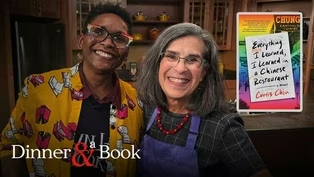
Everything I Learned, I Learned in a Chinese Restaurant Preview
Preview: S25 Ep6 | 19s | Everything I Learned, I Learned in a Chinese Restaurant Preview (19s)
Providing Support for PBS.org
Learn Moreabout PBS online sponsorship

- News and Public Affairs

Top journalists deliver compelling original analysis of the hour's headlines.












Support for PBS provided by:
Dinner & A Book is a local public television program presented by PBS Michiana