
The lasting psychological impact of 9/11 on America
Clip: 9/9/2026 | 10m 8sVideo has Closed Captions
The lasting psychological impact of 9/11 on America
Judy Woodruff recently visited the September 11 Memorial in New York for a look at how the attacks, 25 years ago, continue to shape our lives today. It's part of her series, Crossroads: America at 250.
Problems playing video? | Closed Captioning Feedback
Problems playing video? | Closed Captioning Feedback
Major corporate funding for the PBS News Hour is provided by BDO, BNSF, Consumer Cellular, American Cruise Lines, and Raymond James. Funding for the PBS NewsHour Weekend is provided by...
The lasting psychological impact of 9/11 on America
Clip: 9/9/2026 | 10m 8sVideo has Closed Captions
Judy Woodruff recently visited the September 11 Memorial in New York for a look at how the attacks, 25 years ago, continue to shape our lives today. It's part of her series, Crossroads: America at 250.
Problems playing video? | Closed Captioning Feedback
Where to Watch PBS News Hour
PBS News Hour is available to stream on pbs.org and the PBS app.
Providing Support for PBS.org
Learn Moreabout PBS online sponsorshipGEOFF BENNETT: We turn now to Judy Woodruff, who recently visited the September 11 Memorial in New York for a look at how the attacks 25 years ago continue to shape our lives today.
It's part of her ongoing series Crossroads: America at 250.
DAVID BLIGHT, Yale University: Water, I think, is very important.
It makes you kind of stop, reflect, one hopes in reverence.
JUDY WOODRUFF: I met David Blight and Garrett Graff at the 9/11 Memorial in Lower Manhattan last week, where, for nearly 15 years, water has fallen into the empty footprint of the North and South Towers of the World Trade Center, surrounded by the names of the nearly 3,000 victims who lost their lives that day 25 years ago.
GARRETT GRAFF, Author, "The Only Plane in the Sky: An Oral History of 9/11": Every time I come, I'm just struck by the enormity of the death toll.
JUDY WOODRUFF: Graff authored "The Only Plane in the Sky: An Oral History of 9/11" and is behind the podcast "Long Shadow," the first season devoted to telling the story of 9/11.
DAVID BLIGHT: We had whole sessions on Saturdays about specific issues that they faced.
JUDY WOODRUFF: David Blight is a Yale historian who lectures on traumatic events in our past, like the Civil War, Pearl Harbor and 9/11.
He advised the team that created the museum that sits below the memorial, helping to tell the stories of what happened that day in 2001.
GARRETT GRAFF: The first strike happens into the North Tower at 8:46 that morning.
The second plane hits at 9:03, 17 minutes later.
And that 17-minute period to me has always been the most interesting moment of 9/11, because you see in those 17 minutes how different our country really was.
Everyone in those first minutes, when they hear of that first crash, has a sort of similar befuddled reaction.
BRYANT GUMBEL, NBC Anchor: It's 8:52 here in New York.
I'm Bryant Gumbel.
We understand that there has been a plane crash on the Southern Tip of Manhattan.
MAN: We have no idea what it was.
It was a tremendous boom just a few moments ago.
GARRETT GRAFF: Oh, it was probably a small plane.
Oh, maybe the pilot had a heart attack.
Maybe there was a mechanical problem.
It must have been a terrible navigation error.
JUDY WOODRUFF: That was my reaction when I heard that morning that a plane has gone into... DAVID BLIGHT: Yes, me too.
Small plane, must have been.
GARRETT GRAFF: And then everyone sort of goes on about their morning.
And, of course, at 9:03, that second plane hits, and people all across the country realize America is under attack.
JUDY WOODRUFF: And everything changes at that moment.
And yet watching it happen is surreal.
I mean, it's not anything we have ever imagined.
DAVID BLIGHT: No, and it becomes the most visual event in history.
There is endless film footage, endless photographs.
No one turned their television off for days on end.
I remember my mother, who was still alive, she kept calling me constantly and saying, "We will never be the same again."
"Mom," I remember saying to her, "turn off CNN.
Take it easy."
And, of course, I'm trying to give her some historical perspective, which was impossible.
We were witnessing a colossal human mass murder, and we didn't know the extent of it for quite a while.
JUDY WOODRUFF: We're all -- everyone, I'm sure, on their minds, is God rest the souls of those who've lost their lives this morning in New York.
I was actually on the air on CNN that day, one of the people reporting watching the towers... DAVID BLIGHT: Sorry.
(CROSSTALK) JUDY WOODRUFF: ... come down.
There's no -- there's no way even people who watch terrible things all the time... DAVID BLIGHT: Yes.
Yes.
JUDY WOODRUFF: ... to get our arms around what we were describing, what we were talking about.
GARRETT GRAFF: And I think David raises an important point, which is, here we are 25 years removed from this world-changing event, what I think is one of the great hinges of American history; 40 percent of the country is now too young to remember those attacks.
None of us knew that day what comes next, whether there was a second wave that was coming that afternoon, whether there were more attacks coming on September 12.
And to really understand why America reacted in the way that we did as a country, as a society, as a government, as a military, you really have to understand the deep fear, chaos, confusion, and trauma that the country experienced living through those events.
JUDY WOODRUFF: You're a historian.
Was there anything -- I mean, clearly, this country's lived through terrible things, the Civil War, the attack on Pearl Harbor.
JUDY WOODRUFF: Is there anything in our history that we can compare what happened on 9/11 to?
DAVID BLIGHT: Yes, if it's destruction and slaughter on a single day, and if you think back to the press coverage at that very moment, immediately, people were using Antietam, because it was the largest single casualty count of the Civil War.
Pearl Harbor came to mind for everybody, Fort Sumter, the start of the Civil War.
There were analogies flying everywhere, which is what we do as humans.
We want some parallel to help us know where we're standing.
But nothing quite worked, to be honest.
This was such an immediate, in one hour, mass murder, that no one quite could process that.
That takes historical time.
And, even then, I don't think most Americans could process it, if they ever did, for a very long time.
JUDY WOODRUFF: Garrett, you have looked at the whole picture.
What has it meant for this country that that happened?
GARRETT GRAFF: Yes, 9/11 changes almost everything about daily life in America.
Some of those changes are very obvious to us, the taking our shoes off at the airport, the liquid ban that comes into our carry-on with one of the follow-on al-Qaida plots after 9/11.
But I think there's a bigger backdrop too, which is, we have become a much more fearful and anxious country that I think many Americans who didn't live in the world before 9/11 in the United States don't realize how innocent our country really was.
I also think Americans are very bad at understanding even our own recent history.
And it is impossible to separate from 9/11 the events that we are living through roiling our domestic politics here in the United States today, in terms of the immigration crackdown by ICE, by CBP, by the Border Patrol, by DHS, all of which are an invention of the post-9/11 world and in an attempt to ensure that these types of terror attacks never happen again.
DAVID BLIGHT: I love the point that Garrett made about innocence.
In the wake of 9/11, you may remember this, all sorts of people were writing, I mean, really smart people were writing and asking, this might finally end American innocence, that we don't live above history, that we're not always exceptional, that we have enemies, big enemies.
You know, why do they hate us?
Remember, that phrase was everywhere.
But Americans have lost their innocence many times and regained it.
Part of the civil religion is our sense of chosenness, our sense of specialness, a sense of exceptionalism.
What did we do in 2003?
We invaded Iraq out of, frankly, a rather innocent conception of that country, its history and the whole of the Middle East, and eventually a horribly mistaken idea that Saddam Hussein had nuclear weapons and so forth.
We have a long history of losing innocence.
I mean, you would think the American Civil War would have ended innocence forever, but it didn't at all.
But we regain it.
And look where we are now.
We're having a -- the biggest fight over history, who gets to control it, who owns it, who can -- who can control the narrative in museums.
We're having the biggest fight we have ever had about that.
I have been spending most of my time on that.
And that comes from a certain regained innocence as well, that there is some pure and rigid and static good American history if we can just get back to it, and all this conflict, all this difficulty, all right, we need to know something about it, but can't we just get beyond that?
You don't get beyond 9/11.
You have to sit with it.
It's authentic tragedy.
Where do you fit 9/11 into a narrative of exceptionalism and relative innocence?
You can't.
JUDY WOODRUFF: It's not the whole story... DAVID BLIGHT: No.
JUDY WOODRUFF: ... but it has to be part of the story that we have had.
DAVID BLIGHT: It's a very big part because of all things that had changed.
GARRETT GRAFF: One of the challenges of the way that this history evolves is if you had stood here at the 10th anniversary of 9/11, you would have said President Barack Obama is a direct result of the forces of 9/11, that he comes to prominence in the Democratic Party because of his opposition to the Iraq War.
That, if you are standing here at the 25th, you will say Donald Trump is a direct result of the forces unleashed by 9/11, and that those stories are both true, and those are stories that are very different about where America is heading and what 9/11 will ultimately mean to our country.
JUDY WOODRUFF: For the "PBS News Hour," I'm Judy Woodruff in Lower Manhattan.

AI researcher says companies are ignoring catastrophic risks
Video has Closed Captions
AI researcher warns companies are ignoring catastrophic risks (7m 11s)
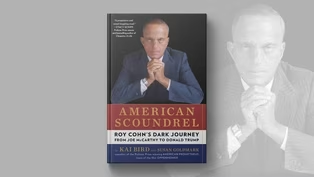
Cohn's influence on politics traced in 'American Scoundrel'
Video has Closed Captions
Roy Cohn's continued influence on politics and Trump traced in 'American Scoundrel' (6m 39s)
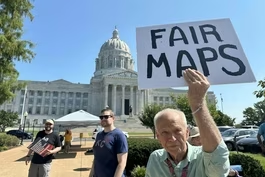
Missouri's election maps in chaos after conflicting rulings
Video has Closed Captions
Missouri's election maps in chaos after conflicting rulings (5m 29s)

Netanyahu under pressure after report on pre-Oct. 7 warnings
Video has Closed Captions
Netanyahu faces pressure after report alleges he brushed off warnings ahead of Oct. 7 (6m 59s)
News Wrap: White House defends Trump's $45,000 gifts
Video has Closed Captions
News Wrap: White House defends Trump's $45,000 gifts to Natalie Harp and other aides (4m 43s)
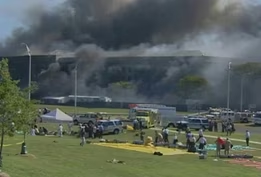
'Total chaos.' PBS News crews filmed the Pentagon on 9/11
Video has Closed Captions
'Total chaos.' How PBS News crews filmed the Pentagon on 9/11 (5m 32s)

What to expect from the GOP's first-ever midterm convention
Video has Closed Captions
What to expect from the GOP's first-ever midterm convention (5m 27s)
Providing Support for PBS.org
Learn Moreabout PBS online sponsorship New Episode
- News and Public Affairs

Today's top journalists discuss Washington's current political events and public affairs.
 New Episode
- News and Public Affairs

FRONTLINE is investigative journalism that questions, explains and changes our world.
 New Episode
 New Episode
 New Episode
 New Episode
 New Episode

 New Episode
 New Episode

Support for PBS provided by:
Major corporate funding for the PBS News Hour is provided by BDO, BNSF, Consumer Cellular, American Cruise Lines, and Raymond James. Funding for the PBS NewsHour Weekend is provided by...