
Tamara Keith and Amy Walter on Trump's focus on the SAVE Act
Clip: 6/29/2026 | 10m 15sVideo has Closed Captions
Tamara Keith and Amy Walter on Trump's focus on the SAVE Act
NPR’s Tamara Keith and Amy Walter of the Cook Political Report with Amy Walter join Geoff Bennett to discuss the latest political news, including the Supreme Court further expanding the president's authority while rejecting President Trump's effort to restrict mail-in voting, Trump focusing on the SAVE Act and progressive candidates winning Democratic primaries.
Problems playing video? | Closed Captioning Feedback
Problems playing video? | Closed Captioning Feedback
Major corporate funding for the PBS News Hour is provided by BDO, BNSF, Consumer Cellular, American Cruise Lines, and Raymond James. Funding for the PBS NewsHour Weekend is provided by...
Tamara Keith and Amy Walter on Trump's focus on the SAVE Act
Clip: 6/29/2026 | 10m 15sVideo has Closed Captions
NPR’s Tamara Keith and Amy Walter of the Cook Political Report with Amy Walter join Geoff Bennett to discuss the latest political news, including the Supreme Court further expanding the president's authority while rejecting President Trump's effort to restrict mail-in voting, Trump focusing on the SAVE Act and progressive candidates winning Democratic primaries.
Problems playing video? | Closed Captioning Feedback
Where to Watch PBS News Hour
PBS News Hour is available to stream on pbs.org and the PBS app.
Providing Support for PBS.org
Learn Moreabout PBS online sponsorshipGEOFF BENNETT: The Supreme Court further expands the president's authority, while rejecting President Trump's effort to restrict mail-in voting, leaving that fight to Congress.
For more, we turn now to our Politics Monday duo.
That's Amy Walter of The Cook Political Report With Amy Walter and Tamara Keith of NPR.
It's good to see you both on this very busy Monday.
AMY WALTER, The Cook Political Report: Yes.
GEOFF BENNETT: So, lots of action from the Supreme Court.
Among the flurry of decisions, the court rejected an RNC, Republican National Committee, challenge and ruled that election officials may count mail-in ballots that arrive after Election Day if they're postmarked beforehand.
So, Tam, this leaves existing rules in place for now while basically setting up Congress to legislate on this very issue.
President Trump is talking about his SAVE Act.
Does this ruling from the court give his SAVE Act more momentum, or does it actually lessen the urgency in some ways?
TAMARA KEITH, National Public Radio: I don't know if it lessens the urgency.
The president's urgency is off the charts.
It's just not clear that his Republicans in Congress feel the same level of urgency.
Obviously, some absolutely support his SAVE America Act, but he's running into a wall in the U.S.
Senate, where there are Republican senators who have concerns about some of the provisions in his so-called SAVE America Act which would strictly reduce the availability of mail-in voting for absent -- or not just absentee, but mail-in voting for people in rural areas, for instance, in Alaska, for instance, where Senator Lisa Murkowski opposes the SAVE America Act.
So there are real issues and challenges.
Bigger picture, he is both running into a wall in Congress and also in the courts.
Last week, there were a number of rulings on his various executive orders to try to change the way people vote, and then you get the Supreme Court ruling this week.
So, a pretty significant pushback on the president's effort to impose his ideas on the administration of elections, which the Constitution says is -- should be in the hands of states.
GEOFF BENNETT: And Democrats, meantime, are dead set against this elections bill.
They say it will disenfranchise millions of voters.
The president, to Tam's point, was in the Oval Office today, speaking in support of it.
Here's some of what he said.
DONALD TRUMP, President of the United States: We're the only country in the world that does this type of mail-in ballot.
There's no other country in the world.
You know why?
They tried it and it was totally dishonest.
And it's really dishonest.
So we shouldn't do mail-in ballots.
GEOFF BENNETT: So, the president there again speaking out against mail-in voting.
He says we're the only country in the world that allows this.
That's not true.
What about the his other point that it's dishonest, that it's open to fraud?
AMY WALTER: That's right.
Some states like Oregon, Colorado have been doing -- Washington state -- just vote by mail.
They conduct it entirely through the mail.
There's been no evidence that any of those elections have been tampered with in any way or that the votes are illegitimate.
I think what the president really dislikes about the way that we vote in this country or certain states vote is, because he has been for so long making this claim that is not true that if you vote -- the vote by mail is not safe and it can be tampered with, that Republicans now are going to the polls, rather than sending in ballots.
And Democrats are more likely to be sending in ballots.
So what you see on election night, and this will probably happen when we're together on election night this year, is the early vote, depending on when -- what a state counts first, but if they count the votes that came in that day first, it looks very red.
And then the other votes come in, the mail ballots, which now have become more Democratic.
And so the president goes to bed seeing, oh, 35 percent of the vote is in, the Republican is ahead, we're going to win this seat, wakes up in the morning, and now the Democrat won.
This is not nefarious.
It's just the math.
GEOFF BENNETT: So he seems to have stuck in his head that mail-in voting benefits Democrats, and this is your explanation as to why.
AMY WALTER: Correct, as to why.
And he -- it's sort of a catch-22, because the more that he says you can't trust mail-in voting, the more likely it is that Democrats will do it or more likely that Republicans won't.
And this is what makes Republican strata strategists crazy, because they want to bank as many votes as they can.
And if they can get somebody to put a vote in the mail, they don't need to worry about turning them out to vote on Election Day when maybe it's raining or the dog's sick, and they just forget.
GEOFF BENNETT: And, Tam, this fight over the SAVE America Act has held up this landmark bipartisan housing bill, which the president today he dismissed as a yawn.
Do we have that sound?
I think we do.
We can listen to that as well.
DONALD TRUMP: Here's what I would like to say.
Much more than a bill that -- big deal.
It's a yawn.
Some people say it's wonderful.
To me, compared to the SAVE America Act, just about everything is a big yawn.
GEOFF BENNETT: So in this moment, where every election in this primary leading up to the midterm, the primaries leading up to the midterms, has been about affordability, this would be a layup for the president to say, let's just go ahead and sign this bill.
And yet... TAMARA KEITH: And yet he is stepping on his own feet and stepping on the feet of his members of Congress, the Republicans in the House and the Senate, who worked in a bipartisan fashion to get this through.
President Trump literally called for one of the major provisions of this bill in his State of the Union address, said, Congress, go out and do this.
Congress went out and did it, and he says it's a yawn.
You add this to other things that he has said, where he's not concerned about inflation, or I'm not really focused on affordability or what things cost, there's a larger context to all of those statements.
But, in campaign ads, the larger context will be gone, and he will just be sounding dismissive of the concerns of Americans, who -- like affordability is the top issue, whether it's about housing or the price of gas or the price of groceries or all of these things.
And a lot of Republicans were very and are very eager to be able to run on something like this housing bill.
GEOFF BENNETT: Well, as we talk about the primaries, we have got another one coming up in Colorado.
And we have seen these progressive victories in New York and Washington state.
Tomorrow, tomorrow -- rather, Washington, D.C., not Washington state.
AMY WALTER: D.C., yes.
GEOFF BENNETT: Can't even read my notes here.
But tomorrow's Colorado primary will be a test because you have got Senator Michael Bennet, and you have got the Congresswoman Diana DeGette.
They're facing serious challenges from the left.
What are you watching for?
AMY WALTER: Yes.
So I think there is -- it's very important to put these challenges into different buckets.
I think, in some of the darkest blue state -- darkest blue district -- now, we saw it in New York City, but we have also seen this in Philadelphia, in New Jersey, and now maybe in Denver, where candidates running as a justice Democrat or those basically on the furthest left of the party, many motivated by the issue of Israel, not all, but definitely is a big piece of that, have been successful.
We're going to see tomorrow night in Denver whether that candidate to the left of longtime incumbent Diana DeGette will be successful.
But when we look at the governor's race between Michael Bennet and the state attorney general, the Democrat there, that's really about, who's the better fighter?
And this is really at its core what the Democratic - - if you want to sort of say what are these Democratic primaries really about, what does it mean to be a fighter in this age, and who are you fighting for and what are you fighting against, in the case of, in these dark blue districts, what I'm fighting against, the left, the further left, the Bernie-backed candidates would say is, I'm fighting against corporate oligarchy, the system, the establishment, which can include Democrats.
If you're talking about, in this case, the governor's race, it's, who's fighting Trump the hardest?
The state attorney general, who's filing court cases and winning court cases, or the guy who's been in Washington as one of 100?
And, by the way, Democrats aren't doing anything in Washington.
I'm the one, says the state attorney general, who's really doing the hard work.
And that same debate is going on in a competitive district in Colorado between two Democrats.
So this, to me, is going to be a fascinating question as we get to 2027.
What does it mean to be a fighter, not just with Trump still in office, but looking forward to when Trump isn't in office?
And, Tam, are you following this race out of Alaska, the two Sullivans?
This is my favorite political story.
GEOFF BENNETT: And I will set it up.
I will set it up so folks know what we're talking about.
So this judge in Alaska has ruled that Democrat Dan J. Sullivan can appear on the ballot alongside incumbent Republican Senator Dan S. Sullivan.
So we have seen ballot confusion before.
I would posit, though, that this is probably less of an issue in Alaska, where Murkowski voters had to know not just who she was, they had to know how to spell her name and write it in on a ballot.
GEOFF BENNETT: So I would think that Alaska voters would be able to discern between a Dan S. Sullivan and a Dan J. Sullivan.
How do you see this?
TAMARA KEITH: However, middle names are very different than Murkowski as a full name.
And so it's a top four primary, so it's possible that both Dans Sullivan, I think that might be the plural, make it out of this primary.
Certainly, I think you can get confusion when you're trying to figure out well, what is the middle name of the guy who I voted for before?
Also their logos are oddly similar as well.
So it's not clear exactly what's happening here, but the word shenanigans does come to mind.
AMY WALTER: Well, and the fact that the RNC filed a lawsuit tells you that, yes, they are concerned about voter confusion.
GEOFF BENNETT: More to come on that front, for sure.
AMY WALTER: Indeed.
GEOFF BENNETT: Amy Walter, Tamara Keith, thanks so much.
AMY WALTER: You're welcome.
TAMARA KEITH: You're welcome.
American dream slipping from DACA recipients, report finds
Video has Closed Captions
American dream slipping out of reach for many DACA recipients, new report finds (6m 46s)
News Wrap: Supreme Court rules location data protected
Video has Closed Captions
News Wrap: Supreme Court rules constitutional protections apply to location data (5m 44s)
Ruling proves Fed is unique agency, Lisa Cook's lawyer says
Video has Closed Captions
Supreme Court ruling proves Federal Reserve is unique agency, Lisa Cook's lawyer says (5m 35s)
Texas board mandates students read Bible stories
Video has Closed Captions
Required Bible stories for Texas students challenge separation of church and state (5m 52s)

Venezuela rescue efforts grow desperate as death toll rises
Video has Closed Captions
Venezuela rescue efforts grow desperate as death toll rises and aftershock rattles country (4m 51s)
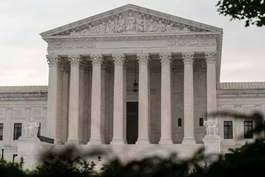
What the Supreme Court rulings mean for presidential power
Video has Closed Captions
What the Supreme Court rulings mean for presidential power (6m 13s)
Willy Vlautin on spotlighting working-class life
Video has Closed Captions
Willy Vlautin on spotlighting working-class American life in his novels and music (7m 31s)
Providing Support for PBS.org
Learn Moreabout PBS online sponsorship New Episode
- News and Public Affairs

Today's top journalists discuss Washington's current political events and public affairs.

- News and Public Affairs

FRONTLINE is investigative journalism that questions, explains and changes our world.
 New Episode
 New Episode
 New Episode
 New Episode
 New Episode
 New Episode

 New Episode
 New Episode
 New Episode
Support for PBS provided by:
Major corporate funding for the PBS News Hour is provided by BDO, BNSF, Consumer Cellular, American Cruise Lines, and Raymond James. Funding for the PBS NewsHour Weekend is provided by...