
Now Hear This – “The Call of Istanbul”
Season 53 Episode 15 | 53m 55sVideo has Closed Captions
With a host of Turkish musicians, Scott Yoo explores the city.
Istanbul sits at the crossroads of Asia and Europe, a melting pot of diverse peoples, languages and ideas. With star Turkish pianist Fazil Say, conductor Çem Mansur, and a host of Anatolian folk and Turkish jazz musicians, Scott Yoo and his wife, flutist Alice Dade, explore the city.
Problems playing video? | Closed Captioning Feedback
Problems playing video? | Closed Captioning Feedback
Major series funding for GREAT PERFORMANCES is provided by The Joseph & Robert Cornell Memorial Foundation, the Anna-Maria and Stephen Kellen Arts Fund, the LuEsther T. Mertz Charitable Trust, Sue...
Support provided by:

Now Hear This – “The Call of Istanbul”
Season 53 Episode 15 | 53m 55sVideo has Closed Captions
Istanbul sits at the crossroads of Asia and Europe, a melting pot of diverse peoples, languages and ideas. With star Turkish pianist Fazil Say, conductor Çem Mansur, and a host of Anatolian folk and Turkish jazz musicians, Scott Yoo and his wife, flutist Alice Dade, explore the city.
Problems playing video? | Closed Captioning Feedback
Where to Watch Great Performances
Great Performances is available to stream on pbs.org and the PBS app.
Buy Now
Great Performances Newsletter
Subscribe to the Great Performances newsletter to keep up with the latest full episodes to stream, exclusive content, and more!Providing Support for PBS.org
Learn Moreabout PBS online sponsorshipPart of These Collections
Now Hear This
Journey across Europe with Scott Yoo to discover how four composers created masterworks.
View Collection
Everything Streaming Now
See everything streaming on Great Performances in one convenient location.
View CollectionProviding Support for PBS.org
Learn Moreabout PBS online sponsorship-Up next on "Great Performances" -- I'm Scott Yoo.
Join me and my wife, Alice Dade, in Istanbul.
-Ooh.
-It's a place we've wanted to visit for years.
-That's one of my favorites, actually.
-I love this.
-I've wanted to find out why this city sounds like no other.
I mean, this is insanely fast.
-They dance like electricity, you know?
-This is such a unique place.
But we would experience so much more... ♪♪ ...the art... ♪♪ -Mm.
-Ooh.
♪♪ Wow.
Ooh!
Hot.
-...the food... -You like it?
-It's good.
-I don't like it so much.
[ Laughter ] -...the traditions... ♪♪ ...and an astonishing variety of music... [ Drums playing ] ...to reveal a culture that has shaped Western music... -It really became a fashion in Haydn and Mozart and onwards.
-...as much as we have shaped it.
Coming up on "Now Hear This: The Call of Istanbul."
♪♪ Major funding for "Great Performances" is provided by... ...and by contributions to your PBS station from viewers like you.
Thank you.
♪♪ -I've come to Istanbul at last for two reasons -- to see my friend Fazil Say, Turkey's most celebrated pianist and composer, and to try to figure out its music.
♪♪ The city spreads across both sides of the Bosphorus, half European, half Asian, and sounds like no other.
I wanted to know why.
♪♪ ♪♪ ♪♪ Istanbul has long been a bridge between continents, a crossroads of many cultures.
I suspected that shaped its music.
[ Birds crying ] ♪♪ ♪♪ ♪♪ Then, when Turkish armies invaded Europe, Istanbul shaped the music of Haydn, Mozart, and Beethoven.
♪♪ ♪♪ Today we know Turkey as a Muslim country.
But that's a cultural crossroads, too, because for centuries before that, Istanbul was Christian.
My wife, Alice, and I went to the Kariye Mosque, which was originally a Byzantine church, with Turkish conductor Cem Mansur.
This looks very, very old.
-Only from the end of the 5th century A.D.
-So the oldest parts of this building, the lowest layers, are 1,600 years old?
-Yes.
Something like that.
-Wow.
-That's crazy.
-That is crazy.
-That's incredible.
-So, before Istanbul was Istanbul, the city was known with different names, and it was founded by a Greek maritime character called Byzas.
And we therefore call that early part of the city's history Byzantium.
But it's really the emperor Constantine, as the emperor of Rome, who decided to move his capital from Rome to this place, which he called Constantinople, after himself.
-Very modest.
-[ Laughs ] -And the interesting thing is, with the Ottoman conquest in 1453, the city became known as Konstantiniyye.
So it was really a Turkish way of saying the city of Constantine.
-So 1453 is actually kind of recent history for this city.
-Absolutely.
And like a lot of these buildings, with the conquest of Constantinople in 1453, it was converted into a mosque and remained a mosque for the next 600 years or so.
And with the republic, it became a museum.
Now it's no longer a museum.
That's even more complicated.
-[ Laughing ] -[ Laughing ] What is it now?
-Yes.
Well, it's back to being a mosque and a museum at the same time.
-Okay.
-One of the most spectacular things about this building is the mosaics inside.
Shall we go and have a look?
-Yes.
Please.
You lead the way.
-This way.
♪♪ -Alice found this old Byzantine hymn written by a priest, set to music by a monk.
♪♪ -That's one of my favorites, actually.
This is the emperor -- You see?
-- the Byzantine emperor giving the church as a present to Christ.
-Beautiful.
♪♪ Cem, how old are these?
-The mosaics, as far as we can tell, date to the 12th century.
♪♪ -These are incredibly advanced for the 1100s.
-Even something that may be interpreted as the art of perspective, before its time.
-I mean, it's incredible.
-And look at those.
-Can you imagine how much work that is?
-Yeah.
-Wow.
♪♪ ♪♪ -What I find really fascinating in this place is to observe how Islamic architecture of mosques afterwards was actually influenced by buildings like this -- the repeating arches, the many domes.
-So, one of the secret superpowers of Turks is that they kind of successfully absorbed everything that came before them.
It was clear the city's arts were at a very high level when it was Constantinople.
And much of that transferred to Istanbul.
But the Turkish art form most visitors know today is the carpet.
In the courtyards off Istanbul's Grand Bazaar, we went to see Aziz Ozcan, a dealer of textiles from Central Asia.
-This is the Kyrgyz embroidery.
-Ooh.
-This is from Kyrgyzstan?
-Kyrgyzstan.
Mirror cover.
-A mirror cover?
Okay.
-Okay.
This is also from Kyrgyzstan?
-Same.
Yes.
This is a more older one.
-You can tell the similarities with the pattern.
That's really nice.
-This is Kungrat.
The same.
Like, a mirror cover.
-And this is from where?
-This is from Uzbekistan.
-Uzbekistan?
-Yeah.
Kungrat.
-Mm.
But still really detailed.
-Salt bag.
-Salt bag?
-Yeah.
Hang on wall in the kitchen.
Some people put a spoon or something.
I saw many time putting the salt inside.
-Okay.
And where was that one made?
-This is the same -- Kyrgyz.
We see the first one.
And one other Kyrgyz.
This is for bread.
-For bread?
-To take the bread inside.
Hang on wall.
You see here?
-Hanging envelope for bread.
Everyone's dream.
-This one is Tajik.
-Tajikistan.
-Burka.
-It's a burka?
-Burka.
Yes.
-So you wear this.
-Okay.
-Like this.
-How long -- Did it take, I mean, days to make this?
-So much days.
-Look at that.
Wow.
♪♪ -It's a woman's dress.
-Mm-hmm.
-You want to try?
-Oh.
[ Laughs ] Sure.
Uzbekistan, Bukhara.
-Uzbekistan.
-From Bukhara.
I love this.
I would wear this.
How old is this?
-Nearly 120, 110 years old.
-[ Laughs ] I mean, this is timeless.
It's just beautiful.
-Tajik ikat.
-Oh.
Okay.
-This is from Tajikistan.
-Yeah.
I would wear both of these.
-Yeah.
[ Laughs ] -It's beautiful.
I want to keep it.
[ Laughs ] -Beautiful.
-You see some in museum like this.
Every time this quality.
-So this is almost a museum-quality piece.
-Museum quality, all the pieces.
Yeah.
If you want, try one more.
-Sure.
-This, actually, women use it like this.
I'll show.
Like this.
-Is this to enter a mosque?
-No.
This woman go to the city, use it like this.
-How old is this?
-A hundred and fifty possible, I can say, this one.
-So these... -Turkmenistan.
-This is from here.
-Yes.
-The burka was from Tajikistan.
-Tajikistan, yes.
-And this one is from Uzbekistan.
-Yes.
-So it's this area.
-These people have unbelievable embroidery.
-So you can be here and buy embroidery from Turkmenistan, Uzbekistan, Kyrgyzstan, Tajikistan.
It doesn't matter because everything comes here.
This is kind of the crossroads.
-Here, more easy you find.
-Mm-hmm.
-Last year, I go to Uzbekistan and Kyrgyzstan.
-Mm-hmm.
-I find only two things.
-Really?
-It's easier to find stuff from Kyrgyzstan or Uzbekistan here than there?
-Yes.
-So all of these countries, they speak sort of a Turkish language.
-Yes.
-They're Turkic people.
-Old Turkish language.
-Can they understand one another?
-Like, we understand 40%, 50% we understand each other.
-So the Turkic people, the people who speak this Turkic language, they came from here.
I guess they traveled through northern Iran.
-Iran -- coming to Iran.
After Iran, Hazara, coming to eastern Turkey, coming to Anatolia.
-So, where exactly on the map is Anatolia?
-Center.
It's here, near Cappadocia, Ankara.
Anatolia, here.
-Okay.
So the Turks that gave this country its name actually came from Central Asia, bringing their textiles and their music with them.
We went to see Coskun Karademir, and Ayfer Vardar, two amazing Anatolian folk musicians.
-[ Singing in Turkish ] ♪♪ ♪♪ ♪♪ ♪♪ [ Music slows, ends ] -Our translator was guitarist Cenk Erdogan.
So, these instruments, did they originate here or did they originate in Central Asia?
-They come from Central Asia, actually, especially saz and the kopuz.
You can see many, many different versions of it when you search back.
But every region of Turkey has a different mode -- we say makams, you know?
-- makams -- and every city has a type of playing and strumming.
So you need to learn all this rhythmic stuff to become, like, a master of this instrument.
Now she's going to perform a song from the middle Anatolia, and this style of playing and this style of song is called Bozlak.
-Okay.
[ Down-tempo introduction plays ] -[ Singing in Turkish ] ♪♪ ♪♪ ♪♪ ♪♪ ♪♪ ♪♪ ♪♪ -What are these songs about?
Are they about love or... -Of course in Anatolia, we have songs about love, but we have different types of love -- love to a woman or a man, love to your country, like a patriotic way, and the last love, it's the love of God.
And most of the Sufis and players, they write poems about how they can reach to God.
-Mm-hmm.
-So now they're going to perform a song from the far east Anatolia.
The name of the song is "Ne Aglarsin," which we can translate it "Why Do You Cry?"
[ Mid-tempo introduction plays ] ♪♪ -[ Singing in Turkish ] ♪♪ ♪♪ ♪♪ ♪♪ ♪♪ [ Down-tempo introduction playing on piano ] [ Birds crying ] ♪♪ ♪♪ ♪♪ ♪♪ ♪♪ -I've known Fazil Say for more than 30 years, from when we were just starting our careers.
Since then, he's written more than 100 original compositions, from solo piano pieces to full orchestral works.
♪♪ You know, I still remember very clearly the first time I heard you play, because you were playing your own piece.
And when you started, I mean, people were shocked.
-Mm.
-And I thought, "Where is this music coming from?
Maybe this is Turkish music."
-Yes.
The first generation of Turkish composers who composed Western music, orchestral music, all this, they were all students of Bartók.
Bartók took them -- They were very young -- beginning of 20th century.
They went wide in east Anatolia, recording and searching, trying to understand the folklore, folk music, and tunes and all this and using the ethnical element in the modern music.
It's also into my music strongly, I think.
-Is that why you wrote... ...this?
-Yes.
This is a microtone between E and E flat.
And this is exactly how Turkish music works.
You have to play in between the notes.
-In between.
Exactly.
We have strange rhythms.
Strange bars and musical bars -- like 7/8, 9/8, 13/8 or so.
All this doesn't exist in Western European music.
-So this part is the Turkish part, right here?
-Many -- -One of the Turkish parts.
-One of the -- On these two pages, you have so many Turkish parts, of course.
♪♪ ♪♪ ♪♪ ♪♪ ♪♪ ♪♪ ♪♪ -Fazil's music is a crossroads, too, where mournful Eastern melodies meet Western romanticism, making it accessible to both.
♪♪ ♪♪ ♪♪ -Taksim Square is the heart of modern Istanbul.
We went to one of their modern concert halls with Cem again.
[ Drumroll, dramatic music plays ] ♪♪ This is such a unique place.
-[ Laughs ] -It's beautiful.
-Yes.
This is the Ataturk Cultural Center.
It's home to the Istanbul State Opera and Ballet.
And I brought you here today especially because they're rehearsing an opera by Adnan Saygun.
Saygun belongs to the first generation of Turkish composers who wrote in a Western style.
♪♪ -He was famous.
-In his lifetime, yes, and since.
I think he's a very important composer.
He's really the kingpin of this change in musical culture in Turkey.
[ Music builds, continues ] Saygun originally fed on Turkish national music -- folk music mainly -- which was typical of that first generation of composers.
A bit of a parallel to consider is that of Bartók, who started as a more, obviously, more overt -- -He was here, right?
-He was here.
He was here with Saygun collecting Turkish folk music, as he did all over Eastern Europe, but also including Anatolia.
But Saygun did not only draw on Turkish folk music, but also on the soil itself.
He was a bit of a mystic and was very interested in what made this soil, this country, what is now Turkey, special.
And the legend of Gilgamesh, on which the opera is based, is actually a Mesopotamian legend.
-I've heard of Gilgamesh.
-Typical story of an evil emperor looking for enlightenment.
As far as we know, it's the oldest written document, oldest piece of literature that we have.
And it originates from what is now this country.
And Saygun was very -- -So Turkey is part of Mesopotamia.
-Mesopotamia is part of what is now Turkey.
-Really?
-What we call Mesopotamia is between the two rivers of the Euphrates and Tigris.
But they're born, naturally, in what is now Turkey.
We are now living on this land, but, you know, it's like a crossroads of the world, which has been home to so many civilizations, including the very earliest ones.
And I think that is the key to understanding the international and universal appeal of his music.
Should we go and have a listen?
-Sure.
-Sure.
♪♪ ♪♪ ♪♪ ♪♪ -From there, we went to see and do another famous Turkish art form with a master artist, Fikret Guney.
-[ Gasps ] Oh!
-You probably recognize this art, called ebru, from bookbindings.
-Wow.
My favorite color's orange.
I'm gonna go with this one.
-Yes.
Only two fingers.
-Right.
This?
-Yes.
Enough.
It is.
-Okay.
-This way.
-Oh, that way.
Okay.
Okay.
Ooh!
[ Laughs ] How did you do that so gracefully?
-Oh, you're doing well.
-The same way.
-Okay.
When was this process first invented?
-Nearly 600 years ago.
-Okay.
-From Turkistan, Bukhara, came to Istanbul.
Making Istanbul, Uskudar, Ozbekler, Tekkesi.
First time from Bukhara.
-So this technique migrated.
It came from Turkistan.
-Turkistan, Bukhara, came to Istanbul.
-To here.
Okay.
♪♪ -Ten centimeters.
Up.
This is tarak.
This way.
-Okay.
-Looks nice.
-Ooh.
-It's a very nice tarak.
♪♪ Ah.
-That looks cool.
-Ooh.
-This way.
-Okay.
-Ah.
-Very nice.
♪♪ Please.
♪♪ Enough.
♪♪ -Oh.
-Nice.
-[ Laughs ] -There's another art form that came to Istanbul, but this one from the West.
We went with Cem to the Pera Museum to see their Ottoman portrait collection.
-This character is a French ambassador to the Ottoman court dressed as a Turk.
-Mm.
-So the depiction of the human image is completely forbidden in Islam.
And the first sultan who actually dared having his portrait painted was Mehmet II.
He had the audacity to bring in a painter from Renaissance Italy called Bellini -- an absolute scandal at the time.
But he could get away with anything.
Highly enlightened monarch.
Very brilliant character, Twenty-one years old when he conquered the city.
Spoke seven languages and all that.
-So at its largest, how far did the Ottoman Empire stretch?
-Very far.
Most of the Arabian Peninsula, the Middle East, the whole of North Africa, the Balkan countries, Greece, quite a bit of the Black Sea region.
Basically, anything with people of Islamic origin was actually covered by the empire.
-So really far east as well.
-Absolutely.
Yes.
-And tell me about Ottoman court music.
What was that like?
-Ottoman music is a slightly confusing term, because it's a little bit like the Ottoman language.
We have a language which is really a synthesis of Persian, Arabic, and what came from Central Asia.
So the music was also very much part of that.
All kinds of instruments, anything that was at hand, could become part of what we now call Ottoman Turkish classical music, to distinguish it from Turkish folk music.
[ Clarinet playing mid-tempo music ] ♪♪ ♪♪ -That is an incredible-sounding clarinet.
I've never heard a clarinet sound like that.
-Thank you.
Yes.
-Is it a different instrument?
-Yes.
-What key is this clarinet in?
-G-clef.
Yeah.
G key.
-It's a G?
-G key.
Yes.
-In sol?
-Yeah.
Sol.
Turkish clarinet.
-Really?
-Yes.
-I've never heard of a G clarinet.
That's incredible.
That is an incredible-looking instrument.
What is that?
-Another incredible one.
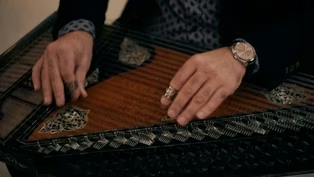
It is canun.
-Canun?
-Canun.
Yes.
Turkish music instrument.
-Okay.
And do you change the tuning with those... -Yes.
These small levers.
These are smaller than quarter tone.
And then, during playing, we are changing it.
-Oh, fantastic.
So it's like a harp pedal?
-Yeah.
But they are quarter tones, you know?
This is very smaller.
[ Ascending notes playing ] -Oh!
-You hear it.
Yeah.
-Wow.
-Yeah.
-You don't tune the harp with these pedals.
You are using pedal number four because you want the quarter tone or you want the three-eighths tone.
-Yes.
During playing, actually.
-During playing?
-Yeah.
During playing, we are changing it.
Yeah.
-And so while you're playing this, you have to memorize, -"Oh, I need this pedal."
-Yes.
-Or, "I need this one."
-Yes.
And you have to know very good Turkish music flavors.
-So you are spicing the music with these?
-Yes.
Absolutely.
-Can we all play together?
-Sure.
-Okay.
Let's try it.
[ Mid-tempo introduction plays ] ♪♪ ♪♪ This reed flute, the ney, is another interesting Turkish instrument.
But we'll come back to that.
♪♪ ♪♪ ♪♪ ♪♪ ♪♪ [ Music ends ] Sultanahmet Square is the heart of old Istanbul, home to its most famous landmarks.
There, we met another Fazil, the imam Fazil Asikkutlu.
Fazil, these are chestnuts, right?
-Yes.
This is our famous chestnut.
-Can we have some?
-Yes.
Of course you can.
-[ Laughs ] -Let me give you.
But please be careful.
-It can be hot.
-Okay.
Yes.
-Thank you.
-You like it?
-It's good.
-I love chestnuts.
-I don't like it so much.
[ Laughter ] And I'm born in Bursa city.
-Mm-hmm.
-And Bursa city is famous for chestnuts.
-Okay.
-Yes.
-How long have you lived in Istanbul?
-Approximately 30 years.
-It seems like Istanbul is a really busy city.
I mean, is it -- What is population of Istanbul?
-When I started to live here, population was approximately 12 million.
-Mm-hmm.
-But now it's 16 million.
-Wow.
-So a very crowded city.
But this city is a very magical and mesmerized city.
-Mm-hmm.
No.
I sense that.
-Great food here, too.
-Great food.
-Great food.
Great sound.
Great music.
-Is that the Blue Mosque?
-Yes.
-Can we walk there?
-Of course.
-So, Fazil, how did you become an imam?
What inspired you?
-I became an imam because I love to serve people.
And in my family, there is lots of imams.
-Oh.
Really?
-Yes.
My father was an imam.
-[ Laughing ] Okay.
-Yes.
My grandfather was an imam.
-And your great-grandparent?
-Yes.
-Really?
-My grandparents since the Ottoman Empire.
There were many religious scholars and leaders who served in high positions.
-It's like a family business.
-Yes.
It's just like a family business.
-You know, in the United States, Islam has, for some people, a violent reputation.
-Unfortunately.
-My own personal experience with Muslims, one of whom, actually, is one of my favorite people -- He's from Istanbul.
He's the least violent person I could ever imagine.
He's so smart, so enlightened.
What are the principles of Islam?
-Islam itself comes from salam, which means peace.
-Peace.
-Yes.
To be honest, to be merciful, to be respectful to each other.
-Fazil, the call of prayer.
-Yes.
-This is the sound of Istanbul.
-In our call to prayer, they are singing with makams, microtones.
And each call to prayer is singing in its own makam.
The words are the same, but the singing is very different.
Every imam and every muezzin has our own style.
-So you have your own style?
-Yes.
-Okay.
-Tomorrow, my friends, they will show you.
[ Man chanting adhan ] ♪♪ -The next day, we went deep into the Uskudar neighborhood, which would have been a separate village when the Cinili Mosque was built 400 years ago.
Though it's small, Cinili is famous for its blue tiles, each a magnificent artwork on its own.
There, we met imams Mustafa Alphayta and Dursun Sahin.
I've never been to a place like this.
This is such a beautiful mosque.
This was built in the 1600s?
-Yes, 1600.
-Wow.
If I may ask a personal question.
-Okay.
-Why did you become an imam?
-Good question.
[ Laughter ] I was a child, and in my village came a new imam.
He sounded very, very nice.
-So the new imam sang well.
-Yes.
I like music.
I finished conservatoire.
-Oh.
Wow.
-Yes.
And after conservatoire, master's.
-Really?
-And now started a doctorate.
-You're doing a doctorate?
-Yes.
Yes.
Imam has to have good sound.
-Yeah.
So is singing your favorite part of being an imam?
-Yes.
Music is my life.
-Fantastic.
-Yes.
-Can we hear you sing now?
-Yes.
[ Clears throat ] [ Singing adhan ] ♪♪ ♪♪ -[ Singing adhan ] ♪♪ ♪♪ ♪♪ ♪♪ ♪♪ -♪ Allahu akbar ♪ ♪ Allahu akbar ♪ ♪ Allahu akbar ♪ [ Vocalizing ] ♪♪ ♪♪ [ Mid-tempo music plays ] -Also in Uskudar, we went to one of Istanbul's famous traditional markets.
Is that a grape leaf?
I love this.
-And rolling?
-Yeah.
-Very tasty.
-I love that.
-In the Black Sea area, they are making rice... -Mm-hmm.
-...dessert.
-Dessert?
-Soup.
-Yes.
[ Laughs ] -What?
Fish dessert?
I don't know about that.
-You can buy this fried over there?
-Yes.
You can buy, and you can eat here.
You can eat here, and it's amazing, right?
-Perfect.
Very delicious.
Very fresh.
-Besides art and culture, this is also the crossroads for food in the region.
From east and west, from land and sea, Istanbul gets the best of everything.
-Can I try one?
Thank you.
-Which one is your favorite?
-Oh, my God.
♪♪ [ Laughs ] -With us were Burcu Karadag, the ney player... -Ah.
Thank you.
-Sorry.
[ Laughs ] -...and Rifat Varol, who makes them.
♪♪ Rifat has built reed flutes for more than 20 years.
By his count, he's made more than 5,000, sold all over the world.
-This is a good ney because it has nine joints.
One, two, three, four.
-Okay.
-And to find it like this, you can look, for example, at 1,000 of them.
Only one of them will be a ney.
Yes.
-One in a thousand will be ney?
-Yes.
One.
Yes.
-Wow.
That's... Okay.
-A Turkish ney has this mouthpiece.
-Oh, and that's beautiful.
-Yes.
And also inside is empty till here.
One horn, only two or three.
Or one.
-One horn?
-On this one, yes.
-Really?
[ Machine whirring ] Mm-hmm.
Wow.
It's got a crown now.
-Now we will find the holes.
-So every reed that you're working with is a different length.
-Yes.
-So the keys are gonna be in different places, so you have to calculate for each every time.
-Because all of them is unique.
[ Drill whirring ] -Somehow it's very cool.
I'm watching a ney being born.
[ Laughs ] Wow.
-We will check the tuning.
It must be C.
-Mm-hmm.
[ Playing mid-tempo music ] -Tune is okay.
-Beautiful.
-Yes.
-So it's done?
-It's yours.
-[ Gasps ] Really?
Wow!
Thank you!
This is so cool.
-Yes.
-Now I just have to learn how to play it.
[ Laughs ] [ Mid-tempo music playing ] ♪♪ -Burcu is one of the most respected ney players in all of Turkey, though this is traditionally a male instrument.
♪♪ ♪♪ ♪♪ ♪♪ ♪♪ ♪♪ [ Music slows, continues ] ♪♪ The ney is best known from the music of Sufis, a Muslim religious sect.
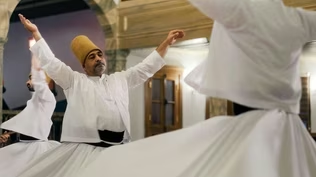
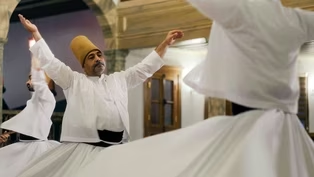
Rifat plays in one of their ensembles, for their famous whirling dervishes.
[ Music continues, men singing ] ♪♪ ♪♪ ♪♪ What does it mean -- Sufi?
Sufism?
-Sufism is right hand is up, left hand is down.
This is the Sufi.
So what is the meaning of this?
This is right hand, takes from the God.
Left hand is down, give to the human.
I am in the middle.
-You're the intermediary between God and man.
-Yes.
-That's Sufism?
-That's Sufism.
[ Music builds, singing continues ] ♪♪ ♪♪ ♪♪ -Do you get dizzy?
-[ Laughs ] The first time, we can.
-The first time, you get dizzy?
-First time, we get dizzy.
-But... -But now, every year, it's going strong, going strong, the dizziness and something like this -- gone.
-So you haven't been dizzy in years?
-No.
♪♪ -Actually, I've heard the whirling focuses their thoughts to enter a trancelike state, a meditation in motion, set to music.
♪♪ ♪♪ ♪♪ [ Music ends ] [ Down-tempo music plays ] ♪♪ Cem took us to the Tekfur Palace, the best preserved from Istanbul's Byzantine era.
But we were here to see and hear an Ottoman-era military fixture -- the Janissary band.
You study Mozart and Beethoven.
You hear about Janissary bands.
I've never heard one live, so I'm very excited to hear one in the flesh.
-Yes.
Well, today's the day.
They used to march in front of the army.
They actually established the rhythm of the march for the soldiers.
-Musicians?
-Yes.
Musicians, drums, and everything on horseback and also brass players on foot, establishing the rhythm and probably creating quite a scary effect for the enemy on the other side.
-[ Speaking Turkish ] [ Men speaking Turkish ] [ Man speaking Turkish ] [ Shouts in Turkish ] [ Mid-tempo march playing ] ♪♪ ♪♪ -So when did the Europeans first hear the Janissary band?
-The Ottoman Empire, at the zenith of its expansion, had reached the gates of Vienna.
They actually heard a Janissary band firsthand.
But Johann Joseph Fux, the composer, we know that he heard it from the ramparts or the top of St.
Stephen's Cathedral, perhaps.
-To be clear, it was not a concert.
-It was not a concert.
-It was an invasion.
-Yes.
It's part of the offensive.
And actually, the composer, he emulated it in a little sinfonia a tre.
He wrote the sinfonia in three parts, and it's very weird.
And it's a full century before it really became a fashion, the trumpets and drums, the Turkish effect, in Haydn and Mozart and onwards.
[ Music continues, men singing ] ♪♪ ♪♪ ♪♪ ♪♪ ♪♪ ♪♪ ♪♪ ♪♪ [ Music ends ] -I studied Mozart's violin concerto when I was 8 years old.
We were taught that as a Janissary band, but I didn't know what I was imitating.
I wonder how many people actually realize that it's Turkish-inspired music.
-It is.
The percussive element is something that comes into the music.
But also the melody contours are really imitated from the Turkish military band of the time.
-Even our 2-year-old son knows what a Janissary band is because he listens to the "Rondo alla Turca" on his toy at home.
-It's part of our musical DNA, isn't it?
So you're right.
Somebody, even if they don't know what it is, they know it.
-And so if we're playing this, what do you suggest we do?
-I think the main thing is to emulate as much as possible the percussive aspect of the music.
And I think in that respect, it's okay to go a little bit over the top with it.
[ Both laugh ] [ "Rondo alla Turca" playing ] ♪♪ ♪♪ ♪♪ ♪♪ ♪♪ -Turkish music may have inspired the West three centuries ago, but today, the West inspires Turkish music through, among other things, jazz.
Cenk Erdogan is a virtuoso of the fretless guitar, the Istanbul version of a Western instrument.
He plays Turkish jazz with crossover artists like Nagme Yarkin on the kemence.
♪♪ Wow.
That sounds very different from a normal guitar.
-Yeah.
Of course, you don't have the frets.
And in our music, microtonal scales can be played only with fretless instruments.
-Right.
-When we play in a Turkish makam system, if you play, like, C-sharp according to the scale, it has to be flatter sometimes.
But on the regular guitar, you don't have it.
-Right.
-You have only one C-sharp.
That's why it's a very open instrument than a guitar -- a regular guitar -- because you can play any type of ethnical music and scale on it.
-Can we hear this fretless instrument with this fretless instrument?
-Of course.
Of course.
[ Mid-tempo introduction plays ] ♪♪ ♪♪ ♪♪ ♪♪ ♪♪ ♪♪ ♪♪ ♪♪ ♪♪ [ Music slows, ends ] -So, when you write pieces, are you still, even today, drawing from Turkish folklore, Turkish folk music?
-Yes.
But I don't take exactly the song or rhythm.
I take the DNA of it.
-This third movement here... -Yeah.
-...what is this inspired by?
-This is music from the Black Sea area by an instrument, kemence, which is a string instrument, size of a violin.
-I've seen that instrument.
-Right.
-Yeah.
It's this big, and you play it this way.
-Of course, this instrument makes this polyphonic microtonality.
-Right.
So that's why you write the microtone here?
-Microtones in this sonata a lot.
Yes.
Exactly.
The other movements are also inspired, like the first movement, the beginning, like a ney flute.
-Yes.
-This melancholic sound of ney.
So these instruments, these colors, these rhythms, this energy of rhythms, of course, are very important in my life.
-Do kemences play this fast?
-Yes.
Yes.
-I mean, this is insanely fast.
-Insanely fast, yes.
And they dance with this.
-Really?
-They dance like, you know... It's like electricity, you know?
Incredible.
Yeah.
-I'll do my very best.
-Yes, you will.
You will.
[ Up-tempo music playing ] ♪♪ ♪♪ ♪♪ -So, what gives Istanbul's music its unique flavor?
Its history as a crossroads certainly plays a part.
But more so the folk music specific to Anatolia... ♪♪ ...and the instruments unique to Central Asia and this region.
♪♪ All these instruments and, of course, the call to prayer, are microtonal, often playing between the notes of Western music.
[ Music builds ] ♪♪ ♪♪ These things combine to make the sound you can only find in Istanbul.
I'm Scott Yoo, and I hope you can now hear this.
[ Music ends ] [ Mid-tempo march playing ] ♪♪ ♪♪ ♪♪ -This program is available with PBS Passport and on Amazon Prime Video.
To find out more about this and other "Great Performances" programs, visit pbs.org/greatperformances and follow us on Facebook and Instagram.
♪♪ ♪♪
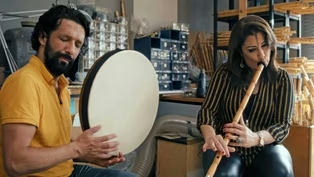
How Does a Turkish Ney Get Created?
Video has Closed Captions
Clip: S53 Ep15 | 2m 28s | Alice Dade learns from Rifat Varo about how the Turkish reed flute gets made. (2m 28s)
Now Hear This – “The Call of Istanbul” Preview
Video has Closed Captions
Preview: S53 Ep15 | 30s | With a host of Turkish musicians, Scott Yoo explores the city. (30s)
Turkish Court Music and the Kanun
Video has Closed Captions
Clip: S53 Ep15 | 2m 18s | Scott Yoo learns about the kanun and Turkish court music. (2m 18s)
Providing Support for PBS.org
Learn Moreabout PBS online sponsorship New Episode
- Arts and Music

Innovative musicians from every genre perform live in the longest-running music series.







 New Episode
 New Episode
 New Episode

Support for PBS provided by:
Major series funding for GREAT PERFORMANCES is provided by The Joseph & Robert Cornell Memorial Foundation, the Anna-Maria and Stephen Kellen Arts Fund, the LuEsther T. Mertz Charitable Trust, Sue...