
May 6, 2026 - PBS News Hour full episode
5/6/2026 | 57m 46sVideo has Closed Captions
May 6, 2026 - PBS News Hour full episode
Wednesday on the News Hour, the U.S. and Iran exchange new proposals to end the war and President Trump tells the News Hour there's a "very good chance" of making a deal, Republican politicians in Texas ramp up campaigns against the state's growing Muslim community and we take a look back at how CNN founder Ted Turner changed the media landscape.
Problems playing video? | Closed Captioning Feedback
Problems playing video? | Closed Captioning Feedback
Major corporate funding for the PBS News Hour is provided by BDO, BNSF, Consumer Cellular, American Cruise Lines, and Raymond James. Funding for the PBS NewsHour Weekend is provided by...
May 6, 2026 - PBS News Hour full episode
5/6/2026 | 57m 46sVideo has Closed Captions
Wednesday on the News Hour, the U.S. and Iran exchange new proposals to end the war and President Trump tells the News Hour there's a "very good chance" of making a deal, Republican politicians in Texas ramp up campaigns against the state's growing Muslim community and we take a look back at how CNN founder Ted Turner changed the media landscape.
Problems playing video? | Closed Captioning Feedback
How to Watch PBS News Hour
PBS News Hour is available to stream on pbs.org and the free PBS App, available on iPhone, Apple TV, Android TV, Android smartphones, Amazon Fire TV, Amazon Fire Tablet, Roku, Samsung Smart TV, LG TV, and Vizio.
Providing Support for PBS.org
Learn Moreabout PBS online sponsorshipAMNA NAWAZ: Good evening.
I'm Amna Nawaz.
Geoff Bennett is on assignment.
On the "News Hour" tonight: The U.S.
and Iran exchange new proposals to end the war, and President Trump tells the "News Hour" there's a very good chance of making a deal.
We report from on the ground in Iran's capital, where residents are on edge and prices are skyrocketing.
Republican politicians in Texas ramp up campaigns against the state's growing Muslim community.
IMRAN CHAUDHARY, President, Community Capital Partners: We feel that we are being targeted just because we are Muslims.
AMNA NAWAZ: And CNN founder Ted Turner dies at the age of 87.
A look back at how he changed the media landscape.
(BREAK) AMNA NAWAZ: Welcome to the "News Hour."
President Trump told "PBS News Hour" today there's a -- quote -- "very good chance" the U.S.
and Iran are close to a deal to end the war and reopen the Strait of Hormuz.
But he added to our Liz Landers that he has felt that confidence before, only for there to be no deal reached.
He echoed that cautious optimism in the Oval Office this afternoon.
DONALD TRUMP, President of the United States: We have had very good talks over the last 24 hours.
And it's very possible that we will make a deal.
We have had some good talks before, as you know, and all of a sudden the next day they're like -- they forgot what happened.
AMNA NAWAZ: The deal on the table would be a negotiated memorandum of understanding that would limit Iran's nuclear program and open the Strait of Hormuz, where Iran has kept its choke hold since the beginning of the war and where U.S.
warships continue to keep a blockade.
Our Nick Schifrin's been reporting out the details of the negotiation.
He's traveling and joins me now from Austin.
So, Nick, what else is in this possible deal and how confident are U.S.
and Iranian officials that they can reach a deal?
NICK SCHIFRIN: Well, as you just mentioned, Amna, President Trump told our colleague Liz Landers that he believes a deal is close, although he's felt that optimism before.
But an Iranian official does confirm to me that there has been progress.
So what's in the deal?
According to an Iranian, a senior regional and a senior European official, they tell me the first phase of the negotiations would focus on the Strait of Hormuz.
Iran would lift its choke hold over the strait and the U.S.
would end its blockade.
All parties would declare an end to the war, including Iranian proxy Hezbollah and Israel.
And then the strait would be opened as quickly as possible.
The second phase would focus on the longer-running issues of contention between the U.S.
and Iran.
Iran would freeze its domestic and uranium enrichment, but the time frame is still under negotiation.
The U.S.
has raised 20 years.
Earlier, Iran countered with five years, with a possible five-year extension.
Today, President Trump told Liz Landers the deal does not include any authorization of low-level Iranian enrichment after that freeze ends, a fact an Iranian official confirmed to me.
In addition, Iran would have to export its nearly 1,000 pounds of highly enriched uranium.
The president told Liz Landers that Iran had to export it to the U.S., although the Iranian official told me it would be exported to the U.N.
's nuclear watchdog.
The IAEA would also gain access to Iranian nuclear sites for inspections.
And the president confirmed to Liz Iran would pledge not to operate underground nuclear facilities, which the Iranian official also confirmed to me.
Now, in exchange for all of that, the U.S.
would lift sanctions on Iran and unfreeze Iranian assets.
The two sides would have about 30 days to negotiate all of those big ideas.
As the president told Liz today -- quote -- "I think it's got a very good chance of ending.
And if it doesn't end, we have to go back to bombing the hell out of them.
Very simple."
AMNA NAWAZ: So, Nick, in all your reporting, how close would you say the two sides actually are to that deal?
NICK SCHIFRIN: Amna, it depends on who you ask.
So we've been talking about the president's cautious optimism.
A senior regional official close to the negotiations told me that they are - - quote -- "the most hopeful" since this started, but there are still -- quote -- "difficult discussions ahead."
And a senior European official who has dealt with Iran extensively over the years told me that they are very doubtful that the two sides can reach this agreement and doubtful that Iran will actually fulfill what it's promising in this agreement.
That said, an Iranian official, Amna, does confirm to me that there has been major progress.
AMNA NAWAZ: Meanwhile, as we've seen before in the region, right before a cease-fire or a possible cease-fire, violence can flare.
There was more fighting today.
Tell us what happened.
NICK SCHIFRIN: Yes, the military's Central Command said that an American jet fired at an Iranian tanker that was trying to run that U.S.
blockade that you mentioned earlier destroyed the rudder on that tanker, disabling it.
But the heaviest fighting today occurred in Lebanon.
Israel launched widespread airstrikes across the south today, where Israel has invaded and occupied.
Israel's top general said today Israeli soldiers were So,the "deepening the dismantling of Hezbollah" and accused Hezbollah of launching drones and rockets that injured multiple soldiers.
The IDF also warned today that it could return to a -- quote -- "powerful and broad campaign" against Iran.
But, Amna, that would require President Trump to give Israel the green light.
And President Trump made clear today that he is at least hoping that this deal can be made quickly.
AMNA NAWAZ: All right, Nick Schifrin, thank you very much.
NICK SCHIFRIN: Thank you.
AMNA NAWAZ: For additional perspective on the latest developments, we turn now to two of our experts.
Alan Eyre worked in the State Department focusing on Iran and was a senior member of the Obama administration's negotiating team for the 2015 Iran nuclear deal.
He's now at the Middle East Institute.
And Miad Maleki was born and raised in Iran, until last year was associate director for sanction targeting in the U.S.
Treasury Department with a focus on Iran.
He's now a senior fellow at the Foundation for the Defense of Democracies.
Welcome back to you both.
ALAN EYRE, Middle East Institute: Thank you.
AMNA NAWAZ: You heard Nick lay out the outline there of what we believe is in this deal.
Also, Miad, an Iranian official telling him that progress has been made.
What's your assessment of how close the two sides are to a deal?
MIAD MALEKI, The Foundation for Defense of Democracies: Well, I think both sides really want to have a deal.
That's very clear.
What I would say is the Iranian regime has never faced a level of pressure that they're facing right now since 1979.
So I would say they're way more desperate to get a deal than the U.S.
side.
And I think, on the U.S.
side, I think there is a realization that this is a leverage that we have, that we haven't had since again since 1979.
This is a time to get a deal if you want to get a deal.
But then at the same time, what we're hearing is Iran trying to go back to the playbook of dragging out negotiations, have the blockade lifted, and then get U.S.
engaged in negotiations that could go on for forever, understanding that the U.S.
administration is probably unwilling to go back to another round of its strikes.
AMNA NAWAZ: Alan, what do you make of that?
ALAN EYRE: I'm glad that both sides are at least saying that they're going to negotiate.
I think it is improbable that it will result in a detailed, comprehensive agreement that both sides will abide by over time.
But if it just gets the Strait of Hormuz open and prevents further hostilities, that's probably the least bad option.
So it's good that we have gotten this far, but basically this one-page document is just saying we agree to negotiate, so not a heavy lift at all.
The real work lies ahead of an agreement on a one-page document.
AMNA NAWAZ: So let me ask you about the phasing then, as Nick had reported, that Iran moves to reopen the strait, the U.S.
ends its blockade, all parties declare an end to the war.
Is that the right phasing, you see?
ALAN EYRE: Here's what's left out.
Yes, Iran is willing to reopen the strait, but they didn't say they're going back to the way it was before.
All indications are Iran has got this new system.
They have got the Persian Gulf strait authority.
They have got new lanes that go through Iranian coastal waters.
So the question is, sure, they're willing to let maritime traffic resume, get back up to 130 ships a day, but is that under the new Iranian system, which seems to be a vermilion line, if not a red line for Iran now, or, less probably, going back to the old system, which everyone in the world other than Iran wants?
AMNA NAWAZ: Miad, what do you make of that?
MIAD MALEKI: I would disagree on -- well, here's the thing.
The closure of the Strait of Hormuz by the Iranian regime is affecting their own economy more than any other economies in the world.
It was a nuclear option that they deployed and is hurting them more than any other nations right now.
So the problem here is, if the blockade is lifted, Iran has definitely want to open up the Strait of Hormuz.
I mean, they're losing $435 million a day in trade, import, export altogether.
The problem here is, domestically, it would be a very heavy lift for this regime to agree to any kind of long-term agreement with President Trump administration.
What they have lost as far as layers and layers of the political figures, including the supreme leader, the fact that they have to give up their nuclear enrichment program, which they have spent hundreds of billions of dollars on, that is going to be a very heavy lift for them.
I think they're just going to go back to dragging their feet in negotiations, and we're going to find ourselves kind of Iranians waiting for the next U.S.
administration.
AMNA NAWAZ: So, Alan, this next phase is where all the more contentious issues live, right,what happens with the highly enriched uranium, what kind of freeze Iranians agree to on the enrichment program.
If it is a five-year freeze, as they have offered before, is that in the U.S.
interest to sign?
ALAN EYRE: Well, we're back to square one.
First of all, again, what is -- Secretary Rubio said yesterday, we're fighting to get the strait open.
The strait was open before the war.
And if we do get the strait open, either under a tolling or non-tolling system, we're just back to the same set of issues that existed February 26, plus a bunch of new issues, because both sides are less trusting of the other because of the war.
Now, yes, you don't need to prevent Iran from indigenous enrichment to prevent a nuclear weapon.
The key is IAEA verification.
If the IAEA gets back in Iran and can do the safeguards agreement, the additional protocol, have eyes and ears on the Iranian nuclear activity, everything else is dealable, how long the enrichment is, how much uranium they have.
But the key is having Iran live up to its obligations under the NPT.
MIAD MALEKI: It's almost -- from my point of view, this regime will not commit to something and then would kind of stay -- would be in compliance with it.
IAEA, I understand they can go in, they can have inspections done on some sites.
But you have robust intelligence agencies of not just the U.S., but many different countries, that fail to capture and trace Iran's underground nuclear operations.
I have doubts that IAEA has intelligence capacity to really watch out what this regime would be doing next on nuclear enrichment program.
So putting that aside, the five-year ban on the enrichment, they probably need 10 to 15 years to rebuild what they have lost in postwar.
Plus, they don't have the economy to throw another rounds of hundreds of billions of dollars in rebuilding the nuclear facilities.
So five years is probably the time they need before they reach the point of going back and rebuilding the nuclear program anyways.
So, a 15-to-20-year makes sense.
AMNA NAWAZ: We have heard President Trump say again and again, we're close to a deal, we're close to a deal.
In the few seconds we have left, do you see this happening in the next few days?
ALAN EYRE: He said it seven times in the last 21 days.
Each time, there's been some serious market manipulation.
I'm not saying he's doing it.
I'm not saying his people are doing it.
But, again, the reality is, we're not close to a deal, it will take long negotiation to get a deal, and you're not going to get a deal just by saying, we're close to a deal.
AMNA NAWAZ: Miad, we will give you the final word.
MIAD MALEKI: I think we're close to a deal if the Iranians kind of show some compromises on some of the assets they have.
But I agree with Alan that the gap is so wide that - - and Iranians having domestic political issues, I mean, I don't think they have one supreme leader anymore who would be willing to accept that -- drinking the poison, as Supreme Leader Khomeini did in the '80s after the end of Iran-Iraq War.
So they also have a political dilemma that no one is probably willing to go to Pakistan or Geneva and give away the nuclear enrichment program.
AMNA NAWAZ: Miad Maleki, Alan Eyre, we will have you back again in another 24, 48 hours, see where this turns next.
Thank you both.
Well, the cease-fire between the U.S.
and Iran is now four weeks' old.
As we have heard this evening, the efforts to resolve the conflict are fraught, but they do continue.
For the people of Iran, who've endured decades of repression and economic privation and now a devastating air war, the cease-fire brought a reprieve.
But the threats and counterthreats between Washington and Tehran persist, as does the specter of renewed conflict.
Special correspondent Reza Sayah in Tehran ventured out into a city on edge.
REZA SAYAH: Under dust and debris, a picture of some of the hundreds of school-aged students Hamidreza Afarideh taught throughout 15 years in his music academy that lies now in ruins.
On the morning of March 23, an American or Israeli airstrike hit this building in a business district in Eastern Tehran.
The exact target of the strike was not clear.
But it destroyed the school Hamidreza spent his life savings to build.
HAMIDREZA AFARIDEH, Honiak Music Academy (through translator): You raise a child for 15 years and in one night that child dies.
It's like your life crashing down over your head.
REZA SAYAH: Hamidreza says he's determined to rebuild, but fresh fear of war has everything on hold.
HAMIDREZA AFARIDEH (through translator): Every day we see the headlines and ask what's going to happen.
It's scary.
It's a nightmare.
REZA SAYAH: Hostilities in the Strait of Hormuz this week and new threats of war have many here on edge.
Every night, at Valiasr Square, Iranians gather for pro-government rallies.
Bahareh Sharifi volunteers for the most popular attraction, a group effort to keep Iran's flag waving through the night.
BAHAREH SHARIFI, Iranian Government Supporter (through translator): As long as this leadership is here, I'm going to keep this flag up high and it feels good to see thousands of like-minded people who are willing, like myself, to sacrifice our lives for our flag.
REZA SAYAH: Her cargo pants and loose hijab scream Western liberal.
But if there is more war, she says, she stands with the Islamic Republic.
BAHAREH SHARIFI (through translator): I hope it doesn't happen again, but I believe in the wisdom of our leaders and strategists and their decisions and honesty.
If they decide it's right for us to resist again, I won't be happy.
But if it's necessary, we will stand with them.
FOAD IZADI, University of Tehran: I think we're going to see more war.
REZA SAYAH: Tehran-based political analyst Foad Izadi says, twice in nine months, in the middle of negotiations, the U.S.
and Israel attacked Iran.
It would be a mistake, he says, for Iran not to be ready for a third attack.
FOAD IZADI: I think sooner or later Trump realizes that this is a failed policy.
He's not there yet.
He thinks that, with a few more bombings and a few weeks of attacks, maybe he can achieve what he wants.
This is what the Israelis are telling him.
REZA SAYAH: And what happens if the U.S.
does attack Iran again?
FOAD IZADI: Same thing that you saw in the 40 days.
Iran will respond, maybe in a harsher manner.
Iran has no other choice.
REZA SAYAH: The Islamic Republic is fighting in economic war too.
The 40-day U.S.-Israeli bombing campaign and the U.S.
naval blockade in the Strait of Hormuz has oil exports and the value of Iranian currency near an all-time low.
Inflation is at an all-time high.
Authorities here say using land routes with Iran's mostly friendly neighbors for oil exports and trade will help.
But there is no avoiding the economic crisis.
FOAD IZADI: So there are ways of going around these type of sanctions, but they are going to be painful and they are going to be real.
REZA SAYAH: The Islamic Republic is seemingly attempting to relieve the economic pain by easing control over social freedoms.
Today, singers and performers regularly defy the state ban on street music.
More women walk the streets of Tehran without the hijab, the very act that launched a wave of protest in 2022 after the death of Mahsa Amini, arrested for allegedly not wearing the hijab.
ZIBA, Tehran, Iran, Resident (through translator): This is something we have achieved at great cost and we're going to fight to keep it tooth and nail.
REZA SAYAH: In this Tehran cafe, Iranians meet every week to debate their political views.
AFSANEH, Tehran, Iran, Resident (through translator): It helps us understand our collective experience and things we all went through, especially the war and the hopes and fears we all experienced together.
REZA SAYAH: And in the streets of Tehran, more women than ever are riding motorcycles.
Law student Shakiba Shokri says the new freedoms are nice, but not enough.
SHAKIBA SHOKRI, Law Student: We're having a lot here these days, but I know we will pass this, and we will show the world that we're strong enough to do anything we want.
REZA SAYAH: What remains a red line for authorities is anything deemed a threat to government security.
Since March, authorities have executed two dozen protesters accused of working with foreign enemies to sow unrest in mass anti-government demonstrations in January, where thousands of protesters and hundreds of security forces were killed.
Since the start of the war, authorities have silenced anti-government street protests.
A woman who took part in the January demonstrations asked not to be filmed, but shared this statement: "It doesn't matter how long our journey is.
We will keep fighting to make our voices heard and for a free and democratic Iran."
A day after bombs destroyed his music academy, Hamidreza Afarideh made this viral video.
He sat in his ruins and played his kamancheh, the classic Iranian string instrument.
It was his personal call for peace.
With the White House reporting progress in talks with Iran, for Hamidreza and millions of Iranians, an end to the war may now be in sight.
For the "PBS News Hour," I'm Reza Sayah in Tehran.
AMNA NAWAZ: Now for a closer look at how Americans are seeing the war in Iran and rising gas prices, Lisa Desjardins is at the Super Screen with insights from our latest PBS News/NPR/Marist poll.
So, Lisa, the U.S.
and Israel launched this war in Iran at the end of February.
President Trump promised a quick conflict.
More than two months on, how are Americans seeing the war?
LISA DESJARDINS: The war is unpopular and it's becoming more so.
When we asked, American adults told us only 33 percent of them approve of this war in Iran and president's handling right now.
That leaves 60 percent who disapprove of this war.
Now, we wanted to have some historical context.
This is significant historically.
We looked back at 2007, another unpopular war, the war in Iraq.
What were the ratings then for President George W. Bush at the time?
Sixty-four percent of Americans disapproved, registered voters at that point.
Now, you can see these numbers are not that far apart, even given the fact that this had been war for a couple of years with American lives lost in the field.
You can see Americans do not have an appetite for war and are unhappy with the president about it in particular.
There is, however, partisan divide.
Republicans stand out, because, overwhelmingly, they approve of what President Trump is doing in Iran right now.
However, this isn't all good news for him when it comes to Republicans.
That number is down seven points from March.
That's statistically significant, especially given this was just two months ago.
AMNA NAWAZ: Lisa, what about the economic impact we know the war is having, especially when it comes to gas prices?
How are Americans looking at that?
LISA DESJARDINS: This is not just a question of opinion, but a question of impact.
We asked Americans what the impact had been for them, and you can see a huge group, 81 percent of Americans -- with 33 of them saying a major strain, 81 percent say they are feeling the strain of increased gas prices on their family.
What that leaves is just a small group, 19 percent, who are not feeling the pinch of these increased gas prices.
I want to remind viewers that there are some five million electric vehicles on the roads in America.
That's an example of who might be involved in this small 19 percent.
But there's a political question here.
Do they blame President Trump for this?
We asked, and the answer is very clear.
They do; 63 percent of Americans we asked said they do blame President Trump for the gas price increase.
Now, the other point about this, though, is the president has been strong on the economy in the past.
How is he doing?
Is this impacting him overall on the economy?
Right now, 61 percent of Americans disapprove of how the president is handling the American economy.
This used to be a strong suit for him.
Again, we looked back at history.
In 2020, as the president was leaving office in December, these numbers were reversed.
More Americans approved of how he was handling the economy, even though he had lost the election.
This is not just a problem for President Trump, but potentially for the Republican Party as well.
AMNA NAWAZ: Lisa, pick up on that point then, because we know all of this is happening just a few months before the midterm elections.
How could it impact Republicans' races?
LISA DESJARDINS: It certainly could.
Let's look at the generic ballot, as we call it.
When you ask who you prefer, Democrats or Republicans in general, there's a 10-point gap preferring Democrats.
And when you ask this question to independents, look at this.
That gap is even larger, now a 12-point preference by independents for Democrats.
Now, this is something that Democrats like, but they also like an enthusiasm gap that we found in our poll.
Look at this.
Who's very enthusiastic about voting in November?
Democrats are more so than Republicans.
Independents, in this partisan time, not as enthusiastic.
But this enthusiasm is something Democrats are counting on to overcome redistricting by Republicans in some red states.
And they say they saw that enthusiasm yesterday in Michigan.
Look at this, pivotal state Senate race in Michigan.
The Democrat won by 20 points.
This is a district where Democrats carried by just seven points four years ago.
That enthusiasm, they say, could matter in remapped districts like this one in Ohio.
This race is now set after primaries.
This is a rematch for Congresswoman Marcy Kaptur.
She hopes to keep her seat in a district that has been remapped to benefit Republicans.
She will need enthusiasm, like we see in this poll, to do it.
AMNA NAWAZ: Lisa, also yesterday, there were some closely watched primary results in Indiana.
President Trump was trying to oust members of his own party who refused to redistrict.
What happened?
LISA DESJARDINS: Here's a visual way to think of it.
These are the seven state senators who voted against redistricting against Trump.
He challenged all of them in the primary.
How many kept their jobs?
Let's look at who did not.
These five state senators are out of their jobs because of primary challenges by President Trump, who one outright state senator will keep his job, and then a seventh is in a race too close to call.
Right now, Amna, this race is down to three votes.
Republicans no doubt are taking this as a message about loyalty across the country.
AMNA NAWAZ: All right, Lisa Desjardins, thank you very much.
LISA DESJARDINS: You're welcome.
AMNA NAWAZ: In the day's other headlines: Three patients were evacuated today from the ship at the center of a hantavirus outbreak.
Two of them are confirmed to have the disease, with the third being a suspected case.
Health workers in protective gear were seen loading them into ambulances.
The ship's British doctor is among the patients.
They were flown to a hospital in the Netherlands for medical attention.
That leaves around 150 people still on board the vessel.
Health officials said today they are not showing any signs of symptoms.
The ship itself is now en route to Spain's Canary Islands.
MONICA GARCIA, Spanish Health Minister (through translator): Once there, a joint health assessment and evacuation procedure will be put in place.
Unless their medical condition prevents it, all foreign passengers will be repatriated.
AMNA NAWAZ: The World Health Organization says there have been at least eight recorded cases of the rare rodent-borne disease.
Five have been confirmed by lab tests.
Three people have died.
A passenger on board the ship said they were misled when the suspected outbreak initially occurred.
RUHI CENET, MV Hondius Passenger: Since we were not informed of any contagious disease, everyone was relaxed.
These vessels are at sea for weeks.
And all the passengers are all together.
I think some tests should have been required.
Regulations should be updated regarding this.
AMNA NAWAZ: Meantime, officials in Europe and Africa are working to identify anyone who may have had contact with passengers during the course of the ship's journey.
But the WHO said again today that the risk to the broader public remains low.
U.S.
Secretary of Commerce Howard Lutnick faced questioning today from the House Oversight Committee over his ties to Jeffrey Epstein.
Security personnel surrounded Lutnick as he arrived on Capitol Hill for the interview, which happened behind closed doors.
A person familiar with Lutnick's testimony told PBS News that he met with Epstein three times over the years, including once at Epstein's private island.
But the federal case files showed the two had kept in contact via e-mail.
Ahead of today's interview, committee Chairman James Comer acknowledged Lutnick's contradictory statements.
REP.
JAMES COMER (R-KY): I haven't seen wrongdoing in the e-mail correspondence, but he wasn't 100 percent truthful with whether or not he had been on the island.
So we will see and we will obviously release the transcripts and everyone can see for themselves.
AMNA NAWAZ: Speaking to reporters outside the meeting room, Democrats on the committee described Lutnick as a pathological liar and called the decision not to film today's session -- quote - - "part of an egregious cover-up."
Lutnick is the first current Trump administration official to testify before the panel.
He has not been accused of any wrongdoing.
Some iPhone owners could get up to $95 in payments after Apple agreed to settle a class action lawsuit over false advertising.
The $250 million settlement would resolve claims that the company had misled consumers over the abilities of its A.I.
system called Apple Intelligence.
The deal covers around 37 million devices.
That includes all iPhone 16 models bought between June 2024 and March 2025, plus some iPhone 15s.
If approved by a judge, the settlement would be one of the biggest ever for Apple.
The company has denied any wrongdoing.
In Colorado, a bout of severe winter weather is overshadowing any earlier hints of spring, with snowfall canceling flights and classes and closing down businesses.
Several cities were under winter storm warnings today, with at least one area seeing up to 28 inches of snow.
And while some snow is not uncommon in Colorado this time of year, the city of Denver, for one, is seeing its heaviest may snow in decades.
There is an upside to the weather, though, as it comes during one of the state's worst droughts on record.
Warmer temperatures are expected to return tomorrow.
Turning over seas, Russia and Ukraine are accusing each other of breaking a unilateral cease-fire announced by Kyiv that was supposed to take effect last night.
Russia says its air defenses shot down more than 50 Ukrainian drones, one of which killed five people in occupied Crimea.
And Ukrainian officials say a Russian drone strike killed two people at this kindergarten in the Northeastern city of Sumy.
The U.N.
says Russian attacks have killed at least 70 Ukrainian civilians since last Friday and wounded more than 500 others.
On Wall Street today, stocks surged on hopes that the Strait of Hormuz will soon reopen.
The Dow Jones industrial average jumped more than 600 points on the day.
The Nasdaq gained around 500 points, or more than 2 percent.
The S&P 500 also ended sharply higher.
Still to come on the "News Hour": the FBI reportedly investigates a journalist who wrote about Kash Patel's alleged drinking; Republican campaigns target Muslims in Texas; and we examine the life and legacy of media mogul Ted Turner.
The FBI has reportedly launched a criminal investigation into whether information was leaked to a reporter for "The Atlantic," who wrote that FBI Director Kash Patel's -- quote -- "excessive drinking" was causing deep concern in the bureau.
Patel was asked about the report last month.
KASH PATEL, FBI Director: I have never been intoxicated on the job.
And that is why we filed a $250 million dollar defamation lawsuit.
And anyone of you that wants to participate, bring it on.
I will see you in court.
AMNA NAWAZ: Late this afternoon, "The Atlantic" published an update to its story that included this photo that shows custom bottles of bourbon with Kash Patel's name on them that he reportedly gives out.
Joining us now to discuss this and more is Carol Leonnig.
She's the senior investigative reporter for MS NOW.
Carol, welcome back.
It's good to see you.
CAROL LEONNIG, MS NOW: Good to be with you.
AMNA NAWAZ: So I want to start with the news that you broke, that the FBI is investigating Sarah Fitzpatrick.
That's "The Atlantic" reporter behind that Kash Patel story.
And I want to start by putting to you what the FBI assistant director had to say in a statement about your report.
He said: "This is completely false.
No such investigation like this exists.
The reporter you mention is not being investigated at all.
Every time there's a publication of false claims by anonymous sources that gets called out, the media plays the victim by investigations that do not exist."
Carol, what's your response to that?
CAROL LEONNIG: My response is that we stand by our reporting.
We have been told by multiple sources that, at the director's instruction from his executive suite, a unit in Huntsville, Alabama, was ordered to begin investigating and reviewing this "Atlantic" reporter's contacts, her -- and begin potentially looking at her phone, metadata, and social media contacts.
Again, we don't know the status of what the FBI has obtained, but we know that they have been ordered to open this investigation.
We also - - I want to emphasize something for viewers of your show who probably don't deal with the Department of Justice and the FBI every day.
When the FBI and the Department of Justice open investigation, it's based on typically a predicate that they have reasonable belief that a crime has occurred.
And, in this case, the FBI agents are raising concerns about whether or not any such predicate exists to open this investigation.
Typically, when there's an investigation of a leak, it's criminal because classified information has been released.
And there's a big question mark here about what potentially is classified, and there's a big question mark as well about why the FBI has to start with a reporter, when usually that is the sort of step of last resort.
And even Pam Bondi, who repealed the requirements for when you could compel telephone metadata or other information from a reporter's provider, even though she restricted -- or loosened those restrictions, Pam Bondi's memo also required that these techniques, these investigative techniques, be used only in extraordinary circumstances.
AMNA NAWAZ: And, Carol, just to underscore your point, Jeffrey Goldberg, the editor in chief of "The Atlantic," issued a statement this morning in response to your report, saying, in part this.
He said: "If confirmed to be true, an FBI criminal leak investigation targeting our reporter would represent an outrageous attack on the free press and the First Amendment itself.
We will defend "The Atlantic" and its staff vigorously."
But, Carol, while I have you, I want to ask you about another topic of news that broke this morning.
That's the FBI raiding the offices of Virginia State Senate Leader Louise Lucas.
She's a Democrat.
What more do we know about that?
CAROL LEONNIG: This is a case, as it happens.
I have been watching for a long time to see when it matured, let's say.
I have been hearing from sources, and we reported today publicly, but I've been hearing for a long time that this case was brewing.
It was first opened under the Biden Department of Justice, so at least three years ago.
And this investigation was looking into evidence suggesting that this prominent Democrat in Virginia state politics had either accepted or solicited bribes.
I don't know the details of what she's alleged to have taken, but I know that that was the basis for the investigation.
Another key thing to share with your viewers is that my sources have told me for many, many weeks now that former acting U.S.
Attorney Lindsey Halligan, a close Trump ally, had put on intense pressure on prosecutors in the Eastern District of Virginia when she was running that office to bring charges against Lucas.
Now, those prosecutors were worried about the robustness, I guess I would say, of this case, but also feeling that it wasn't completely cooked and that Halligan's pressure was inappropriate.
It was in an effort to sort of land a punch, if you will, against a Democrat before the midterms.
And now the U.S.
Attorney's Office in the Eastern District has indeed raided her home.
I should say the FBI have, under the auspices and direction of the Eastern District of Virginia, and we'll see what charges, if any, are brought.
AMNA NAWAZ: That is Carol Leonnig, senior investigator reporter for MS NOW.
Carol, thank you so much for your reporting and your time.
CAROL LEONNIG: Thank you.
AMNA NAWAZ: In Texas, candidates running for office during the primaries have made Muslims and what they call the Islamification of Texas the center of their campaigns.
The state's top Republicans have also passed legislation and made policies targeting Muslim organizations and housing development.
Stephanie Sy reports on how the rise of anti-Muslim rhetoric and policies in the Lone Star State is affecting its Muslim communities.
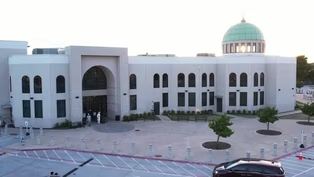
STEPHANIE SY: On a typical Friday service, the East Plano Islamic Center is packed wall-to-wall.
Known by its acronym EPIC, the center's prayer halls are so crowded it's resorted to overflow rooms.
YASIR QADHI, East Plano Islamic Center: We are now one of the largest and one of the most active mosques really in the country.
STEPHANIE SY: Yasir Qadhi, EPIC's resident Islamic scholar, says mosque membership has ballooned, along with the population of the Dallas-Fort Worth metro area.
YASIR QADHI: It's basically saturated out.
We have so many people living in this vicinity.
The idea came from some of the local congregants here, what if we were to have a planned neighborhood?
IMRAN CHAUDHARY, President, Community Capital Partners: Right here, you have the mosque and the community center.
STEPHANIE SY: That planned neighborhood, known as Epic City, began to take shape in 2024.
The proposed development sits 40 minutes northeast of Dallas, with about 1,000 single and multifamily homes planned across 400 acres.
Imran Chaudhary is the lead developer.
When you came up with this plan, did you think it would be controversial?
IMRAN CHAUDHARY: No, absolutely not.
We were just developing a community which was just Muslim-friendly.
And we never thought that it would go this way or the direction that they have taken.
STEPHANIE SY: Last year, this promotional video went viral.
NARRATOR: It's a way of life, a meticulously designed community that brings Islam to the forefront.
STEPHANIE SY: Sparking backlash online, with commentators calling it an Islamic stronghold and Sharia City.
The online rhetoric reached Governor Greg Abbott, who vowed to stop the project, signing a law -- quote -- "banning Sharia compounds in Texas."
GOV.
GREG ABBOTT (R-TX): The development was structured in a way that requires anybody who bought a lot there to abide by Sharia law.
STEPHANIE SY: The development never had a religious requirement for would-be residents, and Chaudhary says all are welcome.
IMRAN CHAUDHARY: All of this misinformation that's being spread from these influencers and the social media and the politicians, that is not true.
YASIR QADHI: When I say Sharia to the average American Muslim, they would literally think of, OK, I need to be kind to my mother, I need to be a good person.
STEPHANIE SY: Qadhi says Sharia is a personal religious practice, often misrepresented by the community's critics.
YASIR QADHI: Their interpretation of Sharia is not one that the Muslims of this country even understand.
It's a personal set of rituals, ethical conduct.
That's literally the association that we have of Sharia is, like, the law of God.
STEPHANIE SY: Governor Abbott also ordered a blitz of investigations by various state agencies to look into the mosque and the development, while Attorney General Ken Paxton filed two lawsuits aimed at ending the project.
The Department of Justice launched an investigation last May, but soon closed it without finding any wrongdoing.
IMRAN CHAUDHARY: We are going to follow the county laws.
We are going to follow the city laws.
We are going to follow the state laws.
This is just like any other development.
STEPHANIE SY: And yet still the project has not gotten off the ground, right?
IMRAN CHAUDHARY: It's true.
Yes, we feel that we are being targeted just because we are Muslims and it's a Muslim developer.
STEPHANIE SY: The project faces an uphill battle with public perception, says veteran Republican strategist Vinny Minchillo.
VINNY MINCHILLO, GOP Strategist: When people saw first the name, Epic City, hey, wait a minute, are you starting a city?
And then they saw the architectural renderings.
It looks like a religious compound and not like a mixed-use development.
STEPHANIE SY: The development has since changed its name from Epic City to The Meadow and removed the promotional video from social media.
But Minchillo says it may be too little, too late.
VINNY MINCHILLO: People perceive they want to be isolationists, they want Sharia law, they want to do their own thing, they don't want to assimilate.
There's a lot of fear about the community and what the community's ultimate goals are.
WOMAN: Is this what you want between Collin and Hunt counties?
I sure don't.
STEPHANIE SY: The online outrage has led to local opposition and high-profile anti-Islamic incidents.
YASIR QADHI: Mr.
Lang came here with a dead pig's head and a copy of the Koran inside the dead pig's head.
STEPHANIE SY: Far right influencer and indicted January 6 rioter Jake Lang staged a grotesque display outside the EPIC Mosque last year.
YASIR QADHI: Now I get it.
There's freedom of speech.
What is the purpose of this other than a media circus?
STEPHANIE SY: It's not just this Muslim community in East Plano facing what it feels is religious discrimination.
Islamic-oriented schools are under scrutiny in the state's school voucher program.
Brighter Horizons Academy is a K-12 private school with 1,200 students in nearby Garland.
EHSAN SAYED, Islamic Services Foundation: It's like any other religiously-oriented school, like a Catholic school or a Jewish day school.
We have the same secular subjects as part of the curriculum, the same clubs and recreational activities, sports and whatnot.
And then we have three other supplementary religious classes, you can call them.
One of them is the Arabic language, and then the other two are religious courses.
STEPHANIE SY: Ehsan Sayed: attended Brighter Horizons in the 90s soon after it opened, and now sits on the board of a nonprofit that oversees the school.
When Texas launched its school choice program, offering families more than $10,000 per student enrolled in approved private schools, Sayed says it was a tremendous opportunity.
EHSAN SAYED: To finally get an infusion of some public funds to the school, to the students, hopefully giving us access to more resources, being able to accept more students.
STEPHANIE SY: Brighter Horizons had long met the accreditation requirements, but when the list of schools approved to participate was released earlier this year, it was excluded, without explanation.
So were several other Islamic private schools in Texas.
EHSAN SAYED: It caused so much confusion, honestly, with our current parents and new parents.
STEPHANIE SY: After the school joined others and sued the state for discrimination, Texas added Brighter Horizons and other plaintiffs to the school choice eligibility list.
They're still suing.
EHSAN SAYED: It's about keeping the requirements consistent and fair every year.
STEPHANIE SY: Sayed says he believes the school's exclusion was part of a broader turn against Muslims in a political game.
SEN.
JOHN CORNYN (R-TX): Radical Islam is a bloodthirsty ideology.
STEPHANIE SY: From the Senate campaign of John Cornyn.
SEN.
JOHN CORNYN: And Sharia law has no place in American courts or communities.
STEPHANIE SY: To a recent speech by Ted Cruz.
SEN.
TED CRUZ (R-TX): Sharia law shall never be allowed in the United States of America.
STEPHANIE SY: GOP strategist Vinny Minchillo says the Muslim community has become a boogeyman in state politics.
VINNY MINCHILLO: I think, to many people's minds, the immigration issue with regard to the Mexican border is either solved or heading toward being solved.
So we feel like, OK, that's going on.
This is the next logical step in immigration concern.
STEPHANIE SY: Is there any nuance in any of this, like, or is every conversation about Muslims in Texas fraught and politically wrought?
VINNY MINCHILLO: Right now, there's zero nuance.
It is really as close to an on/off switch issue as you can get, which is pretty rare in the world of politics.
We see it pop in polls and now naturally politicians and campaigns are reacting to that.
STEPHANIE SY: Political rhetoric that many of Texas' half-a-million Muslims say doesn't match their reality, like Ahmed Osman, an 11th grader at Brighter Horizons.
AHMED OSMAN, Student, Brighter Horizons Academy: I don't think anybody in the school wants to take over Texas or anything like that.
I think most people just want to be accepted without getting any weird looks or any whispers, stuff like that like, most people do.
STEPHANIE SY: He considers himself a Muslim, an American and a Texan.
For the "PBS News Hour" I'm Stephanie Sy in Dallas.
AMNA NAWAZ: The founder of CNN, Ted Turner, died today.
A risk-taking entrepreneur known for his outspoken style, Turner created the first 24-hour news network and revolutionized how billions across the world consume the news.
Judy Woodruff has this remembrance.
TED TURNER, CNN Founder: You will never get in trouble if you don't do anything, but, on the other hand, you will never get anywhere either, you know?
JUDY WOODRUFF: He was brash, bold, a business genius and a television pioneer.
Robert Edward Turner III was born in Cincinnati in 1938 and moved with his family to Savannah, Georgia, after World War II.
He took over the family's advertising firm after his father's suicide in 1963 and built it into a powerhouse.
By the late '60s, he was buying up radio and TV stations.
NARRATOR: Stay with the Superstation as "Newswatch" continues.
JUDY WOODRUFF: They included a struggling Atlanta outlet that he transformed into the first so-called satellite Superstation, WTBS, showing movies and sitcoms.
To that mix, he added sports, buying the Atlanta Braves baseball team and securing the rights to broadcast live games nationwide.
But Ted Turner's real revolutionary moment came in 1980 with the launch of the first all-news cable channel, CNN.
TED TURNER: And barring satellite problems in the future, we won't be signing off until the world ends.
JUDY WOODRUFF: With 24-hour international coverage, it changed the industry and the way the world gets news.
MAN: Officials say allied airstrikes have effectively paralyzed any potential Iraqi counterstrength.
JUDY WOODRUFF: In 1990 and 1991, CNN broadcast the first Persian Gulf War live and from behind Iraqi lines.
TED TURNER: We changed the way things were done.
It wasn't -- we weren't anti-American.
We were just pro-truth.
JUDY WOODRUFF: By the mid-90s the man once dubbed Mouth of the South was at the height of his success, adding the Cartoon Network and Turner Classic Movies to his cable stable.
In 1996, he sold Turner Broadcasting to Time Warner, but stock prices plunged after Time Warner merged with AOL and the tech bubble burst.
In the process, Turner lost a bundle and his last connections with his media empire, as he recalled in a 2015 interview.
ú CHRISTIANE AMANPOUR, CNN Chief International Anchor: Will you ever get over it?
TED TURNER: No.
I don't have to get over it.
I live with it.
You have got to be able to take some disappointment in life too.
JUDY WOODRUFF: Disappointment also came in failed marriages to Jane Fonda and two other wives.
But Turner's zest for competition had brought him a different kind of success in the 1977 America's Cup sailboat races, when he piloted the yacht Courageous to victory.
The feed earned him another nickname, Captain Outrageous.
In later years, he became a fierce advocate for nuclear disarmament and for the environment.
He created the U.N.
Foundation in 1997 to support the world body and donated a billion dollars of his own money.
TED TURNER: We have to have the United Nations just like we have to have a federal government here in the United States.
Is it perfect?
Is it free of corruption?
Is everybody honest and ethical?
No.
But we still have to have it.
JUDY WOODRUFF: Another mission of Turner's, to save American wildlife, and he did, becoming one of the largest individual landowners in the country, preserving roughly two million acres and building up a significant bison herd at his Montana ranch.
In 2018, Turner confirmed he had Lewy body dementia, a progressive brain disorder that resembles Alzheimer's.
He remained largely out of public view in his final years.
Ted Turner was 87.
AMNA NAWAZ: That was our own senior correspondent, Judy Woodruff, reporting.
Judy joins us here now.
Judy, it's good to see you.
JUDY WOODRUFF: It's good to see you.
Thank you for having me.
AMNA NAWAZ: So, Ted hired you to join CNN.
You worked there for years in the '90s and early 2000s as an anchor and correspondent.
Tell us about what it was like back then, how he lured you over to CNN.
JUDY WOODRUFF: Well, I had been at the "News Hour" for 10 years with Jim Lehrer and Robin MacNeil, had no intention of leaving.
But Tom Johnson, who Ted had put in charge of CNN, reached out to me, and after literally almost four months of conversation, and finally he said: "You need to go to Atlanta to have a serious conversation with Ted Turner."
So I show up in Ted's office at CNN headquarters.
And the first -- one of my first questions to him was: "So, tell me, how do you feel about women journalists?
I want to know, do you take them seriously?"
He said: "Are you kidding?
I'm married to Jane Fonda."
(LAUGHTER) JUDY WOODRUFF: And it kind of shut me up.
I mean, I didn't say much about women after that.
But he took the news seriously, Amna.
He was all about the news, and that was ultimately what persuaded me this was a leap worth making.
Both of them said, we wanted -- the news is the king, where we are.
We want to be not just 24/7, but we're going to be global.
They had already done the Iraq War, and they had, frankly, put themselves on the map.
AMNA NAWAZ: I mean, the first 24 hour news network, it seems odd now when it's become the norm, but it was a real gamble back then.
I mean, you mentioned he changed the industry, but does it seem like he changed much more than that?
JUDY WOODRUFF: He changed everything, I mean, in terms of journalism, because he believed that it was possible.
And people told him, this -- people said, this is crazy.
They called it the Chicken Noodle News Network, told him it was -- just couldn't be done.
He was determined.
He had this vision of news being available to everyone, and it being all about the news.
He saw news going in an entertainment division, if you can imagine this, back in 1980.
And he wanted the news to be serious.
He hired Bernie Shaw as one of his first anchors.
He believed in diversity.
He believed the newsroom should look like America.
He talked about that.
And he had that vision even after he lost CNN.
He would talk about the news networks, plural, all of them, need to stick to the news, as he saw them drifting closer and closer to entertainment.
AMNA NAWAZ: I mean, the rest of the world saw him as this visionary and this pioneer.
You knew him personally, though, too.
What do you want people to know about Ted Turner?
JUDY WOODRUFF: That he was the visionary that we have been talking about, that, in a way, he had this almost childlike, naive vision.
He wanted the world to be a place of peace.
He wanted war to end.
He wanted to end nuclear weapons.
He put a lot of effort into nuclear nonproliferation.
He gave a billion dollars, Amna, to the United Nations, which people saying, what?
What was that about?
That was an individual giving his money.
And back then, that was a lot of money.
It sounds like a lot now.
It was a lot then.
And he lived out that pledge, even though his fortune was diminished by those -- by the mergers that happened.
He wanted the world to be a better place.
He cared about a lot of that you saw.
He was one of the country's biggest landowners.
And, as we have been saying, he transformed journalism.
He made it into, frankly, the kind of nonstop place that it is today.
And I think his forever legacy will be this belief that news matters and the truth matters.
You couldn't have a conversation with Ted where he didn't talk about it's important to get the whole story and to tell the truth, to be transparent.
And he said, we need to be in those parts of the world where no one else is.
AMNA NAWAZ: Yes.
JUDY WOODRUFF: That legacy is one that lives on.
AMNA NAWAZ: Well, I'm sorry it has to be under these circumstances, but it is always good to have you here.
JUDY WOODRUFF: It's always... AMNA NAWAZ: Judy Woodruff, thank you so much.
JUDY WOODRUFF: It's good to be with you.
Thank you.
AMNA NAWAZ: And that is the "News Hour" for tonight.
I'm Amna Nawaz.
On behalf of the entire "News Hour" team, thank you for joining us.
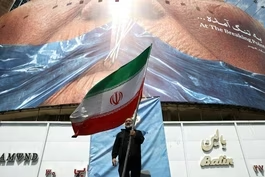
Ceasefire offers reprieve as Iranians endure war in Tehran
Video has Closed Captions
Ceasefire offers reprieve as Iranians endure conflict in Tehran (6m 42s)
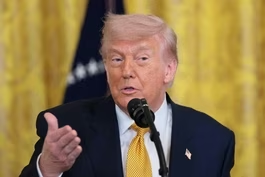
Examining a potential deal between the U.S. and Iran
Video has Closed Captions
Examining a potential deal between the U.S. and Iran (7m 14s)
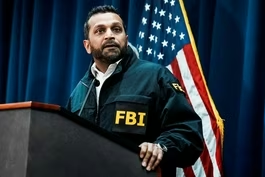
FBI investigates journalist who wrote about Patel's drinking
Video has Closed Captions
FBI reportedly investigates journalist who wrote about Kash Patel's heavy drinking (5m 46s)

Most Americans disapprove of Trump's handling of Iran war
Video has Closed Captions
New poll shows growing number of Americans disapprove of Trump's handling of Iran war (5m 15s)

News Wrap: Patients evacuated from ship with hantavirus
Video has Closed Captions
News Wrap: 3 new patients evacuated from cruise ship with deadly hantavirus outbreak (5m 24s)
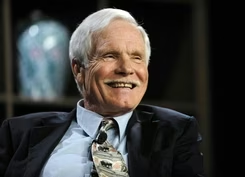
Remembering the life and legacy of CNN founder Ted Turner
Video has Closed Captions
Remembering the life and legacy of visionary CNN founder Ted Turner (8m 33s)
The rise of anti-Muslim policies and rhetoric in Texas
Video has Closed Captions
The rise of anti-Muslim policies and rhetoric in Texas (8m 50s)

U.S. and Iran trade new proposals to end war
Video has Closed Captions
U.S. and Iran exchange new proposals to end war (4m 20s)
Providing Support for PBS.org
Learn Moreabout PBS online sponsorship
- News and Public Affairs

Today's top journalists discuss Washington's current political events and public affairs.

- News and Public Affairs

FRONTLINE is investigative journalism that questions, explains and changes our world.











Support for PBS provided by:
Major corporate funding for the PBS News Hour is provided by BDO, BNSF, Consumer Cellular, American Cruise Lines, and Raymond James. Funding for the PBS NewsHour Weekend is provided by...