
Lulu
Season 2 Episode 1 | 45m 50sVideo has Closed Captions
Prue is joined by Lulu and makes a 'poshed-up' haggis with neaps and tatties.
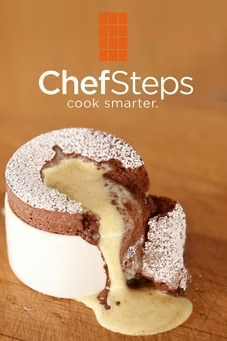
Prue is joined by Lulu, who bursts into song while making a chocolate puddle cake. John joins Prue in the kitchen for a 'poshed-up' version of haggis with neaps and tatties, then heads to the local flower farm to create a wonderful arrangement with the help of gardener Philippa. Prue shares her hacks for peeling tomatoes and making overnight oats.
Problems playing video? | Closed Captioning Feedback
Problems playing video? | Closed Captioning Feedback
Lulu
Season 2 Episode 1 | 45m 50sVideo has Closed Captions
Prue is joined by Lulu, who bursts into song while making a chocolate puddle cake. John joins Prue in the kitchen for a 'poshed-up' version of haggis with neaps and tatties, then heads to the local flower farm to create a wonderful arrangement with the help of gardener Philippa. Prue shares her hacks for peeling tomatoes and making overnight oats.
Problems playing video? | Closed Captioning Feedback
How to Watch Prue Leith’s Cotswold Kitchen
Prue Leith’s Cotswold Kitchen is available to stream on pbs.org and the free PBS App, available on iPhone, Apple TV, Android TV, Android smartphones, Amazon Fire TV, Amazon Fire Tablet, Roku, Samsung Smart TV, and Vizio.
Providing Support for PBS.org
Learn Moreabout PBS online sponsorship♪ [Mixer whirring] Leith, voice-over: I'm Prue Leith-- cook, caterer, restaurateur, cookery school founder, and writer of 16 cookbooks.
Woman: This looks so delicious.
I'm absolutely dribbling.
Leith, voice-over: I'm in my 80s, so I haven't got time to waste.
This series is all about the things that really matter to me-- family, fun, food, and friends.
Ha, ha!
Got to let it out while you can.
[Laughing] ♪ Ah, da da da da ♪ Leith, voiceover: We'll be sharing simple, home-cooked recipes... Oh!
I did it.
And what does that do?
Well, unfortunately, it's not quite doing it.
[Both laugh] Leith, voice-over: ...and celebrating the best produce.
I'm lucky enough to live in the astonishingly beautiful Cotswolds, with my long-suffering husband, John.
And now he's agreed to join me in the kitchen, too.
[Cork popping] Oh... Leith, voiceover: In today's episode, I'll be cooking a classic from my old restaurant and chatting with a fabulous former customer, Lulu... I do remember as clearly as I possibly-- it was a chocolate pudding.
And it was to die for.
Leith, voiceover: ...John gets picky at our local flower farm... John: Can we find some red?
Red is happiness.
...and I'll show you a hack for skinning tomatoes.
And if you're doing a caprese salad, texturally, it's so lovely.
Welcome to my Cotswold Kitchen.
♪ ♪ Leith, voiceover: I love nothing more than being in my kitchen, cooking food to share with family and friends.
And creating something delicious doesn't have to take forever.
I'm all for speed in the kitchen, and having initially been reluctant to try an air fryer, I am now a complete convert.
My first dish is a real family favorite, and it is so quick and easy to do.
Today's dish is really simple.
It's chicken thighs in a peri-peri sauce, cooked in an air fryer, with beans and broccoli.
You can do it in the oven as well, but I always do it in the air fryer, because it gets crunchy all over.
♪ These have been marinating all night, so they will be really spicy.
If you don't like it too spicy, either use a very-- a medium peri-peri sauce or a mild one, or just leave them in there for much less time.
Leith, voiceover: I love peri-peri sauce.
It's a chili pepper sauce with lemon, garlic, and herbs.
And if you don't have time to make your own, the quickest fix is to buy a ready-made one.
The chicken will probably take 20 or 25 minutes in the air fryer.
So, I'll start that now.
♪ In there, you want to make sure that they don't touch each other, because you want the chicken skin to crisp up all around it.
Leith, voiceover: Cover the chicken with the sauce and pop it into the air fryer.
And now for the broccoli.
I've got simmering water here.
You put it in the water.
It's salted water.
♪ Tuck it in, get it to go under, and let it bubble away a few minutes, and then it'll be done.
I do love broccoli, and I especially love the purple, sprouty one, which is this one.
We've got a mixture here.
But children love it too, because it's quite sweet.
It's one good way of getting green veg into kids.
Voiceover: Broccoli is such an amazing vegetable and has as much vitamin C in it as an orange.
It's also rich in minerals such as potassium, iron, and calcium.
While that's simmering away, I will just sweat the onions in a little bit of oil.
Almost all recipes seem to start with either sweating or softly cooking chopped onions or sliced onions.
And one of the quickest ways to get them going is a bit of a cheat-- is you just put a bit of water in with it.
Like that, see?
Let it bubble away.
And what happens is the water evaporates, but it softens the onions.
And then, by the time all the water is gone, then the oil is absorbed by the onions anyway, and you get the same result.
But you've just cheated by speeding it up.
Otherwise, it takes, I would say, 6 to 8 minutes.
But if you put some water in, it takes about 4 or 5.
Right, well, I think my broccoli must be done.
Have a look.
I think that's right.
It's a little bit crunchy, but I like it like that.
Now, if you dip it in cold water or run it under a cold tap briefly, you will set the color, and you'll keep this lovely bright-green color, and you leave it in just until the broccoli is cold.
Voiceover: Once cooled, drain the broccoli and put it on a piece of kitchen towel to dry.
Do you see, it's now frying rather than just simmering, which it was when it was full of water.
So, I'm now going to put in a bit of garlic.
Garlic, usually, you need an extra minute for the garlic.
But you usually put the garlic in after the onion, because garlic is full of sugar, and it burns very easily.
So, you just knock that around for half a minute or a minute until you can smell it.
You know, herbs and garlic and all sorts of things, they know when they're cooked.
It's when the fragrance hits you.
You can actually smell the garlic.
And then we're going to put the "agro" part in.
Voiceover: "Agro" is the sour, or tart, part of the recipe.
A tablespoon of white vinegar, or apple vinegar, or any vinegar you like.
Then a teaspoon of honey.
Voiceover: "Dolce" is the sweetness, so "agrodolce" is a little sweet and a little sour.
And don't forget, honey will burn very easily, because it's full of sugar.
And then a tablespoon of currants.
You could use your raisins, but currants have a very concentrated, strong flavor.
I like currants.
And these are pine nuts, which have been toasted, so they're nice and brown.
And a bit of chopped parsley.
♪ I mean, that looks just delicious by itself, doesn't it?
But it's going to be the topping for my broccoli.
♪ Well, I'd love to eat that right now, but we've got to wait until the chicken is done.
So, now for the beans.
Voiceover: For the base of the chicken, I'm using butter beans, another nutritional powerhouse native to South America.
But any beans will work just as well.
My top tip is to put the jar in the microwave for a few seconds to stop the beans from sticking to the glass, but don't forget to remove the lid first.
♪ The actual juice of the beans is delicious too, so I want to keep that.
And you see that sometimes they don't all come out of the jar.
So, what you can do is, if you've got one of these rubbery things, is put it down the edge and just loosen the beans and turn them like that with the spoon, and then you can get them all out without crushing them all.
If you try to get them out when they're cold, you can end up mashing the lot.
By the way, mashed beans are delicious as well, but we're not trying to mash them today.
And then, any kind of herbs you like.
With this, I've got coriander and parsley, mint, thyme, and a lot of them, because I want it really herby.
And some melted butter.
If you want to mix it up, either be very careful and use a spatula like that, which won't mash them, or just use your fingers.
Your fingers are very much more delicate than any tool you can use.
So, for delicate stuff, [Clicks tongue] use your fingers.
You want to put this in the microwave and get it really hot.
And then when the chicken comes out, you just plunk them on the top, and that's it.
Voiceover: Microwave the dressed beans for 2 minutes to heat them up.
♪ Butter beans are a great source of protein, low in fat but high in vitamins and minerals, such as folate and iron.
The beans are steaming and hot.
♪ The chicken are all nice and crisp, and crisp on all sides.
If you want to know if your chicken is cooked, you just get a skewer and shove it into any of the fleshy part, and it should go in really easily.
If it glides in, it's cooked.
So... obviously, you can serve them separately, or you can serve them one on top of t'other.
♪ Like that.
A little agrodolce.
Voiceover: Serve the chicken and beans with the broccoli.
So, there we have peri-peri chicken with herby beans and agrodolce broccoli.
♪ Mm.
They're so good.
Beautiful.
♪ ♪ Voiceover: Coming up, I'll show you a handy hack for skinning tomatoes... The skin starts to open up a little bit.
...and Lulu will be helping me to recreate an old classic and getting vocal in the kitchen.
Well, you're so tiny.
I can't believe all this comes out of this little thing.
♪ ♪ Voiceover: John enjoys growing our own tomatoes.
And I must say, there's nothing nicer than having fresh produce literally on the doorstep.
And I'm all about ease in the kitchen and cutting corners where I can.
So, before my guest, Lulu, arrives, I have a hack that is so simple, it takes a matter of seconds.
So, now, I'm going to show you how to skin a tomato.
♪ I have to confess, I hardly ever skin tomatoes.
If they're nice and ripe and I'm making a tomato sauce, I just chop everything up.
But, sometimes, for example, if you're doing a caprese salad, you know, which is tomato and mozzarella and very often avocado, if you skin the tomato and they're really ripe and you get a big piece of skinned tomato, it's just-- texturally, it's so lovely.
So, the easiest thing to do is to make a little cut in the skin with a sharp knife, maybe a cross.
You don't need to go too deep, just through the skin.
♪ The thing to remember is that ripe tomatoes, like these three, will probably skin more quickly than slightly underripe ones, like these two.
And then you simply pour boiling water all over them, count to 10 quite slowly... ♪ ...and then give it a try.
You can usually tell when it's ready, because the skin starts to open up a little bit.
Do you see how on that one there's a-- it's opened up a tiny bit?
But then you'll find that the skin just peels off like magic.
You know, when I first started cooking, I used to do a lot of catering, and sometimes you'd have to peel whole boxes of tomatoes.
And I've never been allergic to anything, but my fingers and hands used to itch like crazy.
And if you find that your tomato's not skinning, dump it back in the hot water for a few seconds.
♪ Voiceover: If you dunk the tomatoes into cold water, they'll be easier to handle, and you'll stop them overcooking.
This one would need the iced water, because it's so hot, I can feel it's still cooking.
Ah... it's burning my fingers.
♪ So, that's how you peel a tomato.
♪ ♪ Voiceover: I'm at my happiest in the kitchen, and I really enjoy having friends over to share in the fun, and the work, of course.
My guest today has been a singer, songwriter, actress, television personality for almost as long-- not quite as long-- as I've been cooking.
Ha!
[Leith laughs] She is, of course, the famous, wonderful Lulu.
Oh, it's so good to be here.
You look absolutely gorgeous.
I remember in the '70s, you used to come to my restaurant.
I did.
Do you remember it?
Absolutely.
I am a devotee.
Well, you know what?
What is so interesting is that you were the only really top celeb, and you were just taking off, weren't you, in the '70s?
You were so famous.
Yeah, it was a big moment.
All your mates, you know, the Beatles and the Stones.
Yes, and I was married to a Bee Gee.
And you were married to a Bee Gee.
I came with Morris.
Yes, yes.
Exactly.
The lovely thing about you is, you said hello to everybody.
You lit up the whole restaurant.
Everybody loved it when you came, because you were on fire.
That's very sweet that you're saying that.
I'm just a big show-off, really.
[Laughs] No, no, no.
You were lovely.
Anyway, what are we going to-- What are we going to cook?
We're not cooking awful, I know that.
[Scottish accent] I'm Scottish, like John, like your husband.
And we have a very sweet tooth in Scotland.
So, I do remember... as clearly as I possibly... there was a chocolate pudding.
A chocolate pudding.
And it was to die for.
Yeah, well, I did hear that you remembered the chocolate pudding, and so we are doing one which I call a warm chocolate puddle cake.
It's really a chocolate sponge with the sort of gooey middle.
That's what it was!
That--Mm.
♪ So, I'm just brushing up the little molds, one for each of us, with a bit of butter.
And then I'm going to dust a bit of cocoa into the bowl, like that.
Just make it sort of lined with cocoa.
That's a good tip.
Go on, then.
Can I have a go?
Yeah.
Yep.
And you just... shake it around.
Yeah, that's right.
And get it around all the... That's right.
You did.
You did actually put butter around it.
Yeah, I've done the butter.
Just checking.
[Laughs] Yeah, I did butter it.
So, does it matter if it falls over the edge?
No, it doesn't.
In fact, it's good if it falls over the edge.
All right, great, great.
So, here's the chocolate.
What you must be careful of is, don't have the bowl touching the water, because that gets too hot.
And then we've got to whisk the eggs.
There's one whole egg.
Yeah.
And one yolk.
Now, that's the tricky bit.
Look at that.
Look at that.
Yeah.
Voiceover: Add 30 grams of sugar to the eggs, and whisk them up.
Maybe you'll give me a job in one of your restaurants.
If it all goes sour, I'm going to sing.
Yeah, it's got to be really moussey.
Really moussey.
♪ Ah, da da da da ♪ ♪ Ta da da da da ♪ I've got Lulu singing in my kitchen.
I could be the singing chef, if I really study hard.
You know, I wanted to ask you about that, because you have been singing for-- 60 years?
It's my 60th year, yes.
Your 60th year.
Yes, professionally.
And, um... And your voice is just magic.
How do you-- do you do anything to protect your voice?
A hundred percent.
I think-- and the older we get, you know, we have to really be mindful of a lot of things that we weren't when we were young.
So, yes, I mean, when I'm on tour--in fact, a lot of people talk to me about it, because they've heard... it's sort of widely known that I don't speak from 12 midnight to 12 noon when I'm on tour, because I have to rest my voice.
I have to reboot for the next night.
So, I stay silent, but I have singing-- I have exercises, I warm up my vocals.
Do you know, like an athlete would warm up their muscle for doing whatever they do, the vocal cords are a muscle.
Exactly.
How am I doing with this, though, by the way?
You're very nearly there.
Very nearly there.
Just tell me when.
"Stop!"
Is this it?
Do you think this is it?
Oh, I think we're getting to a mousse stage here.
Whoa!
Voiceover: Add 85 grams of unsalted butter to the chocolate, and stir until melted.
You learn to use the mix in your voice, the chest voice, and the head voice.
If men are using the head voice, they call it "falsetto."
[Singing high-pitched note] That is-- that's-- Oh, that's high.
But you can see my voice is still intact.
Yes.
Well, you're so tiny.
I can't believe all this comes out of this little thing.
They say, you know, if you're small, you have to really make yourself heard, you know.
[Laughing] Um, that sort of "Napoleon complex" thing.
[Laughing] But, um, it's a craft you can learn.
You find the right teachers, like everything.
Like if I came to you, I could become a great chef.
I know I could.
You certainly could.
♪ Voiceover: Fold the chocolate mixture into the eggs and sugar... add a tablespoon of flour... and divide the mixture evenly between the molds.
I can do it without dropping it all over the place.
[Scottish accent] Oh, you're alright there, Lulu, look at that!
That's a very good batter.
That's a very good batter, yes.
Wish I could say it was all my own work, but, of course, it isn't.
Voiceover: Pop them into a preheated oven at 190 degrees Celsius and bake for 8 to 10 minutes.
♪ Thing is, you do need to take them out at the right moment, because we want them to be runny in the middle.
I'm hoping they'll just come plopping out.
Yeah, I think they will.
Just want to check that they're not stuck on the side.
Yes.
But, you see, there's a confidence about the way you do that.
I would be so tentative that I'd probably slightly make a mess, and part would fall out, and part wouldn't.
I very nearly did make a fine mess there.
♪ Come on, baby.
Oops.
That is not quite what I intended.
Voiceover: What was I saying about the timing being right?
That's a disaster.
But I think that's very good that people at home can see you're not invincible.
[Laughing] You're human, and it happens.
[Laughing] You know, I hate to waste anything, so if things go wrong, I try to make them look alright.
Now, say I've done this, it went wrong.
So, let's pretend I was dishing this up-- You're gonna do this anyway.
[Laughs] ...at somebody's dinner party.
These are cherries that have been soaked in Kirsch.
Put a bit of icing sugar on the top.
Oh, it looks so pretty.
And then we put a nice ball of ice cream on it.
[Gasping] Well, I think we might do better with the second one.
♪ And, look, it hasn't got burnt, it's not fallen through in the middle.
Voiceover: Let's hope this one turns out okay.
Ah!
Success!
Bravo, bravo!
Bit late.
Voiceover: Sprinkle with icing sugar, add some soaked cherries, and ice cream to serve.
I have to say, I am a great admirer of yours, because you're a woman of a certain age-- we don't have to say how old--like I am.
Joanna Lumley and I, you know, we always say we're never going to retire.
Are you the same?
Absolutely.
Yeah.
I will go on doing what I want to do as long as I like, and the nice-- As long as you can.
But I'm like you, in a sense, that, you know, I want to do work for as long as I can, because I love what I do.
And I think that's one of the greatest gifts.
If anyone says, "Have you got any advice for anybody?"
And I say, "If you can find a job that you really are passionate about--" Really love.
"Love" is the key.
And then you can do it, hopefully, 'til you drop.
And "retire" is a dirty word to me.
I think I might quite like to retire, but I haven't got time to retire.
Ha!
That's great!
I haven't got time!
Right, shall we eat this before it melts?
Oh!
♪ That's quite nice.
The memory is flooding back from Leith's in 1960...'70... Oh, my God.
So, what's next for Lulu?
Oh, my God, I just-- I'm now doing-- writing a memoir.
I've had such a long career, and I've had so many amazing moments, and there have been ups, and there's been downs.
So, it's to talk about it.
And you've worked with all the greats in the industry.
That's another thing.
I have had amazing, amazing... Access.
Oh!
To so many people.
But also to be able to just-- I think it's cathartic, too, for myself, but it was suggested that it would be good for my grandchildren, and there's a lot of photographs and memories of people-- Oh, it will be fantastic.
...and things that I've done, yes.
And then the tour.
And then there is talk about me collaborating again for some recordings, so... Well, your collaborations have been so successful.
I mean, I take that was just fantastic.
That was Lulu back like-- I mean, really, it was an incredible thing that you couldn't predict.
And, you know, working with David Bowie, being part of the 007 family, you know, doing a Bond song, winning the Eurovision Song Contest.
Now--now I know how amazing that was, because it's very hard to win the Eurovision Song Contest.
Lulu, I've so enjoyed chatting to you.
In fact, we've done so much chatting, the ice cream melted, and we didn't eat it.
But thank you so much for coming.
This has been a... It's a joy.
It's a nice thing to connect with a really wonderful woman of my age.
My darling, you are nine years younger than me.
We're around the same age.
Let's not be picky, dear.
♪ Voiceover: Coming up, we celebrate a social enterprise in Swansea uniting the local community through a love of good food.
We meet round the table, chop round the table.
It's all about cooking alongside each other and then sharing a meal.
Voiceover: And John is getting creative with locally-grown flowers.
I just love the architectural nature of some of this, especially the green foliage you put in to begin with.
♪ Voiceover: One of the best ways to add instant joy to a house is with fresh flowers.
John and I like to grow our own, but I love to add as much variety as possible.
Today, John has gone off to the local flower farm, and I'm hoping that he will come back with a great, big bunch.
♪ Voiceover: Helping John choose the best seasonal flowers for the arrangement is Tif Loehnis.
Tif set up her flower farm in 2021 to offer locals a more sustainable alternative to imported flowers.
Now, how did you start here?
It was a completely blank field three years ago.
We put endless cardboard down, 300 tons of compost on top, and let the worms do the work, planted it up, and here we are, three and a half years later.
So, no big machinery?
No machinery.
No digging?
It was all girl power and a few teenagers that we roped in.
Fantastic.
The goal, John, was to give locals a place that they could come and get flowers that are locally grown and not mucked around with.
♪ What have we got here, Tif?
Well, let's get some bright Lavatera, do you think?
So, we'll do a couple of big stems.
What we do is we take the greenery off here, because you want to have no greenery under the waterline in your vase, because it will discolor.
♪ Now, the poppy's towards the end of the season, but we've got some.
You want to cut them when they're in cracked bud.
I found that very interesting that you just-- when you're taking the side shoots off, you just let everything drop where it is?
Well, because it's a farm, not a garden, we drop the leaves onto the ground, because it makes compost.
Fantastic.
It's not ideal to pick when the sun's high.
Okay.
We pick a lot at, you know, 5, 6 a.m.
in the morning.
Good Lord, okay.
Because that's when the flowers have got the most hydration.
There's some more color over there.
Shall we get you some more?
And can we find some red?
I'm a great believer in the Chinese... Yes, we can.
Red is happiness.
Let's get some happiness.
♪ So, this is a plant called bee balm, or monarda.
And it will give you that kick of red, if you'd like.
And the bees love it.
That's why it's called "bee balm."
It's covered in bees in the mornings when we come in.
We find them asleep in the flowers.
♪ John: Here we are.
Thank you, thank you, thank you.
My goodness me.
The perfume.
Oh, it's delicious.
I think we've got enough.
I think, somehow, we're going to get these back home, and then Philippa and I are going to see what we can do to make a bouquet for Prue.
Thank you.
What a lovely day.
♪ Voiceover: Our gardener, Philippa, is a trained florist, so she has all the tips and tricks for John to make the most out of his bunch.
John: Hi, Philippa.
Oh, hello, John.
Oh, wow.
Look what I've just got from the flower farm.
So, let's get going.
What I would generally start with is your foliage.
I would sort of make an outline shape with some of your foliages.
There isn't a right or wrong, really.
That sounds good to me.
Flowers-- Yeah.
There's no right or wrong.
No.
I think it's a very personal thing, flower arranging.
The other thing to remember with flowers is, as well, you tend to sort of tightly pack them, but space is actually good, because it shows off the flowers a lot better then.
Just to give you an idea when choosing a vase and when you're creating an arrangement, you tend to have-- the vase is a third of the height, so therefore, you'll bring your flowers up probably two-thirds.
Okay.
Re-cut the stem.
And let's... This will take it from cool, calm hues to zingy... Well, I think, again, it brings it alive.
It's less funereal.
[Laughs] Funereal.
These are Icelandic poppies, I understand.
And we need to recut and then put a matchstick to the bottom of them for just a second or two, Tif would say.
Okay.
Voiceover: Burning the ends for a few seconds will help them to last in your vase.
Well, I just love the architectural nature of some of those, especially the green foliage you put in to begin with.
Do you know, I think that is just perfect.
♪ Voiceover: Thank you, John.
They're just beautiful.
♪ From one thing of beauty to another--breakfast.
And I've got a simple hack to turn John's obsession for homemade yogurt into an even more nutritious and satisfying way to start the day.
I'm going to show you a really quick and easy, healthy breakfast.
♪ John makes probably a liter of yogurt every few days in our house.
We both eat a lot of yogurt.
And my favorite way to have it is this way, which is a breakfast overnight oats.
It was actually invented by a doctor called Maximilian Bircher-Benner, and often called Bircher muesli.
And he invented it for his patients, because it's so healthy.
Basically, it's raw porridge soaked in yogurt and then mixed with nuts and seeds, and anything you like, really-- fresh fruit.
So, you start off with rolled oats, just straight out of the packet.
Voiceover: I'm using 200 grams of jumbo oats... And you soak that in apple juice.
Voiceover: That's 450 mils.
You can use water instead for a less sugary, lower-calorie version, and then add a quarter of a teaspoon of cinnamon and leave to soak overnight.
♪ So, here's one that's been soaked overnight.
The next morning, you take it out of the fridge, and... there you are, it's soaked.
And, basically, you're going to eat it like that, but we're going to flavor it, and what we're flavoring it with is, first of all, yogurt.
Bircher-Benner was very keen on yogurt, so, that was part of his Bircher muesli.
And then the other classic is grated apple.
It could be chopped-up pear or anything else, but I think apple is the best, and I recommend that you wash the apple but then you grate it with the skin on, because half the goodness is in the skin.
Voiceover: If you want to grate the apple the night before, mix it with the yogurt to prevent it from browning, and keep it stored in the fridge.
And then, any dried fruit you like.
We've got sultanas here.
And then this is a mixture of seeds-- sunflower seeds and flax.
So, that goes in there.
And then nuts-- this is pecans and almonds.
But, again, you can have walnuts or any other nuts you like.
And then you mix it all up.
I just love the sort of sumptuousness of the Bircher muesli.
Mind you, I like porridge.
I think that some people like that soft texture, and some people don't, but I love it.
Voiceover: Once it's all mixed together, serve it with berries of your choosing.
Bircher muesli.
It's really quick to make, and you can vary the ingredients as you like.
But it's always much cheaper than buying those tiny little pots in the supermarket, which cost a fortune and are really, frankly, too small.
♪ ♪ Food is a great way of bringing people together, and in Swansea, there is a social enterprise that is doing wonders in the local community, and they are my food heroes today.
♪ Voiceover: A stone's throw from the center of Swansea lies a special kitchen and workshop which aims to connect locals through food.
Co-founder Niaomh Convery, was a chef in London, but she wanted to do more than just make great food.
The Shared Plate was created with people and food at its heart, a social enterprise that runs a variety of community projects.
Chop 'n' Chat is one of our flagship programs, so it's actually our longest-running program.
We're pretty proud of it, and we started it about five and a half years ago.
It's basically about bringing the local community together.
We come together monthly and chop and chat.
Each month, we cook something from around the world.
We meet round the table, chop round the table.
It's all about cooking alongside each other and then sharing a meal, and then hopefully doing the washing up together as well, but-- [Clears throat] ...some people scarper before that happens.
♪ Really passionate about bringing people together.
I think that we live in a society that's, like, so displaced, and, like, often, you won't know your neighbors.
Youngest person we've had at a Chop 'n' Chat was 10 months old, and I think the oldest person was 86.
And the beauty of seeing that melting pot of people come together to be together and laugh together is just a beautiful thing, really.
Voiceover: Annie Duckworth joined the team in 2019, having attended a monthly Chop 'n' Chat.
We do one with rhubarb and one without, then.
Voiceover: Her passion for cooking seasonally, from the land, helps inspire the monthly menu.
Tonight's theme is homegrown.
So, we're going to do a charred stew, which is a Middle Eastern stew.
And then I thought we'd do a plum and apple cobbler, one vegan and one non-vegan.
[General chatter] It's just a really informal way of people getting... And they've made really good friendships.
Some of them have been coming for five years, some of them have only been twice.
Annie: Watch out, this pan is super hot.
The rice in there.
Yeah, so we're doing, like, the colors of Italy.
♪ Leith, voiceover: Jackie is a regular here.
I've been coming along to Chop 'n' Chat since the very first time they started doing it.
I think it's a brilliant project.
I love meeting new people, and cooking and eating are my favorite subjects.
I've made many, many friends.
Some come, some go, some come every time now, and it's a way of all getting together from different walks of life and just having a common interest, really.
Chop 'n' chatting.
♪ Okay, tuck in, everybody.
Well done, good job.
♪ Beans, beans.
Creating spaces that support people to come together is really necessary, because, unfortunately, we don't live in a time where we naturally come together, or certainly not in the West or the UK.
We don't have communal cooking spaces.
We don't have kind of communal areas to really come and meet, unless they're places where you're spending money, which, for all of us, especially in this cost-of-living crisis, are becoming less and less available to us.
♪ It's really important that we create free spaces, spaces that are kind of supportive and nurturing and offer the opportunity for people to connect wherever you are.
♪ ♪ Leith, voiceover: Still to come, John helps me posh up a classic Scottish staple that is close to both of our hearts.
Quite sure you don't regret that first haggis?
Say the right thing.
[Laughing] ♪ John, do you remember when you first wooed me, you did it with haggis?
Do I?
[Laughing] Well, in honor of that, we are having haggis, neeps, and tatties.
Good, that's fantastic.
But it's going to be a rather dinner-party, posh version of haggis.
♪ We eat a lot of haggis, and, frankly, I just take it out of its bag and put it in the microwave, and then we have mash with it.
Voiceover: Haggis comes vacuum-packed in a bag which needs to be removed before heating.
You see, it has a metal end there, so you have to make sure you cut that off, because if you put it in the microwave with the metal on, it's not good.
Okay, so, take that off.
And then you just take this whole fatty bag out, and that's a haggis.
While I deal with the haggis, John, can you mash the carrots and the swedes?
Okay.
Okay.
Voiceover: We simmered the swede and carrots earlier for about 15 minutes until tender and then drained them and left them to steam dry for a further 10 minutes.
"Neeps and tatties" is a traditional Scottish side dish of mashed potatoes and swede.
People worry about what's in haggis, but, honestly, it's no different from sausages, really.
Instead of breadcrumbs, it has oats in it.
And it is probably made with some of the offal of the beast, which I'm all for, because I think we should eat all of the animal, not just the steaks.
Nose to tail.
Nose to tail, exactly.
And it's very spicy.
That's what I like about it.
It's got... ♪ ...cinnamon and cloves.
Well, you think of all the trading they did, all the spices came to Glasgow and Edinburgh.
Right, I'm mashed.
You're mashed.
Do I put in butter?
Are you good and mashed?
I think so.
Put the butter in.
Okay.
And season it with a bit of-- tiny little bit of cinnamon and a bit of white pepper.
Okay.
So, then, the first layer of our posh haggis, which is going to be the haggis, which I'll put at the bottom, you want to push it down.
Um, do I add the pepper now?
Yeah.
Okay.
Probably needs a bit of salt.
Quite a bit of pepper in the haggis itself, isn't there?
Yes, the haggis is already very spicy, so I'm not doing any extra seasoning.
And--[Clears throat] I like a tiny bit of cinnamon.
Okay.
So, just to give it a little background.
There we go.
Well, I usually just do this with my fingers, but, look, I've got a lovely little tool, a stamper.
♪ Voiceover: Add a layer of carrots and swede and microwave the ready-made potato mash for 3 to 4 minutes.
I think frozen mashed potato from a supermarket is often as good as mashing it yourself.
Of course, if you've got your homegrown potatoes, and they're a lovely variety, and they're absolutely delicious, it would probably be worth it.
And when we have a lot of potatoes, I do use ours, but it's so quick and it's so easy, and it's a very pure product.
It's just mash and a bit of butter, salt, and pepper.
I've no shame about using supermarket mash.
Shall I get it out?
Yeah.
[Clears throat] Careful of the steam when you open this up.
There we are.
Okay.
So, then, we'll put a bit of mash on the top.
♪ Make it look a bit pretty.
Do you want to use that?
I want to give it a little... Rustic.
...rustic look.
♪ Voiceover: Beat an egg yolk... Haggis to me is such a simple, peasant sort of dish.
You either get it on Burns night when you get the whole haggis and a whole ceremony about an ode to the haggis, Robbie Burns' poem... Otherwise, it's just Sunday night supper, and it's slap a bit of haggis straight out of the microwave onto a plate with a bit of tomato sauce and some mash.
So, this is really classy.
♪ Voiceover: Brush the potato with the egg yolk.
Pop the haggis into a preheated oven at 175 degrees Celsius for 20 to 25 minutes.
Do you know, I was reluctant to get an air fryer, but I did in the end.
And I now think that, if for no other reason, it makes the most beautiful, crispy bacon.
But I do use it a lot.
It just does bacon perfectly.
What you do is just put the bits of streaky bacon in the air fryer, in a nice little row.
But, of course, you can fry it in a frying pan, or you could grill them, or you could do them however you like, but the most important thing is to get them crispy.
Voiceover: Cook the bacon in the air fryer for 6 minutes, or until crispy.
So, now, we're going to make a whiskey sauce.
I think this is absolutely delicious.
If you don't want to have a creamy sauce, which is quite rich, ordinary tomato sauce is really delicious too.
Any tomato sauce.
Voiceover: Heat up 2 tablespoons of vegetable oil, 15 grams of butter, and a shallot, finely chopped.
[Sizzling] Put a bit of water in it and boil it for a while, and that'll cook it fast.
Do they go brown?
I don't want them to go brown.
When they say "sweated" or "softened," you just want it to be cooked enough to be translucent and soft, but not colored.
Voiceover: Once the shallots are soft, add 30 mils of whiskey and carefully light it.
Yeah.
That's it.
Ooh.
[Chuckles] It's quite warm.
Yeah.
What's happening is it's burning off the alcohol, but I don't want it to burn the onions, so I'm going to put the cream in it, which will stop all that nonsense.
Voiceover: That's 250 mils of cream, 1 tablespoon of Dijon mustard, and 2 teaspoons of wholegrain mustard.
This is a classic mustard sauce.
All it is, is sweated onions and mustard and cream.
The difference with this one is we've got a bit of whiskey in it and a little bit of lemon juice.
Well, that was a lot of fun.
I haven't seen anything like that before.
Go on, taste it.
That's very good.
Can I have a spoon?
Here you are.
Thank you very much.
Is it hot?
Yeah.
Okay, so that's the whiskey sauce.
Voiceover: Get the bacon out of the air fryer.
So, here we have the bacon, which is nice and crisp.
I like them to be absolutely crisp, right through like that.
Voiceover: Take the haggis out of the oven and gently remove from their molds.
♪ Add a few pieces of bacon... then finish the sauce.
I'm going to put some chives in.
♪ Voiceover: Drizzle the sauce around the haggis and garnish with more chives.
Here we have poshed-up haggis, tatties, and neeps.
♪ Voiceover: And why not serve with a full-bodied red?
Such an elegant way of doing such a nice peasant dish.
You should see it in smart Scottish restaurants, shouldn't you?
I would see this in one of Tom Kitchin's restaurants.
Yeah.
Yeah.
We went to Tom Kitchin's restaurant in Leith, in Edinburgh.
On our honeymoon?
No, the night before we got married.
Oh, really?
I gave you the last chance to "get out now."
I just want to see what it tastes like with haggis and whiskey sauce.
♪ I must say that I was a bit worried about the sauce.
I thought it would... Overpower.
...detract.
But it is so complimentary, fantastic.
So delicious.
And really crisp bacon.
I could demolish that extremely quickly.
♪ You know what, John?
Ever since we met, which was 12 years ago, and you gave me haggis, we've had haggis in the freezer, and it's come out-- once a month?
Oh, easy peasy, even in the summer with salad.
It's delicious.
But we've never thought of doing it for a dinner party.
No, that's very good.
I'd have that any day.
Really, really good.
Quite sure you don't regret that first haggis?
Say the right thing.
[Both laugh] ♪ ♪

- Food
Christopher Kimball’s Milk Street Television
Transform home cooking with the editors of Christopher Kimball’s Milk Street Magazine.









Support for PBS provided by: