
Best Heartland Music
6/8/2026 | 26m 30sVideo has Closed Captions
Best of Heartland music with Rodney Dillard, Michael Martin Murphey. Mule team brings in harvest.
Music from the Heartland! We’ll sit with Rodney Dillard, who is now returning to his farming roots. Singer/songwriter Michael Martin Murphey meets us in Colorado and takes to the stage to salute American agriculture. It’s old-time harvest days in California…bringing in the crop with a 30-mule team hitch. On Farm to Fork, discover how to add some zing to your zucchini.
Problems playing video? | Closed Captioning Feedback
Problems playing video? | Closed Captioning Feedback
America's Heartland is presented by your local public television station.
Funding for America’s Heartland is provided by US Soy, Sustainable Agriculture Research and Education, Rural Development Partners, and a Specialty Crop Grant from the California Department of Food and Agriculture.
Best Heartland Music
6/8/2026 | 26m 30sVideo has Closed Captions
Music from the Heartland! We’ll sit with Rodney Dillard, who is now returning to his farming roots. Singer/songwriter Michael Martin Murphey meets us in Colorado and takes to the stage to salute American agriculture. It’s old-time harvest days in California…bringing in the crop with a 30-mule team hitch. On Farm to Fork, discover how to add some zing to your zucchini.
Problems playing video? | Closed Captioning Feedback
How to Watch America's Heartland
America's Heartland is available to stream on pbs.org and the free PBS App, available on iPhone, Apple TV, Android TV, Android smartphones, Amazon Fire TV, Amazon Fire Tablet, Roku, Samsung Smart TV, LG TV, and Vizio.
Providing Support for PBS.org
Learn Moreabout PBS online sponsorship>> We have some spectacular music and a bit of farming history on this edition of America's Heartland.
Hi, I'm Jason Shoultz.
We'll hook up a thirty mule team, climb aboard a steam train and serve up a recipe that's sure to make a hit at your next dinner party.
Farming the heartland a century ago meant long days on both mechanized machinery and mule driven harvesters.
These farm folks are recapturing that era in a "Tractor Days" celebration.
Sharon Profis is in the kitchen with us.
She'll show you how to turn that garden fresh zucchini into something special.
That's in our Farm to Fork Segment.
Country Musician Rodney Dillard found fame on the Andy Griffith show.
Today, he's combining his love of music and farming on his land in Missouri.
Speaking of music, Michael Martin Murphey sings the America's Heartland theme song on each and every episode.
We'll join him in Colorado for a salute to American agriculture.
It's all coming up on America's Heartland.
♪ On a pony she named Wildfire ♪ >> America's Heartland is made possible by: >> America never stops.
Neither do the farmers and ranchers who call her home.
And as rural America grows further, Farm Credit will be there, just as we have for 100 years.
>> CropLife America and its member companies and associations in the crop protection industry, including: >> The Fund for Agriculture Education.
A fund created by KVIE to support America's Heartland programming.
Contributors include the following: ♪ You can see it in the eyes ♪ ♪ of every woman and man.
♪ In America's Heartland, living close to the land.
♪ ♪ There's a love for the country ♪ ♪ and a pride in the brand.
♪ In America's Heartland, living close, ♪ ♪ close to the land.
♪♪ >> We're glad you could join us for America's Heartland.
You know, a lot of people associate country music with American agriculture and there is a long history of music touching on the themes of hardship and emotion faced by those who make their living on the land.
Everything from the work songs of field hands to cowboy music, and heartfelt tunes about traveling west to find new opportunities.
Rodney Dillard is a man whose music celebrates some of those themes.
Our Sarah Gardner says Dillard's family farm in Missouri gives him the opportunity to reconnect with his farming roots.
♪♪ >> Little faster >> Rodney Dillard may be more comfortable with a guitar in his hands than tools for working the land, but after four decades of traveling the country playing bluegrass music, Rodney is happy to add an additional "career" to his repertoire-entertainer and farmer.
>> I'm doing this for my children, my family, my grand kids.
I want them to have that opportunity.
I want them to be part of a farm that's been here over a hundred years.
>> Working the land has tangible benefits, but it's the "intangibles" that he says are the best part of coming home.
>> That is the most difficult part to explain.
It's like trying to put sunlight in a bottle.
Or going out and taking pictures of a rainbow with a black and white camera.
It comes from within.
And I believe it comes up from the soul and the spirit.
It's comforting.
♪♪ ♪ It's been 10 long years since I left my home.
♪ ♪ In a hollar where I was born.
♪ >> The Rodney Dillard success story dates back to the 50's when, trying to make a career choice and frustrated with college, he focused on what seemed natural in his life.
>> My first early imprinting memories were of my mom and dad playing music, and my uncles.
And being a kid you don't realize that we all just thought that was a part of our lives that everybody played music and everybody sang or played a guitar or fiddle or banjo.
So that just became part of my imprinting growing up.
>> So, along with his brother and a couple of childhood friends, Rodney formed a bluegrass band, called the Dillard's, and set out for Hollywood.
They landed a recording contract within two weeks of arriving.
>> They put a blurb in Variety that says, "Elecktra Records signs these weird looking rangy guys from the mountains that play this real funny kind of music."
[Laughs] And Andy Griffith had a script in his hand the day the day they got Variety and it said "The Darlings are coming, these rangy mountain guys that come down and play bluegrass music and give Andy a hard time."
He picks up the phone and whoever the people were and call, at the time we had a manager, and said, "Could you send these boys over to audition?"
And so we went over to Desilu studios.
And Andy was shooting an episode, I'll never forget this.
He and Bob Sweeney, the director, stopped the production, pulled up a couple of chairs, and said, "Okay show us what you got."
So, we started playing, you know, singing and playing.
And Andy slapped his knee and said, "That's it."
And I thought he was kicking us out.
He said, "Where you going?
You got the job."
>> The Andy Griffith Show was just the beginning.
It led to a host of performances with well-known entertainers and groups.
>> Steve Martin.
Earl Scruggs.
Gosh, who else?
Elton John.
The Byrds, and somehow we fit into the rock genre.
So we were traveling with these rock-and-roll tours, which was a lot of fun.
>> Rodney, this was the second home that you lived in on the property.
>> Yeah, this was our summer home [laughs].
>> Despite a career in "the bright lights", Rodney's not forgotten his roots, like those early years on the farm and what could only be called, "some unique lodgings."
>> And we lived in the chicken house...it was a little newer than this and there were no chickens in it.
>> Not yet, anyway.
>> If there would have been we would have run them out.
But, we lived in here until we got the newer place built.
But, this was my home for a long time with a cook stove and a barrel out back with a hand pump.
>> I see your name down in that concrete.
>> Oh, yeah, there it is my hand print.
>> Oh, wow, that's amazing.
>> I'd forgotten that was there.
>> What year do you think that was?
>> 1940... It was after 45.
Yeah, you know what, I hadn't noticed that.
I had forgotten all about that.
Look at that.
>> Rodney says those small town and rural experiences later became the basis for much of the music he's known for.
>> If you work and extend the family and their memories, that you really got a solid way of life.
And I think that is what farming is all about.
You ask a lot of farmers to describe it to you and it's very difficult.
It's very difficult to describe what it's like to be out on your own place.
And someday this will all be my little grandchild's, Mattie's.
This will all be hers.
♪♪ >> Yeah >> A couple of "sweet" notes about Missouri.
The honey bee is the official state insect for the "Show Me" state and if you like ice cream in a cone, consider the St.
Louis World's Fair of 1904.
Now there is debate on the actual inventor of the edible ice cream cone, but ice cream in a cone really took off at the fair.
Waffle cones were served up to fairgoers and soon thereafter, St.
Louis baking companies were packaging cones to be filled with the dairy delectable.
>> Let's head for the American Southwest and another musician who champions the cause of agriculture.
Michael Martin Murphey sings our America's Heartland theme song each and every episode.
He's also a man whose family once farmed the open plains of rural Texas.
He's best known today for his cowboy songs and bluegrass music.
Our Akiba Howard takes us along to New Mexico and Colorado where Murphey's words and music tell of a commitment to the land.
♪ There's a love for the country ♪ ♪ and a pride in the brand.
>> On this late summer afternoon, singer-songwriter Michael Martin Murphey has brought his award winning music to this high mountain meadow in southeast Colorado.
♪ In America's heartland, close to the land.
♪ It's a performance that taps into his country roots, and his admiration for people who make their living on the land.
>> I kind of grew up more in the piney woods of Texas and saw people clear the land and work really hard.
That piney woods country to get a pasture, you got to really work hard to clear it.
>> Murphey's rendition of "America's Heartland" has been the show's theme song from its beginning.
Performing keeps him on the road, but he works his schedule to spend a significant amount of time here in the rolling hills and mountains of northern New Mexico and southern Colorado.
♪♪ Off stage, Murphey can often be found in the saddle, keeping horses for himself and his family near his summer home in Red River, New Mexico.
>> So how did you start riding?
>> Well my grand-daddy was a cowboy in east Texas.
He was from Kentucky.
He moved from the coal mines of Harlan Kentucky to east Texas to be a cowboy, and that's all he ever wanted to do is run cattle.
So he taught me how to ride.
[Clapping] ♪ >> There's a lost river that flows... ♪ ♪ and a valley where no one goes, ♪ ♪ where the wild wonders close, ♪ ♪ close deep in the... >> The settings here allow Murphey to perform in some unique venues, sharing his favorite songs at chuck wagon and campfire concerts on an outdoor stage in the tall pines of the Southern Rocky Mountains.
>> A lot of our cowboy songs don't come from people that look like me or look like Clint Eastwood.
Right.
Or Roy Rogers.
Right.
They come from the Indians, The come from the ex-black slaves, the ex-slaves from the south.
They come from the Spanish people.
(Steam Engine) >> But the summer concert on this day begins with a train ride.
Onboard the San Luis and Rio Grande Railroad.
>> All Aboard The San Luis and Rio Grande takes audience members up some 9 thousand feet to Colorado's La Veta Pass.
♪ On a dark flat land she rides, ♪ ♪ On a pony she named wildfire... ♪ >> With sidemen Gary Roller and Pat Flynn, concert goers are entertained, with music, >>♪ On a cold Nebraska night.
and some tongue in cheek country humor.
>> For a great farm to run or a great ranch to survive, it takes a couple.
Boys, when you're dating, date anybody that you want and have a good time, but when you get married, you make sure that you marry a woman who can run a Bobcat and back a trailer.
>> There's a theme that runs through the music Murphey's written, and the songs he performs.
A celebration of those who provide the food, fuel and fiber we enjoy as a nation.
>> Working hard is something that I just really respect and you don't find harder workers that people who work the land.
♪ You can see it in the eyes ♪ ♪ of every woman and man.
>> Every single day that you get to ride in the saddle and every single day that you get to get out there and work on your tractor on a good day is a fantastic experience."
♪ In America's heartland, living close, ♪ ♪ close to the land.
>> Railroads revolutionized agriculture in America, making it easy to ship commodities like corn and wheat great distances in a short amount of time.
A steam engine nicknamed "The Best Friend" lays claim to being the first American built engine.
It rolled into service in 1830.
It had a short career however.
A boiler explosion took it off the rails in 1831.
>> The bounty we enjoy from American agriculture gives us almost unlimited choices when we head for the supermarket or farmers market.
Even better, how about converting a plain garden vegetable into something very special?
Well, our Sharon Profis has an idea on adding a little zing to your zucchini.
♪♪ >> Zucchini is one of my favorite vegetables and around summertime when there's a lot of it, I love to make zucchini pie.
So today we're making mini zucchini pies that come together really fast and make for a delicious breakfast or an appetizer.
So to speed up the process what I'm actually using is prepared pie crust.
I took it out of the fridge-let it thaw a little bit- and all you want to do is find some kind of cookie cutter or, in my case, a plastic cup that's just a little bit bigger than the size of your muffin pan.
And I just cut them out and put it right into the pan.
And this recipe makes about ten of these mini zucchini pies.
>> Now, let's work on the filling.
Of course zucchini is our star vegetable so I have four small to medium sized zucchini here.
Now when you're choosing zucchini, what you want to look for is really shiny skin and you want the vegetable to be pretty firm - that's how you know that they're fresh.
Now, I'm going to grate them right onto the cutting board and one little trick that I love to share is that you can actually leave the stem on and use it as a holder as you're grating.
>> I love cooking with zucchini because it has a really sweet delicate flavor.
And the smaller the zucchini, the sweeter it is.
(Grating sound) Zucchini is available year round, but you will mostly see it around May through September when it is actually in season.
And around that time if you go to the farmers market or even the grocery story, you'll see more varieties.
Now here's the thing about zucchini.
It is full of water.
So if you're not going to cook it, you have to do something to get all of that water out.
What I did is I lined a colander with a kitchen towel over a bowl.
>> And what I'm going to do is put all of the zucchini right in there.
And while we prep the rest of the ingredients, I'm salting the zucchini which will help some of the water come out of it.
And after a few minutes we'll be able to wring a lot of that water content out so that when we bake these pies they don't turn into a watery mess.
>> Just make sure that this is well salted.
And we'll set that aside while we prep the rest of the filling.
For the pies, we're complimenting the zucchini with fresh sweet corn.
For the same reason that we removed the water from the zucchini, we're using fresh corn because the canned variety is much too watery.
Perfect!
Adding to that I have half a cup of Monterey Jack cheese.
We're also adding Parmesan Cheese for a little bit of a nuttier flavor.
And a couple of green onions.
I like using green onions in this recipe because it offers that "oniony" flavor, but it's not as strong as a yellow onion or even a red onion.
For a little added freshness, four basil leaves.
Perfect.
Every bite is going to get some basil.
>> For our seasonings, we're keeping it pretty simple.
I have a quarter teaspoon of garlic powder.
For a little bit of a "kick", chili pepper flakes.
You can also use cayenne here.
And now here's what really ties all of the ingredients together cohesively.
And that's Dijon mustard.
Trust me when you're actually eating the pies, you won't really be able to tell that it's in there, but it definitely creates a great flavor for the pie.
♪♪ >> Before we add the eggs, we need to get the water out of the zucchini.
And it's really easy.
Just wrap the towel around.
By now, hopefully, that salt has removed the water.
And squeeze.
This part requires a lot of patience.
You want to get as much water out as possible.
The more you do the better the pies will be.
I think we got all the water out.
>> So, let's put it into the bowl with the rest of our ingredients.
What we want is really dry zucchini.
That's perfect.
Now we can add those eggs.
This is going to bind our pies together.
My mom used to make zucchini pie when I was growing up, It was my favorite thing and you bet when summer came around, she was making zucchini pie right and left.
So this is a dish that is especially near and dear to my heart.
>> Now, all that's left to do is fill up our mini zucchini pies.
And even though there is already plenty of cheese inside, I can't help but add a little bit more parmesan right on top so that they brown beautifully.
These will go in the over at 400 degrees for about 20 minutes or until they are completely set and browned.
I pulled the pies out of the oven and let them cool for a few minutes.
And to remove them, you just run your knife around the edges and they should pop right out.
Look at how cute they are!
Our last one is out and now all that's left to do is eat.
Mmm-hmm!
♪♪ >> Squash family members including Zucchini were well known in the Americas hundreds of years ago, but the genetic mutation that gives us the current variety of zucchini was developed in Italy in the 1800's.
From there it made its way to the United States and became the vegetable of choice for legions of home gardeners.
>> Technology has made a dramatic difference in farming.
As farms across the heartland have gotten larger and more productive, the equipment being used has modernized as well.
Larger units have reduced planting and harvest time.
GPS technology has helped farmers be more exact and efficient in seeding and spraying.
But you know, that there's still a lot of old equipment that's still up and running.
It's not being used in the fields much, but it's being honored at places like this in Woodland, California.
♪ (Steam engines) >> The sound of steam engines.
The smoke from wood-burning fireboxes.
The tractors that helped farmers break this soil more than 100 years ago are back.
>> It's the Best Show Harvest Spectacular.
>> Dozens of antique tractor aficionados are on hand to get hands on with these restored machines.
>> It's called the Best Show after the Best Tractor, which is an early California tractor company which was formed by CL Best.
>> The development of steam-powered mechanical harvest equipment in the 1800's revolutionized agriculture.
But the giant heavy equipment would get stuck in California soft ground.
Clarence Leo Best's tractor designs helped to deal with the problem.
(Steam engine) >> At today's tractor show, one of Best's early tractors stands out high above the horizon.
>> How high in the air are we right now, Dean?
>> 15 feet at this level.
>> 15 feet in the air.
It's a nice view up here.
Its funny people think about old tractors being small and the new equipment we've got now being big.
But this is from what year?
>> This is from 1906.
>> Best went on to perfect the "track"-based tractor, using tracks instead of wheels.
After 15 years in business he joined with the Holt Manufacturing Company to become Caterpillar.
And you see that "track" design in use today on earth moving equipment around the globe.
>> While Best's designs are the highlight, there are many other tractors on display here today.
♪ I'm a tractor driving man, if I'm dragging, ♪ ♪ don't mind me, when you're looking for me, ♪ ♪ in that tall seat you'll find me... ♪ Dick Vennerbeck brought his 1917 Case tractor.
Today it's being used to demonstrate grain thrashing.
>> Uh, its steam powered.
We're burning, we're burning wood.
Uh, today we're burning incense cedar because it smells nice and it, and it burns quickly.
Uh, we need to make a lot of energy.
We're, we're uh, turning a lot of water into steam to run this engine.
It's a 11-inch piston and an 11-inch bore right here behind us, right.
>> That's amazing.
>> 75 horsepower, 1 cylinder And, and so what's going on down there?
>> Right now we've harvested the field and we've stacked the grain in shocks in a pile.
And the, the shocks are being thrown into a thing called a thrasher.
And the thrasher separates them and takes the heads of the grain off.
These are the heads of the, of the grain.
They get thrown into this machine behind me.
And it separates these and... >> Oh, wow.
Look at that.
>> And there's the grain.
>> There it is.
>> Today's festivities are really a celebration of just how much tractors and harvesters revolutionized agriculture.
And to get an idea of just how tough it was before these big-wheeled beasts were around, a 30-mule team in on hand to demonstrate harvesting.
>> And it doesn't take long to realize just how challenging it was.
>> For us to have the future we must restore the past.
We must pass it on.
We need to know how a loaf of bread is made and how arduous it was.
>> There's so much history here today.
>> Oh, it's really wonderful, isn't it?
>> Uh, sometimes I think I was born 100 years too late [laughter].
>> I'm a, I'm a semi-retired semiconductor executive and I'm, I'm reverting to my hobby to have fun.
>> You love it.
>> I do.
I go one extreme to the other.
This is the way I use to decompress.
>> Oh, wow.
>> And this is, you know, it's really fun.
>> It's quite a hobby.
>> It really is.
It's the world's heaviest hobby [laughter] ♪ A tractor driving man... >> If you're looking to discover more about agriculture or just want to revisit one of the stories that we bring you on each program, just log on to our America's Heartland website at AmericasHeartland.org.
We have video from all of our programs and links to other information on the stories we've brought you.
Remember, too, that you can find us on Facebook or connect with us on our America's Heartland Channel on YouTube.
That's going to do it for us.
Thanks for traveling the country with us.
We'll see you next time on America's Heartland.
♪ You can see it in the eyes ♪ ♪ of every woman and man.
♪ In America's Heartland, living close to the land.
♪ ♪ There's a love for the country ♪ ♪ and a pride in the brand.
♪ In America's Heartland, living close, ♪ ♪ close to the land.
♪♪ >> America's Heartland is made possible by: >> America never stops.
Neither do the farmers and ranchers who call her home.
And as rural America grows further, Farm Credit will be there, just as we have for 100 years.
>> CropLife America and its member companies and associations in the crop protection industry, including: >> The Fund for Agriculture Education.
A fund created by KVIE to support America's Heartland programming.
Contributors include the following:
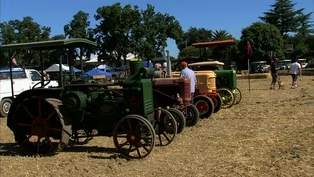 New
NewCalifornia Historic Tractors Take to the Field
Video has Closed Captions
It’s old-time harvest days in California…bringing in the crop with a 30-mule team hitch. (4m 33s)
 New
NewFarm to Fork: Mini Zucchini Pies
Video has Closed Captions
On Farm to Fork, discover how to add some zing to your zucchini. (6m 58s)
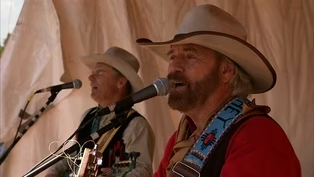 New
NewMichael Martin Murphey Salutes America's Farmers
Video has Closed Captions
Singer/songwriter Michael Martin Murphey takes to the stage to salute American agriculture. (4m 52s)
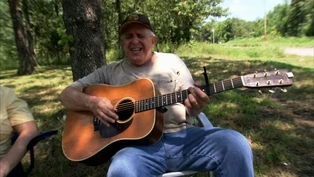 New
NewRodney Dillard - Famous Musician and Farmer
Video has Closed Captions
We’ll sit with Rodney Dillard, who is now returning to his farming roots. (5m 49s)
Providing Support for PBS.org
Learn Moreabout PBS online sponsorship
- Food
Christopher Kimball’s Milk Street Television
Transform home cooking with the editors of Christopher Kimball’s Milk Street Magazine.






Support for PBS provided by:
America's Heartland is presented by your local public television station.
Funding for America’s Heartland is provided by US Soy, Sustainable Agriculture Research and Education, Rural Development Partners, and a Specialty Crop Grant from the California Department of Food and Agriculture.