
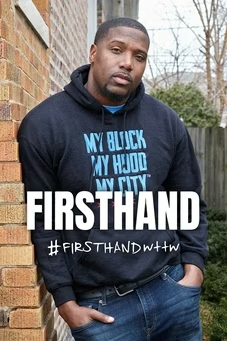
February 20, 2026 - Rep. Tyrone Carter | OFF THE RECORD
Season 55 Episode 33 | 27m 45sVideo has Closed Captions
Guest: Rep. Tyrone Carter. Topic: Property tax relief.
This week the panel discusses property tax relief with guest Rep. Tyrone Carter. Simon Schuster, Jordyn Hermani, and Zachary Gorchow join senior capitol correspondent Tim Skubick.
Problems playing video? | Closed Captioning Feedback
Problems playing video? | Closed Captioning Feedback
Off the Record is a local public television program presented by WKAR
Support for Off the Record is provided by Bellwether Public Relations.
February 20, 2026 - Rep. Tyrone Carter | OFF THE RECORD
Season 55 Episode 33 | 27m 45sVideo has Closed Captions
This week the panel discusses property tax relief with guest Rep. Tyrone Carter. Simon Schuster, Jordyn Hermani, and Zachary Gorchow join senior capitol correspondent Tim Skubick.
Problems playing video? | Closed Captioning Feedback
How to Watch Off the Record
Off the Record is available to stream on pbs.org and the free PBS App, available on iPhone, Apple TV, Android TV, Android smartphones, Amazon Fire TV, Amazon Fire Tablet, Roku, Samsung Smart TV, and Vizio.
Providing Support for PBS.org
Learn Moreabout PBS online sponsorshipOn the next edition of OTR, Detroi Democratic Representative Tyrone Carter is here to talk about property tax relief.
Speaker Hall has something t say on that this week as well.
So sit in with us as we get the inside out.
Off the Record.
Production of Off the Record is made possible in par by Bellwether Public Relations, a full servic strategic communications agency partnering with clients through public relations, digital marketing and issue advocacy.
Learn more at bellwetherpr.com.
And now this edition of Off the Record, with Tim Skubick.
Thank you very much.
Welcome back to Studio C on this Friday morning.
And we have a property tax relief plan on the table to the tune of $5 billion smackers.
We need real bold and meaningful property tax reform.
And here's part of his bold package.
Everybody remembers the historic and devastating ice storm that blanketed the state of Michigan, putting real strain on the power grid.
Well, House Speaker Matt Hall wants to end the personal property taxe that businesses are now paying, and then they could us that money to beef up the grid.
But there's a catch for the utilities in return for the tax break.
The speaker wants them to do this.
I would also add to that we're going to have to require the utilitie to lower their rates, at least $1 billion roll back in our energy bills.
The speaker also wants to eliminate the so-called real estate transfer tax, which could say between $2000 to $3000 in closing costs when you sell your home.
But there is more.
Right now, homeowners are savin money on their property taxes.
Under tax reforms passed years ago.
However, when you sell your home now, the new buyer is suddenly stuck with paying a whopping property tax bill that pops up that we need to get rid of this pop up tax so that there is a wa to, you know, you have that base value and it doesn't go way up when you sell it.
Of course if you reduce the property tax, local schools and governments will lose revenue.
They rely on that tax to make things go.
But the speaker says he'll find a way to backfill or replace the money.
We're going to backfill all the schools and we're going to backfill all of the local governments.
I think it's really important that our local governments, are made whole.
Of course, none of this happens until and unless the speaker can convince the governor and Democrats to play ball.
What do you make of all this?
I think that it is an ambitious thought.
I think that I am going to hold my breath until I see the actual documentation detailing those plans, specifically the backfilling portion.
I know yesterday when House Speaker Matt Hall held a press conference in Lansing, he had said that he believed tha there were still more to be cut from the state budget, which, Governor Gretchen Whitmer unveiled her $88 billion proposal earlier this month.
We haven't seen anything out of the legislature yet, but I, I that remains to be seen.
I suppose we saw how vicious the fight over this so-called waste fraud and abuse was last year.
And, I definitely think that this has some serious implications for the budget fight moving forward.
I think that politically, the will to make this lift happen would be enormous.
I mean, preventing, property tax bump up when you look at, you know, major Michigan cities that are on the move, like, say, Detroit, for example, where they're seeing rising property value and a lot of housing turnover.
If when people are selling those homes, if Detroit can't recou that increased property value, despite the value of those homes going up, they're going to be really strongly opposed to that sort of effort.
This is all about 2026 politics and affordability.
affordability is the buzzword.
It is the issue.
I don't thin I'm going out on a limb to say there's not going to be a $5 billion tax cut passed through the legislature and signed by this governor, but if Speaker Hall puts he puts forward this plan, he gets something for his Republican members who right now are really on the firing line when it comes to the, dynamics of the 26 election.
Democrats are doing well around the country.
It's looking like it's going to be a big challenge for Republicans to hold onto the House, given the dynamics that are in place.
So what do you do here?
We give our members a chance to go around and tell voters we are working t not just cut property taxes, but dramatically cut property taxes and your utility bills.
And boy, doesn't that sound great on a mailer.
Well, and there's one other part of the mailer, and the Democrats won't let us do it.
Well, I would actually caution against what?
So there is that.
But Governor Gretchen Whitmer, in her budget proposal is also proposing some level of property tax relief, albeit a much smaller subsection, which is what Republicans have dinged her on.
It applies to seniors 65 and older.
So.
$354 or loose change.
To the I suppose, credit of Democrats.
They are at least signaling that this is something that is an issue for them as well.
To the credit of Republicans, they're saying, well, it's not going far enough.
And it's more than just seniors who are feeling hurt in their pocketbooks right now.
I would love to have bee in the corporate offices of DTE and Consumers Energy if they were watching that performance and going, wow, this is great.
We're going to get money to fix the grid.
And then comes the other shoe.
Do they give you $1 billion tax relief so they can fix the grid?
You know, I don't think well, consumers in responding to some of this proposal wasn't immediately negative and didn't throw things under the bus.
Yeah.
But at the same time, you know, I think when looking at sort of the legitimacy of this proposal, how serious it is when you look back a year ago, House Republicans also had an opening gambit in budget negotiations and passing.
They're shut down prevention plan, the skinny budget that sort of laid out a lot of fiscal conservatives goals for reducing the size of state government if it had been implemented as written.
And I think that, you know, this is part of a longer negotiation I think that, Speaker Hall sees budget negotiations as a year long effort.
It's not something that happens in a narrow window.
And this is very much an open gambit.
So I said earlier that I don't think there's going to be a $5 billion property tax cut, but it does seem there is going to be some type of property tax relief in some form.
It'll be more than what the governor, the governor has his 90 million.
I mean, it's a tiny fraction of what the House Republicans have proposed.
Senator Anthony, chair of the Senate Appropriations Committee with a Senate Republican, Michelle, joining us from up north.
They're working on an expansion of the homestead property tax credit that is quite a bit bigger than what the governor is proposing, but nowhere near what the speaker is proposing.
But you take it together.
All three legs of the stool are saying, we think there needs to be some property tax relief.
I talked about affordability earlier.
Everybody in the legislature is feeling that and wanting to do something about that.
But we have a chasm in the size of the proposals.
I think the best thing that we can use to look at how this may go is actually to last years road fight.
I mean, you saw Republicans put out a roads plan.
It was vastly different than what we ended up.
You saw Governor Whitmer put out a road plan.
It was pretty different from what we ended up with.
And I think that that's probably, you know, where we're going to end up.
I think we're all kind of saying the same thin here, that it's bound to happen.
But how deeply it happens remains to be seen.
And I would caution, you know, Republicans last year pulled the fire alarm, so to speak, when it comes to, the, the pork spending, the legislative pork spending, when you're talking about all this extra waste, fraud and abuse, they signaled last year that they're willing to pull the rug out from underneath, these, these kinds of negotiations if they feel like the money isn't being spent prudently enough.
So I do wonder if you are a Senate Democrat, the Senate Democratic member.
Excuse me.
walking into these negotiations, hearing, well, we have $5 billion of waste, fraud and abuse.
We can still cut.
How do you treat tha negotiating tactic at its worst?
Yeah.
And I think it's also important to mention that we're sitting at a markedly different landscape from budget negotiations heading into this year than we had in years prior.
For example, Matt Hall is calling for this $4 billion tax cut, but we're also facing down an $800 million Medicaid funding gap that Governor Whitmer is proposing, raising new revenue, levying new taxes to make up.
And at the same time, we're calling for these homestead, tax exemptions.
The idea that we're going to also cut the state budget further.
Something's going to have to give here.
Well especially with Hall signaling that the $800 million of Medicaid, the tax.
But like, we've got t really call that a nonstarter.
He's already said that that's something he's completely uninterested in.
So you know, this there's a lot of moving parts here that there's going to be a lot, a lot also key to the negotiations.
And we have not seen what the speaker's plan is, but the schools and local governments were going yesterday.
Oh my goodness.
Here we go again.
Here's the thing.
I mean most of this revenue doe not go to the state of Michigan.
So it's not really part of the state budget.
The personal property tax in large measure goes to schools and local governments.
It is a weird tax.
It's a tax on equipment.
I think everybody agrees it's sort of a relic, but it's also $2 billion to schools and local government that can't just be flushed.
So what do you do to backfill?
You know, he's talking about affordability.
We need to save people money.
Well, so what do you do then?
Do you raise the sales tax a cent?
Well, you know, okay that could be framed as we just cut $1.9 billion on for taxes on businesses.
And we just raised it on Joe and Jane citizen.
So there's you do something over here.
There's pressure over there.
What do you do?
Well he did fold on the tax increase on the road package okay.
He gave her something okay.
The marijuana tax okay.
And he complained about syntaxes in the presser yesterday.
There's a way to get this thing done.
And I think they might come close to 3 to 4 billion.
3 to 4 billion?
Yeah.
Okay, Tim, we're going to hold you to that on this.
Do you want to you want to see what's, in my cup?
Like I said, the personal property tax is low.
That nobody is like has great love for it.
If there was some way to get rid of it and come up with a smoother form of gathering the revenue, that could be a real win for a lot of folks.
The reason I say that is because this is an election year.
This issue, if done, is a win win for both parties.
The and that's what they're looking for.
No one wants to be vulnerable of not playing ball on this issue.
Yeah.
And I think the beauty of public policy and politics too, is that you notice that he said he's going to cut and eliminate these taxes.
But he you know, he also didn't close out the option that these people are no longer going to tha these groups, such as businesses that get levied the personal property tax, are no longer going to have to pay into the tax, because this gives room to sort of restructure these taxes and sort of modernizes, as Zach was referring to, and still make sure that these same stakeholders are paying into the same funds, but in a restructured way, in a way that might seem more modernized and make more sense.
Now Dick Headly is rolling over in his grave, so move on to you know what I'm talking about right?
Let's talk about the governor's upcoming state of the state.
What are we looking for?
Had sworn as what?
Well, I think probably a lot of, valedictory, victory lap.
It's her last state of the state.
I think she last year in her speec said I only have one more to go, you know, thank goodness.
Or something to that effect.
you know, it's usually a governor's last speech is always kind of emotional.
you know, I can remember John Engler struggling to hold back tears with his daughters in the first row.
You know, I think Governor Granholm was the same way.
so I would imagine it will be a very reflective moment.
This is somebody who first set foot onto the floor of the house in 2001 and worked on staff before that.
in terms of an agenda, I'd expect it to be pretty, light in the sense o I don't see big audacious ask.
So she ignored the mat hall stuff.
I'm sure she I if I would guess based on what she said in the past, she will probably say something about property tax relief and she will turn to the speaker who is either sitting at her right or left.
I can't remember and will say, you know, Mr.
Speaker, I'm looking forward to working on this with you.
I would imagine that's what she will do.
That's typically what she does.
If she ignores it.
I don't think she's she'll she'll mention she's getting some.
Yeah.
I was going to say I would be shocked if she doesn't mention property taxes in some way shape or form.
I mean, it's in her own budget and we can use that as sort of a North Star for what she may mention and call for.
I mean, we looked to her last state of the state, actually, Simon and I jus recently did a review of that.
And she, you know, she made 14 promises.
She made good or partially good on on ten of them.
And a number of them di come back to the state budget.
So, you know, it wouldn't shock me if we heard, for instance, her bring up the property tax stuff, but she has been rather diplomatic to not let, issues or, you know, any internal maybe, issues, personnel issues get out into the open media.
You know, if she's struggling with Hall, she's been rather diplomatic about that in speeches past.
So I don't think that she would, you know, use this one to throw a bomb, so to speak.
And I think the sort of the intelligence of sort of her strategy in terms of this in the states is that when you look at her first two addresses, she made a number of promises to the audience, to the Michigander watching the legislature before, if things that were going to get done.
And, you know, obviously we saw a few with their most notably the gas tax increase in 2019.
And since then, the shift has been instead, we're going to call on the legislature to act on these issues.
So then whether or not they happen, the ball is sort of out of her court.
She can say that, you know, this was, contingent on lawmakers to get these things done.
Yeah, she can see the ball is out of her court, but believe me, she's on the court.
Okay.
If not center stage.
All right, let's talk about center stage with Representative Tyrone Carter down in the good city of Detroit.
Representative, how you doing?
Hey.
Good morning.
Oh, there we go.
Yeah, I'm doing well.
Yeah.
Nice to have you on board.
All right, so you ready to buy thi Matt Hall property tax thing ay?
This is the first time I'm hearing of his.
So in the city of Detroit, I don't know if you remember, a few years ago, there was this over taxation of $600 million that the residents, you know, are in uproar.
Properties were over assessed.
So I've been working on property tax relief for the city of Detroit for a while now.
But it's interesting to me that all of a sudden it's bubbling to the top.
you know, I was listening you know, through the governor, through, you know, Matt Hall, through other groups that property taxes, are a big thing, especially the pop up that is really, a big one.
And so I've been working with Alvin Horne down at the assessor's office, a professional who does this for a living to find ou what's doable, what's possible, and what we can do to work around.
So when we get in these groups, we can have those conversations.
So when the speaker put out his program yesterday what parts sit in your mind said this is doable?
The I think the biggest one is the pop up tax because it's uncapped.
what does uncappe mean to a person buying a home?
So we had a situation here in the city, and it was on the new where a young couple moved up, bought a house $400,000.
First year.
Okay.
Escrow pops up.
I think their bills shot up $15,000 or $16,000.
Ouch.
How do you feel that And how do you chip that away?
And what are the warning signs for a new homeowner to have an idea of what their tax liabilit is going to be moving forward?
We don't know.
So we've got to figure out a way to at least, full disclosure, coming in, what it possibly could b to kind of give you an estimate.
So those are the things that we're what working on because we keep hearing that housing is unaffordable.
Well, here in the city of Detroit, that pop up tax will get you to move.
Add that to car insurance because we pay more than anybody else.
and, and folks are looking for other opportunities.
Were you surprised, representative, the governor's proposal on property tax relief is fully geared towards seniors who are really the beneficiaries of the existing property tax system.
My mother has lived in her home for almost 50 years.
Her property taxes have been capped for for a very, very long time.
But it's that new homeowne that gets hit with the big tab.
Is the governor's proposal, you know, off key in a way?
It is.
Because, again, what you just stated, well, I'm in my home and I've been here since 76, my family home.
So when you look at it, my taxes are really low.
I bought a, purchase a house down the street from a family that I knew.
They parents passed away.
The taxes tripled almost four times what they were.
And what is the difference that I'm receiving if I'm a new person moving in that home?
Because I don't know the old one.
So I think we need to look at future, seniors.
Yeah.
We're working on poverty exemptions.
We're working on, raising the cap, for eligibility.
But if we really want to attract people, we need to address that unknown.
And I don't expect a realtor who's selling you a home to tell you, this has got to be a new liability trying to get that commission.
So as a legislature, we've got to figure out ways, to get as much information for folks to make, you know, informed decisions on a major purchase.
Representative, you talk about being in favor of, this repeal of the so-called pop up tax, you know, but components of, Speaker Hall's plans also include, you know, endin the six mil state education tax, ending the real estate transfer tax, ending personal property taxes altogether, I guess.
Where do you stand on the feasibility of that?
I haven't looked at.
I didn't even watch his press conference.
you know, I'll be honest with you, I, I live in real district with real issues.
I went to a senior meeting last night.
And the taxes, because they got their assessments this month, and it's the month to appeal.
So we have to look at everything and look at what's possible.
The biggest thing for, you know, my seniors are if they leave their home, if they sell their home, if they move to if they downsize, will their tax liability be more that it' beneficial for them to stay in?
I'd have to look at the title transfer and bring in, you know, probably some assessors to have those.
We need to bring in more professionals than than just throwing this stuff out and, and creating this, I don't want to say false hope, but, folks are looking for relief.
I'll say that.
The good thing about your question and what people are doing, everybody's at least talking about this.
So maybe we can get somewhere to to have some relief for, you know, the folks that, everything else has gone up, the taxes get in trouble.
Contingent on that plan, though, if I may, a follow up, Speaker Hall, you know, said he wants to hold schools harmless, backfill all this revenue, and then sort of intimated that there was more that could be cut from the state budget.
Representative, do you believe that there is enough that could be cut from the state budget to theoretically backfill, a $4 to $5 billion tax plan?
I mean, all of those things are subjective.
You could look at it through a different lens.
he's in a better position to say that, being the speaker and and being able to hold things up.
But I think we need to operate with reasonableness and and figure out there's less money in the budget.
You know, where do we continue to cut, without raising taxes to maintain what we have?
Trying to get more would be a blessing, but trying to maintain what we have, I think, is the challenge right now.
So I'd be curious to see, where the cuts or the, the waste, fraud and abuse that that I hear like a broken record.
quite often exist.
we we've done it a few times.
So I'm curious, just as many of you are.
Representative Carter.
While there is like a means and methodology to property assessment.
I was interested that you brought up first this over assessment lawsuit, because this showed clearly a pattern of systemic over assessment for a lot of homeowners that period of property assessmen is sort of a black box to them.
They see the number that arrives in the mail, and they don't really have a good sense of how that was arrived at.
Is there a structural fix that you can point to that you think should be implemented to prevent this sort of, over assessment in the future so that we don't end up with another one of these lawsuits?
Those are the things that I'm working with the assessor on.
Because if you remember, you know, the bottom fell out of city of Detroit.
They never reevaluated, the valuations and people were still being taxed at a higher rate.
And we know that Detroit is taxed at a higher rate than any other place in the state.
And so I think it was a group came out of Chicago, did that study and found out that, you know, pretty much every homeowner was being overtaxed?
Well, nobody saw any relief, even when the state had money, even when the city had money.
So now, when you get that and I've got quite a few when you get that, your new assessment, everything's gone up.
So there has never been any relief.
And the majority of folks don' know the appeal process either.
I'm glad to see that locals are sending out letter saying, hey, this is the month.
So before I got elected out, the president of my neighborhood organization, which is mostly seniors, widowers, widows, limited income.
And when you see your cos of living go up, the first thing you're trying to figure out is how do you get relief?
So in my role now, my goal is to find, opportunities for relief for folks who have no way to create extra income.
So it starts, like you just said, with the, you know, how do you evaluate this?
Do we allow Zillo and other companies to come in and tell us what it is, or do we go by median price?
Do we go by income what the houses are selling for?
Nobody knows if there's a consistent way to measure what a house is worth.
At the end of the day, it's only worth what you can sell it for.
Excuse me, representative, at the end of the day, do you believe Donald Trump will allow the new bridge to open?
Yes.
I mean, the bridge was being buil when he was, in his first term.
There were no issues then.
There's been a lot of money, put into that.
I won't talk about the destruction of a neighborhood and my beloved Southwestern high school, to build that, place, but I think the investment has been too big and has gone on for too long.
That at the end of the bridge, you're going to say it's not going to open.
I expect it to open.
So you're buying the Republican argument.
This is just a negotiating tool to get something.
Okay.
What is the something.
Well, money.
Well if I put up the money to build it because if you did the homework and it is in my district, the legislature back then wouldn't approve it.
So I don't know what end the round deal happened, but it happened.
And so Canada put up all the money to, to there was a lot of pushback in the community because it moved folks out.
Some folks are saying that the, the big, what did we have last year?
Where the water main burst that is in the area, and they said that's due to the heavy equipment, the truck traffic, the banging.
You know, so there's been a lot of things that have been done to ge that bridge to the finish line.
So I expected to get to the finish line.
Representative Former mayor Mike Duggan recently had some comments that were really, really critical of the Democratic trifecta, which you were a part of in the 2023-24 term.
Basically, I'm paraphrasing here that it was a bunch of woke leftist ideology that came out of the legislature.
What did you think of that when you heard that?
I mean, what do I expect him to say no that he's running for governor?
But I also know that the city of Detroit benefited greatly because I was a chair of the, you know, Detroit caucus, the legislative Detroit caucus.
And I know that somewhere around $1 billion was poured into the city of Detroit, not just possibly to the city of Detroit, but the surrounding areas into organizations, that service, the metropolitan area.
So I I'll say this when folks can't get their way, even now with the city, they blame the legislature.
But I don't ever recall getting a thank you note for the moneys that we sent for right to counsel for thought or, United Way for organizations that do the work every day.
And I'm not saying that they need to, but I like to have balance.
You know if you said what we didn't do, how about you talk about what we did do?
Do you think he was two faced on this?
Well, I'm a Gemini for those of us that don't do astrology translate it into English?
Help me out here representative.
Was he just playing politics?
He was playing politics.
Do you think that gets him the the job of governor?
No, that.
Yeah.
When I think the one thin whether you agree like, disagree with, the current administration, the president, he has made people pay more attention and be more informed, about, folks, what they've done in the past, what they say they're going to do.
And so there's a way for voters to be more educated now than it has been before.
So if somebody tells you they're going to do something or they're able to do it, you can actually look up and see.
And what a lot of people forge that politics is a team sport.
I have to explain that in community meetings.
56-21 I need 56 representatives, I need 20 senators an I need the governor to sign it.
No one person can go in there and say I'm going to make this happen.
Do you think that, Mayor Duggan could win the city of Detroit come November?
That's a possibility.
But you also have to look at winning the city of Detroit.
What does that look like when we only had 20% of, registered voters vote?
You know, just recently in the mayoral election.
So I know that there's more races on the tabl now, so people are more, look, you know short of a presidential election to come out and vote.
So, what does winning the city of Detroit look like now that more people are paying attention?
It's going to be interesting because there's pluses and minuses for every administration we've had here in the city.
But when you're running for office, you get to tell your stor and highlight what you've done.
Quickly your your candidate for governor is?
Nothing, heard that was crickets, right?
You're not going to answer the question?
I said it'll be a Democrat.
Well there we go.
All right.
Representative I'll give you the ball game on that one.
All right Thanks for being on our program.
So always good to see you.
Have a nice peaceful weekend.
Thanks to our great panel next week.
More Off the Record post state of the state, including one on one intervie with Governor Gretchen Whitmer.
See you then.
Production of Off the Record is made possible in par by Bellwether Public Relations, a full servic strategic communications agency partnering with clients through public relations, digital marketing and issue advocacy.
Learn more at bellwetherprocom.
For more Off the record, visit wkar.org.
Michigan public television stations have contributed to the production costs of Off the Record.

- News and Public Affairs

Top journalists deliver compelling original analysis of the hour's headlines.

- News and Public Affairs

FRONTLINE is investigative journalism that questions, explains and changes our world.











Support for PBS provided by:
Off the Record is a local public television program presented by WKAR
Support for Off the Record is provided by Bellwether Public Relations.